Newsletter Subscribe
Enter your email address below and subscribe to our newsletter

Enter your email address below and subscribe to our newsletter
My wife made fun of me.
Not for anything major… just for being genuinely excited about Olympic curling. Before the Winter Games even started, I was marking the schedule like it was the Super Bowl. She gave me that look. You know the one.
Then she sat down to watch a match with me… probably to gather more material for future teasing. But somewhere around the second end, the smirk disappeared. The questions started. “Why did they sweep there?” “What’s the strategy behind that shot?” “Wait… is that the same team from yesterday?”
She ended up watching more curling than I did. The woman who mocked me became a fan.
If you’ve ever been hypnotized by a 42-pound granite stone gliding across ice with surgical precision… welcome to the club. Curling does that to people.
Turns out, it does that to robots too.
According to a recent article in IEEE Spectrum, engineers have built robots that don’t just throw curling stones… they learn how to throw them better with every single shot.
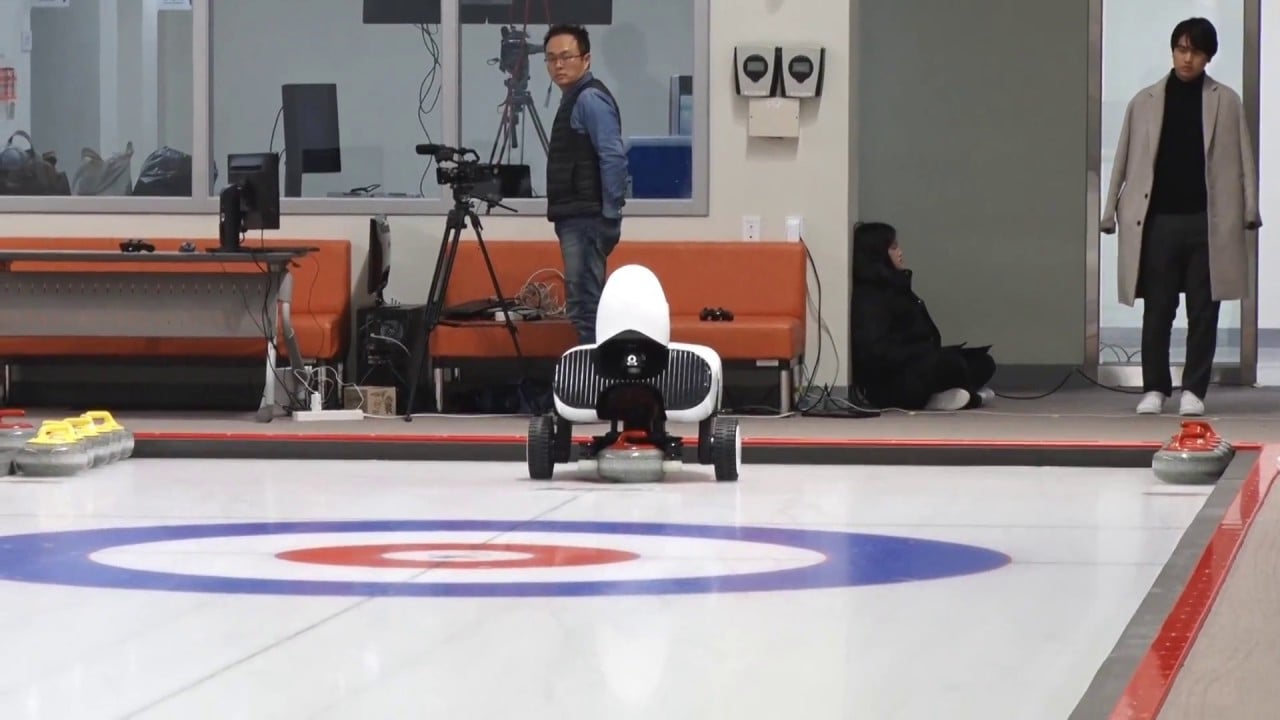
Meet Curly, a two-part AI-powered system built by engineers at Korea University in Seoul. Curly doesn’t work like some glorified pitching machine. It studies the ice, learns from its own mistakes, and adjusts its aim as conditions change throughout a match. Think of a bowler who gets sharper with every frame… except this bowler has a computer for a brain and never gets distracted by nachos.
When Curly was tested against top-ranked Korean curlers, it lost the first match while still figuring things out. Then it won the next three. In a row.
But wait… it gets wilder.
For the 2022 Beijing Olympics, Chinese engineers unveiled a six-legged robot that actually walks on the ice, positions itself at the starting block, slides forward, and releases the stone with competition-level spin. It uses lasers and cameras to map the entire sheet and calculate the perfect release for each shot.
Picture a metallic spider gracefully gliding across an ice rink and delicately releasing a curling stone. That’s basically what happened.
For all their precision, these robots have one enormous blind spot.
They can’t sweep.
If you’ve watched any curling, you know sweeping isn’t just for show. Those teammates furiously brushing the ice in front of the stone are controlling how far it travels, how much it curves, and where it stops. It’s part science, part art, and part serious cardio.
So right now, a robot can make a beautiful throw… and then just stand there hoping for the best. Like hitting a perfect golf drive into a crosswind and having absolutely no say in what happens next.
It goes way beyond stone-throwing robots. In Japan, a government-backed program called “Curling of the Future” is developing AI strategy coaches, “smart stones” with built-in sensors, and rock launchers that deliver perfectly identical throws every single time.
And here’s a really cool one… Canada’s national wheelchair curling team has been training inside a virtual reality replica of the actual Olympic arena in Cortina, Italy. Using VR headsets, athletes can see the ice, the stones, their wheelchair, and their throwing stick… all without leaving home. It’s helping athletes who face mobility challenges or limited ice access practice together as a team. That’s technology doing exactly what it should.
Curling has always been called “chess on ice,” and that comparison is getting uncomfortably accurate.
Remember when IBM’s Deep Blue beat chess champion Garry Kasparov in 1997? That was the moment the world realized a computer could outthink a human at the most cerebral game on the planet. Some folks in curling see a similar reckoning on the horizon.
But curling has something chess doesn’t… an unwritten code called the “Spirit of Curling,” built on trust, fairness, and mutual respect. This is a sport where players have traditionally called their own fouls. The human element isn’t just part of the game. It is the game.
One AI ethics researcher at the University of Ottawa summed it up pretty well… the AI doesn’t care about any of that. There’s no “Spirit” programmed into a machine.
For now, the stones still leave human hands, and the final calls still come from the skip reading the ice with years of hard-earned instinct.
But the algorithms are inching closer to the button.
Whether that’s exciting or unsettling probably depends on who you ask. Personally, I think there’s room for both… technology that helps athletes train smarter and the irreplaceable human magic that makes the sport so mesmerizing to watch.
Even for people who didn’t think they’d enjoy it.
Just ask my wife.