Newsletter Subscribe
Enter your email address below and subscribe to our newsletter

Enter your email address below and subscribe to our newsletter
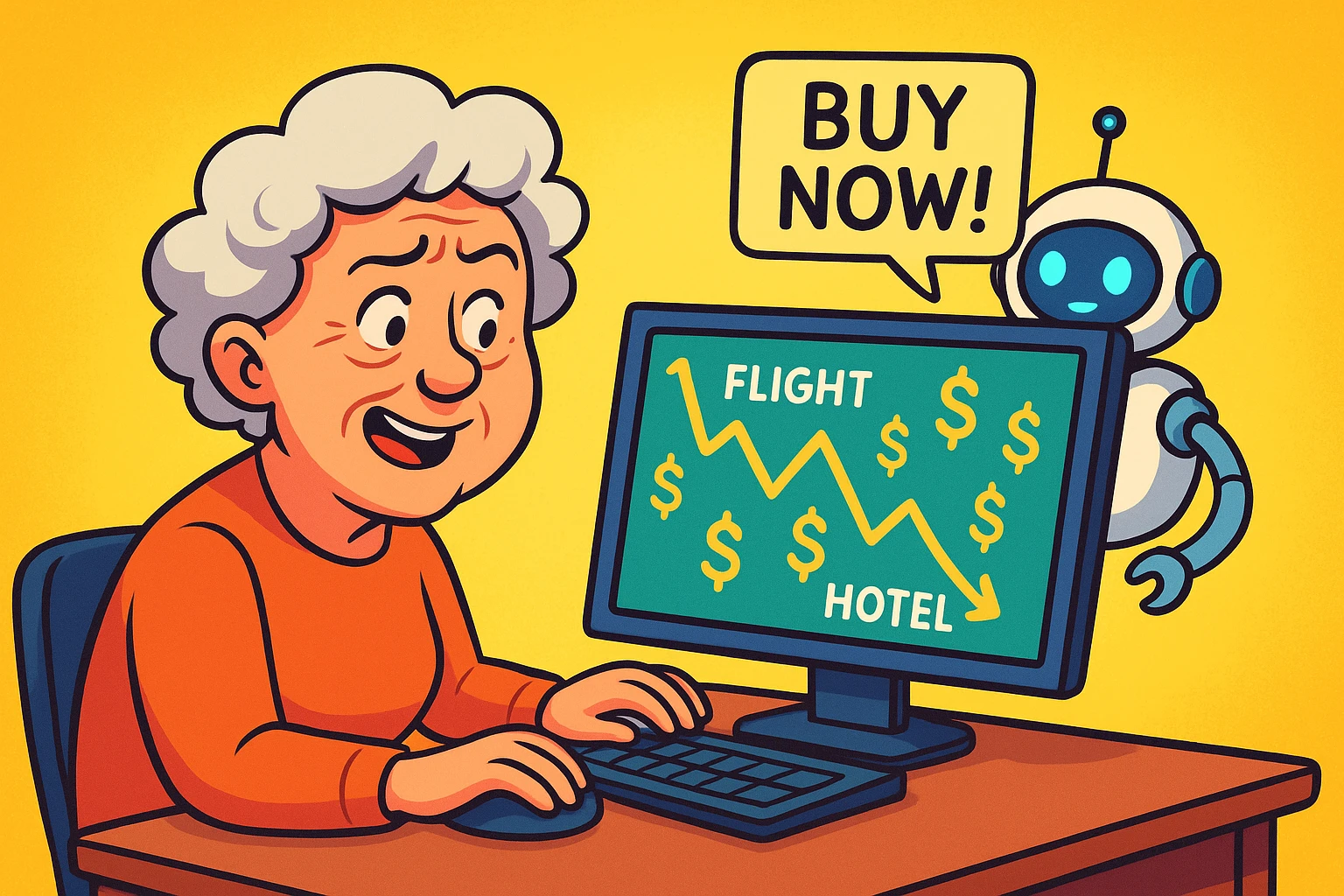
Have you ever searched for a flight to visit the grandkids, found a decent price, and thought, “I’ll just book it after my coffee”? Then you come back, refresh the page, and the price has shot up by an amount that could have paid for your coffee for the next six months. It’s a feeling that ranks right up there with realizing the grocery line you just switched to is now the slowest one in the store.
It’s not your imagination, and the airline isn’t personally targeting your travel plans. You’ve just witnessed the bizarre, high-speed world of AI-powered travel pricing. It’s like every airline and hotel chain has hired a tiny, hyperactive super-genius to sit inside their computers, constantly fiddling with prices based on everything from the weather in Timbuktu to how many people in your zip code are also searching for flights to Florida.
But here’s the good news: you can get your own team of digital super-geniuses to work for you. These are called AI price predictors, and they’re designed to level the playing field. Think of them as your personal travel deal detectives, sniffing out bargains and telling you when to pounce. Let’s pull back the curtain on this digital magic show and learn how to make it work for your wallet.
Before your eyes glaze over at the term “AI,” let’s break it down. An AI price predictor is just a fancy computer program that’s really, really good at spotting patterns.
Imagine you have a friend who has obsessively tracked the price of cantaloupe at the local market for 20 years. They know it’s cheapest on Tuesdays in July and most expensive the day before a holiday picnic. That’s essentially what these AI tools do, but for flights and hotels, and they analyze billions of prices in seconds instead of just one melon.
They look at historical data, current demand, school holidays, fuel costs, competitor prices, and probably the moon’s phase (just kidding… we think). Based on all that information, they make an educated guess:
This isn’t magic; it’s just high-powered math. But for us, it feels like having a crystal ball for travel deals.
While the goal is the same—find the best price—the computers behind flight and hotel predictors are looking at slightly different things.
Airlines are masters of what’s called “dynamic pricing.” This is a fancy term for “changing the price whenever they feel like it.” A flight’s cost is a wild cocktail of factors:
AI flight predictors analyze these chaotic signals to find moments of sanity, telling you the best time to click “purchase.”
Hotel pricing is a bit more local. The AI is still playing a chess match, but on a smaller board. It’s looking at:
Knowing this helps you understand why a tool might tell you to book a flight now but wait on the hotel—or vice versa.
Okay, theory is nice, but how do you actually use these tools to save real money? It’s not about finding one “best” app, but about developing a smart strategy.
Almost every major travel search engine (like Google Flights, Kayak, Skyscanner, or Hopper) has a price alert feature. This is your number one tool. Find the flight or hotel you want and click the button that says “Track Prices” or “Set Alert.” The computer will then email you when the price changes. You can go about your day, and your digital assistant will do the tedious work of checking prices 50 times an hour.
Have you ever noticed that after searching for a flight, you suddenly see ads for it everywhere? That’s because websites track your activity. Some experts warn this can lead to “personalized pricing,” where you might be shown a higher price if the site thinks you’re desperate to book. While airlines deny this, it’s a good practice to clear your browser’s cookies or search in a “private” or “incognito” window. This is a crucial part of keeping your personal information safe online and can help you avoid potential price hikes.
Don’t just trust one tool. Check a couple of different sites. One AI might have a “buy” recommendation while another says “wait.” Seeing what multiple experts say gives you a more balanced view before you make a decision, much like getting a second opinion from a doctor.
The AI is a powerful assistant, not the boss. It can’t know that you absolutely must be at your granddaughter’s graduation on a specific day. Use its advice, but factor in your own needs. Sometimes, paying an extra $20 for a flight at a more convenient time is worth it. Also, always check the airline’s own website; occasionally, they have deals you won’t find elsewhere.
Are these AI price predictions always right?
Nope. They are highly educated guesses, not guarantees. Think of them as a weather forecast: usually pretty accurate, but sometimes they predict sun and you get a downpour. They claim around 95% accuracy, but it’s best to treat them as a strong suggestion, not a fact.
Which apps or tools are the best?
There are many great ones!
Do these tools cost money?
Most of the prediction and alert features are completely free. Some, like Hopper, offer paid add-ons, but the core functionality you need to save money is usually available at no cost.
Could these tools be used to trick me?
That’s a smart question. The tools themselves are designed to help you, but it’s always wise to be cautious online. Stick to reputable, well-known sites. If a deal looks too good to be true, it might be. This is where your skills in spotting online scams come in handy. Always book directly on the travel site or airline’s official page, not through a weird link in an email.
Navigating the world of online travel can feel like you need a degree in computer science. But with AI price predictors, you now have a powerful co-pilot. You don’t need to understand the complex algorithms any more than you need to understand how your microwave works to heat up leftovers.
All you need to know is this: these tools watch the market for you, alert you to deals, and give you the confidence to book at the right time. So set up those alerts, compare your options, and get ready to trade price-watching anxiety for the excitement of planning your next great adventure. The world is waiting, and now you have the tools to see it more affordably than ever before.