Newsletter Subscribe
Enter your email address below and subscribe to our newsletter

Enter your email address below and subscribe to our newsletter
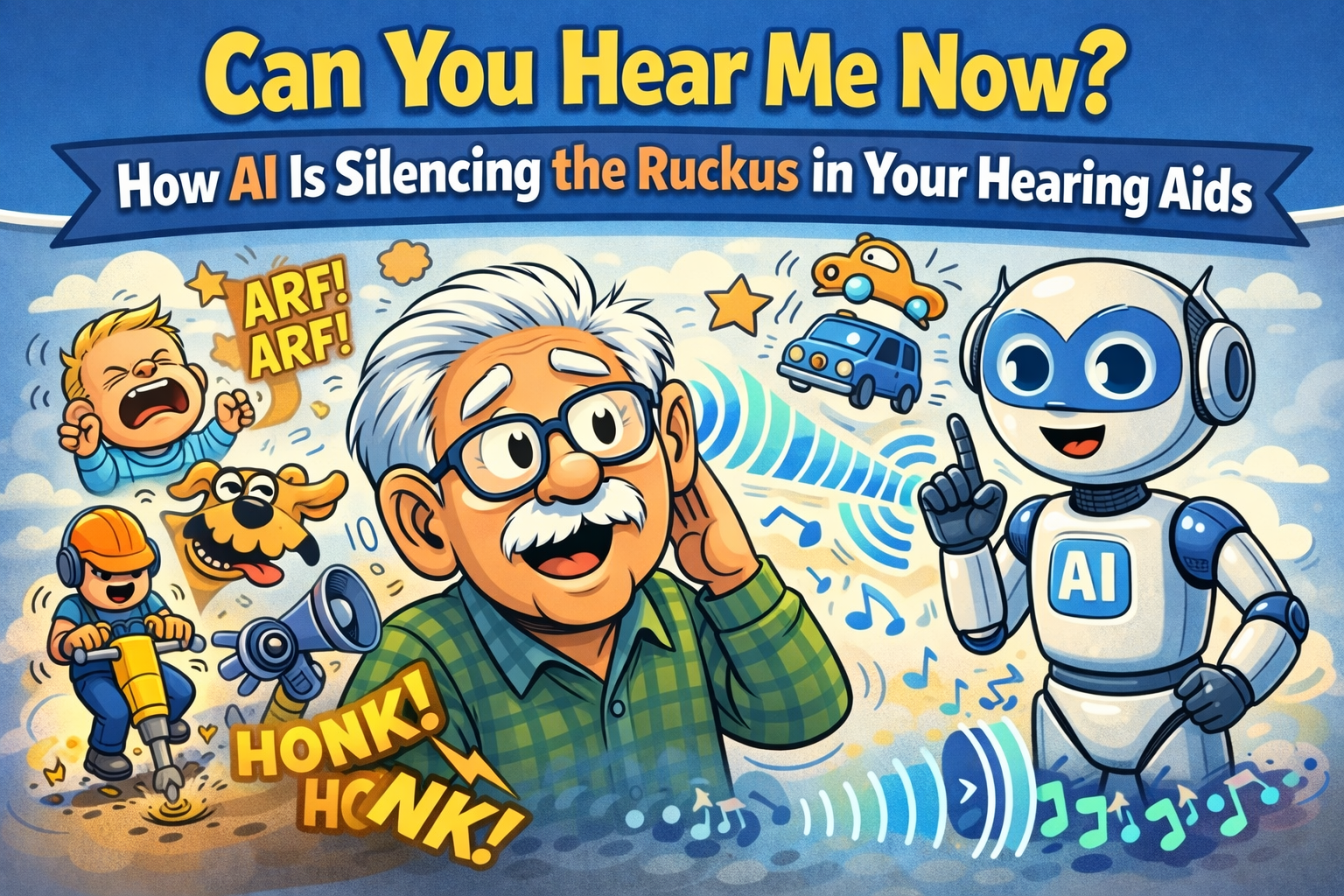
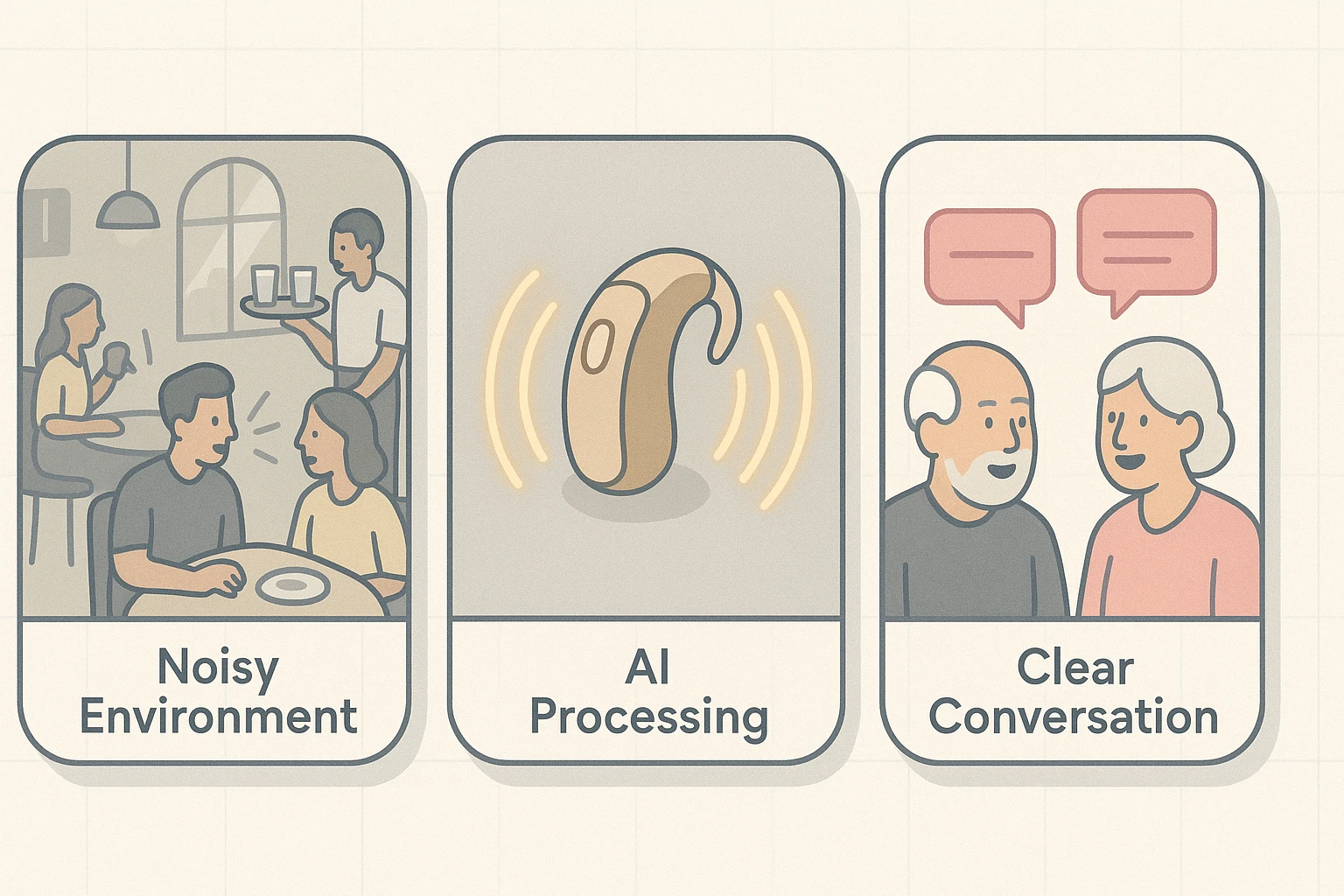
Have you ever been at a family dinner in a restaurant that sounds like it’s hosting a blender-testing convention? You’re trying to hear your granddaughter’s story about her soccer game, but all you’re getting is a wall of sound: clattering plates, a birthday party three tables over singing with more enthusiasm than talent, and the general roar of a hundred conversations you don’t care about.
You nod and smile, pretending you heard the part about the winning goal, but in reality, you’ve just been lip-reading and hoping for the best. It’s frustrating. It feels isolating. You’re present, but you’re not really participating.
For years, the solution was simply turning up the volume on everything, which often made the clattering forks sound like a blacksmith forging a sword next to your ear. But now, technology has a new trick up its sleeve, and it’s a game-changer. It’s called Artificial Intelligence (AI), and it’s giving hearing aids and smartphones a superpower: the ability to listen smarter, not just louder.
Imagine you’re at that noisy restaurant, but this time, you have a tiny, invisible sound engineer sitting on your shoulder. Their only job is to listen to the entire room, instantly identify your granddaughter’s voice, and gently turn down the volume on everything else. The clattering plates fade, the birthday singers become a distant hum, but your granddaughter’s voice comes through, clear as a bell.
That’s exactly what AI-powered noise filtering does. It’s not just noise cancellation; it’s noise management. It intelligently separates the sounds you want to hear (speech) from the ones you don’t (background chaos).

This technology is a huge leap forward, but it’s often confused with something you might already know: the noise-canceling feature in those big, fancy headphones people wear on airplanes. They are, in fact, two very different beasts.
This is the part that causes the most confusion, so let’s clear it up. Think of it like this: regular noise canceling is like putting on earmuffs, while AI filtering is like having a super-listener.
Active Noise Cancellation (ANC), the kind found in headphones, works best on steady, droning sounds like an airplane engine or an air conditioner. It listens to that constant hum and creates an opposite sound wave—an “anti-noise”—to cancel it out. The goal is to create a cone of silence.
AI Noise Filtering, on the other hand, is all about conversation. It’s not trying to make the world silent. Its goal is to make the human voices you’re listening to pop out from the background. It’s less about subtraction and more about clarification.
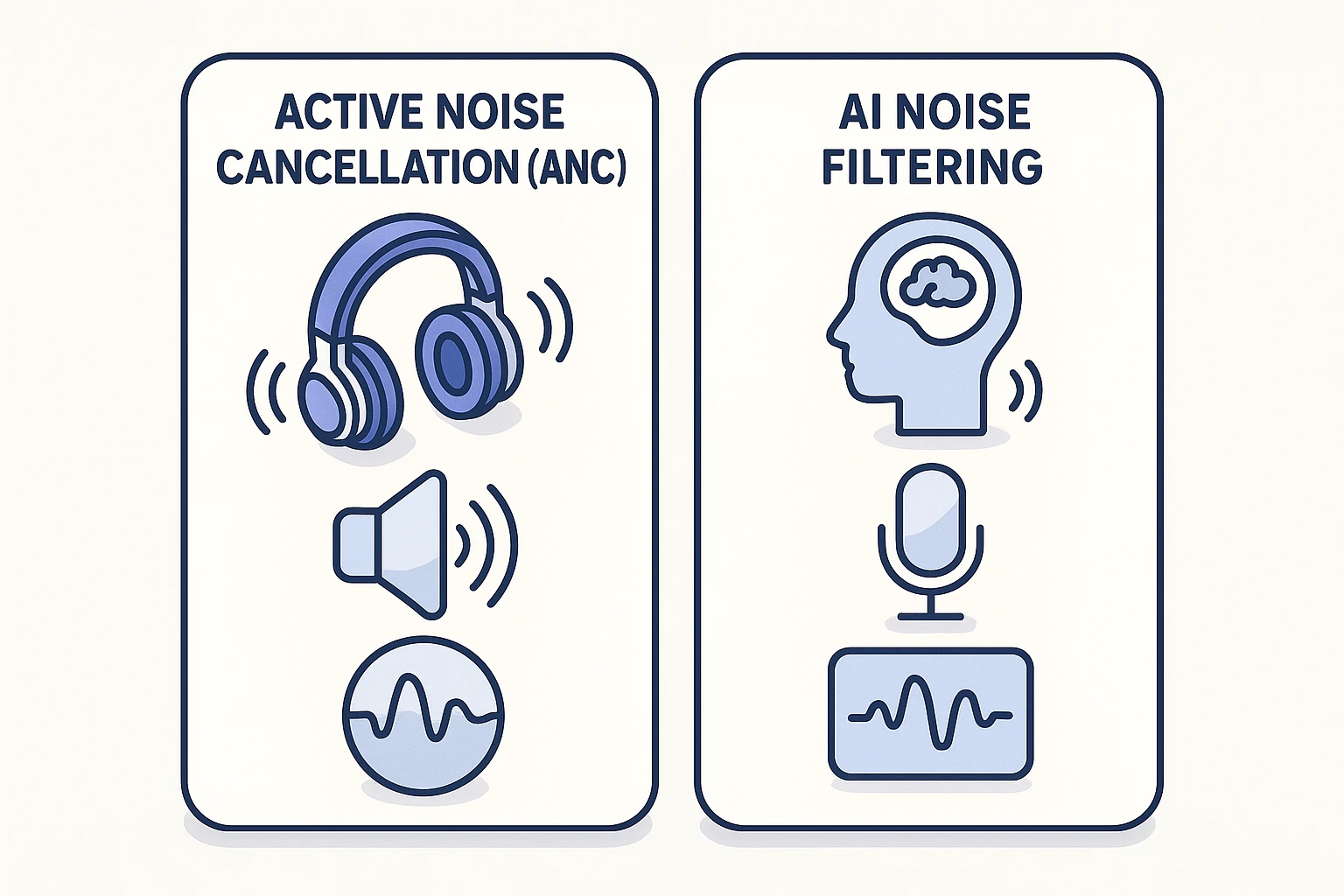
Key Takeaway: Noise canceling wants to mute the world. AI filtering wants to turn up the volume on people and turn down the volume on everything else.
So how does this tiny device know which sounds to keep and which to toss? It uses something called a Deep Neural Network (DNN), which is a fancy term for a computer brain that’s been trained to recognize one thing really, really well: human speech.
Imagine you’re at a cocktail party. Your brain naturally tunes out the clinking glasses and background music to focus on the person you’re talking to. Scientists call this the “cocktail party effect.” The AI in a hearing aid has been trained on thousands of hours of sounds from every environment imaginable—from quiet libraries to chaotic train stations—to do the same thing, but with superhuman precision.
This digital brain learns the unique patterns of speech versus the patterns of noise. When sound enters the hearing aid, the AI analyzes it in real-time and asks, “Is this a voice, or is this a fork hitting a plate?” It then boosts the voice and suppresses the fork. The result can be astonishing, with some studies showing these systems can achieve a 10-decibel reduction in background noise, making a huge difference in comprehension.
This isn’t just a gimmick; it’s a powerful application of the same kind of artificial intelligence (AI) that’s changing so many other parts of our world.
Let’s go back to those frustrating situations and see how this technology gives you a practical advantage. Research has shown that AI-driven hearing aids can increase a person’s ability to hear amid background noise by a whopping 55%.
The AI identifies the speech of the people at your table, even with multiple people talking. It suppresses the sharp, sudden sound of a dropped dish and the constant, low roar of the crowd, so you can follow the conversation instead of just catching every third word.
At a birthday party, kids are yelling, adults are laughing, and music is playing. The AI zeroes in on the voice closest to you or the one you are facing, amplifying it while softening the surrounding chaos. You can finally hear that story from Uncle Larry without asking him to shout.
Wind is the arch-nemesis of older hearing aids, creating a roar that drowns out everything. Modern AI can identify the specific pattern of wind noise and reduce it dramatically, allowing you to have a pleasant conversation while enjoying a stroll outside.
Many of these devices also come with smartphone apps that give you control. You can create custom settings like “Restaurant Mode” or “Family Party Mode” to tell the AI what kind of environment you’re in, giving you even more power to hear what matters. Of course, managing apps also means thinking about securing your online accounts, which is always a smart move.
For anyone who has felt the frustration of social isolation due to hearing loss in noisy places, the answer is a resounding yes. It’s about more than just hearing; it’s about reconnecting with the people and activities you love.
Nope, and you wouldn’t want it to! The goal is not to create an unnatural bubble of silence. It’s to make conversations clear and understandable while keeping you aware of your surroundings. You’ll still hear the world around you, just with the important parts turned up.
While many AI-powered hearing aids use smartphone apps for customization, most are designed to work automatically right out of the box. The AI is smart enough to analyze your environment and adjust on the fly without you having to touch a thing. The app just gives you extra control if you want it.
The primary consideration is cost, as this advanced technology often comes with a higher price tag. Additionally, like any new technology, there might be a small learning curve as you get used to how they sound and feel.
For too long, the solution to hearing loss was to make everything louder. It was a sledgehammer approach to a problem that needed a scalpel.
AI-powered filtering is that scalpel. It’s a smarter, more nuanced technology that understands the real goal isn’t just to amplify sound, but to restore clarity and connection. It’s about making sure that the next time you’re at that loud family dinner, you don’t just nod and smile—you hear the story, you laugh at the joke, and you’re fully part of the moment. And that’s a superpower worth having.