
Newsletter Subscribe
Enter your email address below and subscribe to our newsletter

Enter your email address below and subscribe to our newsletter
Remember when “robots” meant a clunky metal box from a 1950s sci-fi movie that blinked, beeped, and occasionally tried to vaporize the hero? Or maybe your current idea of a robot is that little hockey-puck vacuum that constantly gets stuck under the sofa and cries for help until you rescue it.
If that sounds familiar, you are not alone. Most of us grew up assuming robots would either take over the world or, at the very least, fold our laundry. We’re still waiting on the laundry part, but times have definitely changed. Today, you don’t need a PhD in astrophysics to invite a robot into your home.
In fact, an entire industry has quietly sprung up around creating robots specifically designed to help older adults. We aren’t talking about cyborgs that will demand your clothes and your motorcycle. We’re talking about clever, helpful devices that can remind you to drink water, play trivia with you, or even help keep an eye on your health.
But buying a robot companion isn’t exactly like picking out a new toaster. You’re inviting an internet-connected brain into your living room. So, let’s cut through the tech-bro jargon, put the sci-fi movies on pause, and look at what these robotic assistants actually do, what they cost, and whether you might actually want one in your life.
The idea of bringing a robot into your home might feel like a massive leap into the unknown. But the truth is, the elderly care robotics market is already a massive $3.14 billion industry. And experts project it will hit a whopping $10 billion by 2035.
Why the sudden boom? Well, quite simply, we have a growing number of older adults and a severe shortage of human caregivers. Tech companies realized that if they could build robots to help bridge that gap, they’d strike gold. But instead of building cold, calculating machines, the focus has shifted to “emotional AI.”
These new devices are designed to tackle loneliness, boost safety, and help you maintain your independence. In fact, studies show that interacting with companion robots has led to a 97% reduction in reported loneliness among users. That is a staggering number, especially when you consider that a robot never gets tired of hearing the same story about your grandkids.
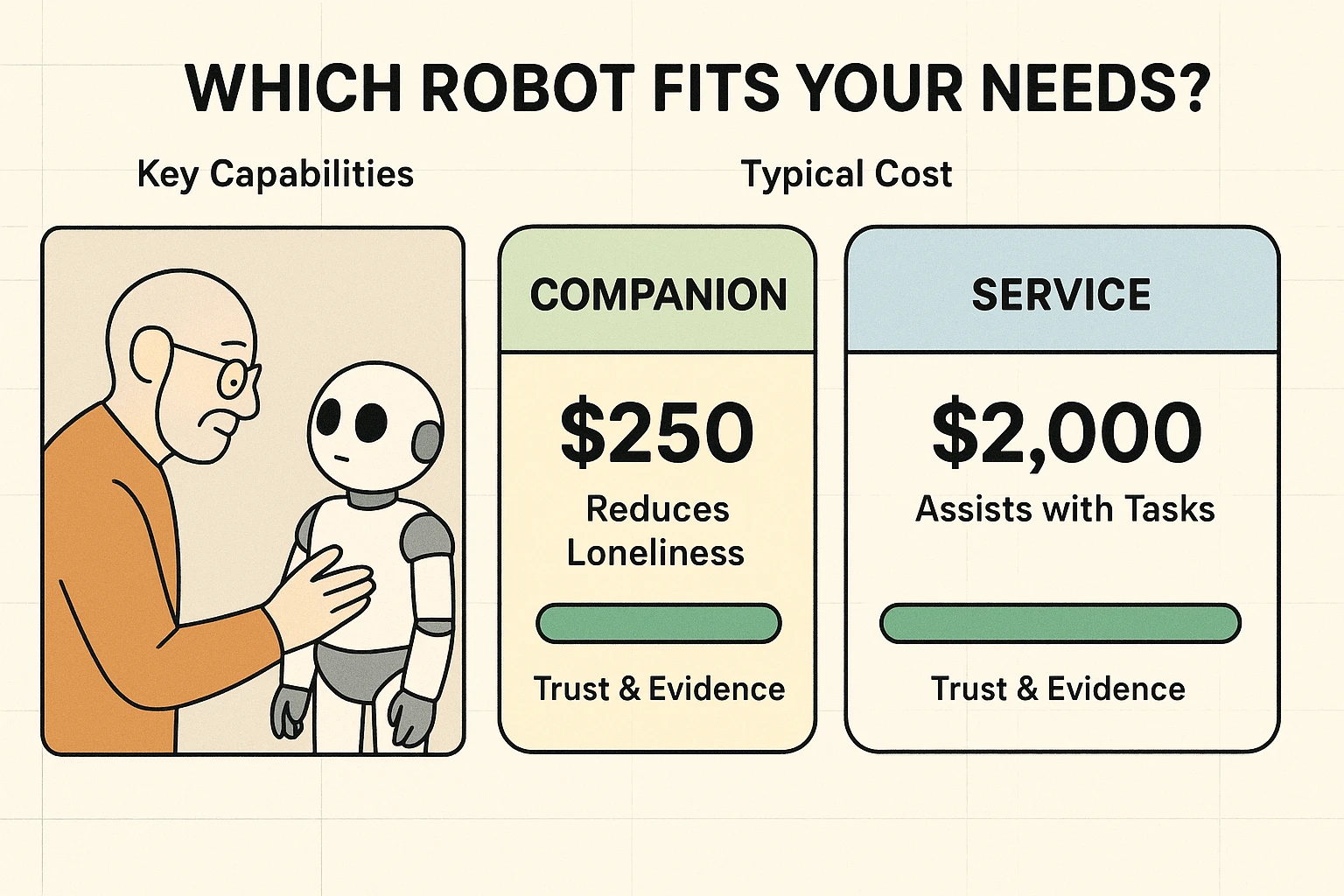
If you’re evaluating options for yourself or a loved one, the sheer variety of robots can make your head spin. To keep things simple, let’s break them down into three main categories.
Think of these as smart speakers (like Alexa) that went to finishing school. The most famous example right now is ElliQ. It looks like a sleek little desk lamp, but it’s actually an AI companion designed to proactively engage with you.
Instead of waiting for you to ask it the weather, ElliQ might suggest a mindfulness exercise, initiate a trivia game, or remind you to call your daughter. The results speak for themselves: ElliQ users report a 96% improvement in health and wellness, and 94% say it enhanced their quality of life. It’s like having a friendly neighbor who never overstays their welcome.
If you love animals but hate the vet bills and the 6:00 AM dog walks, this category is for you. Paro is a robotic baby harp seal that responds to petting, voice, and light. It sounds like a toy, but it’s actually a Class II medical device. A massive 29-study meta-review showed that Paro actively reduces negative emotions and boosts social engagement.
Another massive hit in this space is Hyodol, an AI-powered smart doll. Over 12,000 of these chatty companions have been deployed in South Korea to massive success. They are designed to offer comfort, sing songs, and remind users about daily routines. A U.S. launch for Hyodol is planned for 2026.
This is where things get a bit more futuristic. While many folks happily rely on a simple medication reminder on their smartphone, medical robots take things to the next level. These machines can monitor vital signs, detect falls, and connect directly to healthcare providers.
Then there are humanoid service robots, like the newly launched Fourier GR-3. These are designed to help with physical tasks, mobility assistance, and household chores. We are still in the early days of humanoid robots in the home, but they represent the ultimate goal of helping seniors age in place safely.
Now for the part that makes everyone’s wallet twitch. How much is this digital wizardry going to set you back? The pricing models vary wildly depending on what you want the robot to do.
A sophisticated therapeutic device like the Paro seal costs around $6,000. That is a hefty chunk of change for what looks like a stuffed animal, but it is often purchased by care facilities rather than individuals. On the other end of the spectrum, companion robots like ElliQ are much more accessible. You pay about $250 for the device upfront, followed by a $30 monthly subscription fee.
When evaluating the cost, it helps to look at the bigger picture. The annual salary for a full-time human caregiver currently ranges from $75,000 to $85,000. If a $30/month robot can handle basic check-ins, medication prompts, and emotional support, it suddenly looks like a remarkable bargain. It doesn’t replace a human, but it certainly lightens the load for family caregivers.
At Senior Tech Cafe, we don’t blindly cheerlead for Big Tech. When a device has microphones, cameras, and internet access, we want to know exactly what it’s doing with our data.
Inviting a robot into your home means giving a company access to your daily habits. Most reputable care robots are designed with strict privacy controls, encrypting your data and ensuring it isn’t sold to advertisers who want to bombard you with ads for denture cream. However, it is crucial that you (or your family) read the fine print before plugging anything in.
Ethically, there’s also the question of human connection. A robot should be a bridge to better well-being, not a wall that isolates you from real people. The best care robots encourage users to reach out to their human family members, acting as a supplement to human care, not a replacement.
If you’re ready to explore bringing a robot into your home, start by identifying your biggest daily frustration. Are you physically fine but feeling a bit isolated? A conversational companion like ElliQ is likely your best bet.
Do you have a loved one with cognitive decline who gets easily agitated? A therapeutic robot like Paro or Hyodol could provide incredible comfort. Always start with the problem you want to solve, rather than buying a flashy piece of tech and trying to figure out what to do with it.
Finally, check the technical requirements. Most of these devices require a stable, high-speed Wi-Fi connection to function properly. If your current internet router is a relic from the early 2000s that drops the connection every time it rains, you’ll need to upgrade that first.
Not usually. Companies know their target audience isn’t made up of IT professionals. Most companion robots plug into the wall, connect to your Wi-Fi via a simple smartphone app, and guide you through the rest using voice prompts.
This is a very real concern. If you buy a cloud-connected robot and the manufacturer goes bankrupt (which recently happened to the makers of the $20,000 Pepper robot), your device could become an expensive paperweight. Stick to established brands with proven track records.
Studies actually show the opposite. Many companion robots feature built-in video calling and message sharing, making it easier than ever to send a quick photo or joke to your grandkids. They often increase family communication by removing the technical friction of smartphones.
Dipping your toes into the world of robotics doesn’t mean you have to surrender your humanity to the machines. It simply means taking advantage of tools designed to make your life a little easier, safer, and more entertaining.
If you are considering a device, start by writing down the specific tasks you’d like help with. Then, visit the official websites of models like ElliQ or Paro to watch videos of real seniors interacting with them. Seeing the technology in action is the best way to realize that the future isn’t scary—it’s actually quite friendly, and it might just remind you to take your vitamins.