
Newsletter Subscribe
Enter your email address below and subscribe to our newsletter

Enter your email address below and subscribe to our newsletter

Remember the last time you went on a “relaxing” vacation? It likely started with waking up at 3:00 AM, dragging a suitcase that suddenly weighed forty pounds more than it did at home, and standing in a security line behind a guy who forgot to take the change out of his pockets. Approximately twelve dollars in quarters later, you were allowed to squeeze into an airplane seat designed for a malnourished elf.
By the time you actually saw the Eiffel Tower or the Grand Canyon, you were too exhausted to do anything but look for a place to sit down and a bathroom that didn’t require a secret code.
But what if I told you that you could tour the Parthenon in Greece, inspect ancient Chinese artifacts in Beijing, and roam the halls of London’s British Museum—all while wearing your fuzzy slippers and drinking coffee from your own mug?
Welcome to the golden age of Armchair Adventures. Thanks to a boom in technology (and let’s be honest, a few years where we were all stuck inside), the world has come to us. The virtual tour market for museums and galleries is skyrocketing—experts predict it will grow to over $11 billion by 2030. That means institutions are spending serious money to make sure your digital visit is just as impressive as a physical one, minus the jet lag.
We are going to cut through the noise and show you exactly how to explore the globe from your living room, distinguishing the truly breathtaking experiences from the ones that are just glorified slideshows.
Before we start clicking buttons, we need to define what we’re actually looking for. Not all “virtual travel” is created equal. Some days you want to be an explorer; other days, you just want to be entertained.
Here is the breakdown of the three main categories you’ll encounter:
Let’s bust a myth right now. When you hear “Virtual Reality” or VR, you might picture teenagers wearing giant plastic ski goggles, flailing their arms around the living room.
For the purpose of these museum tours, you do not need a VR headset.
All you need is:
Just because you aren’t physically traveling doesn’t mean you should leave your common sense at the gate. Official museum sites are generally very safe. However, some might ask you to create an account to “save your progress” or access special features.
If you sign up, create a unique password. Do not use the same password you use for your bank account (or the one you use for everything else). And be wary of third-party sites that ask for credit card details for “free” tours. The reputable ones we list below are legitimate.
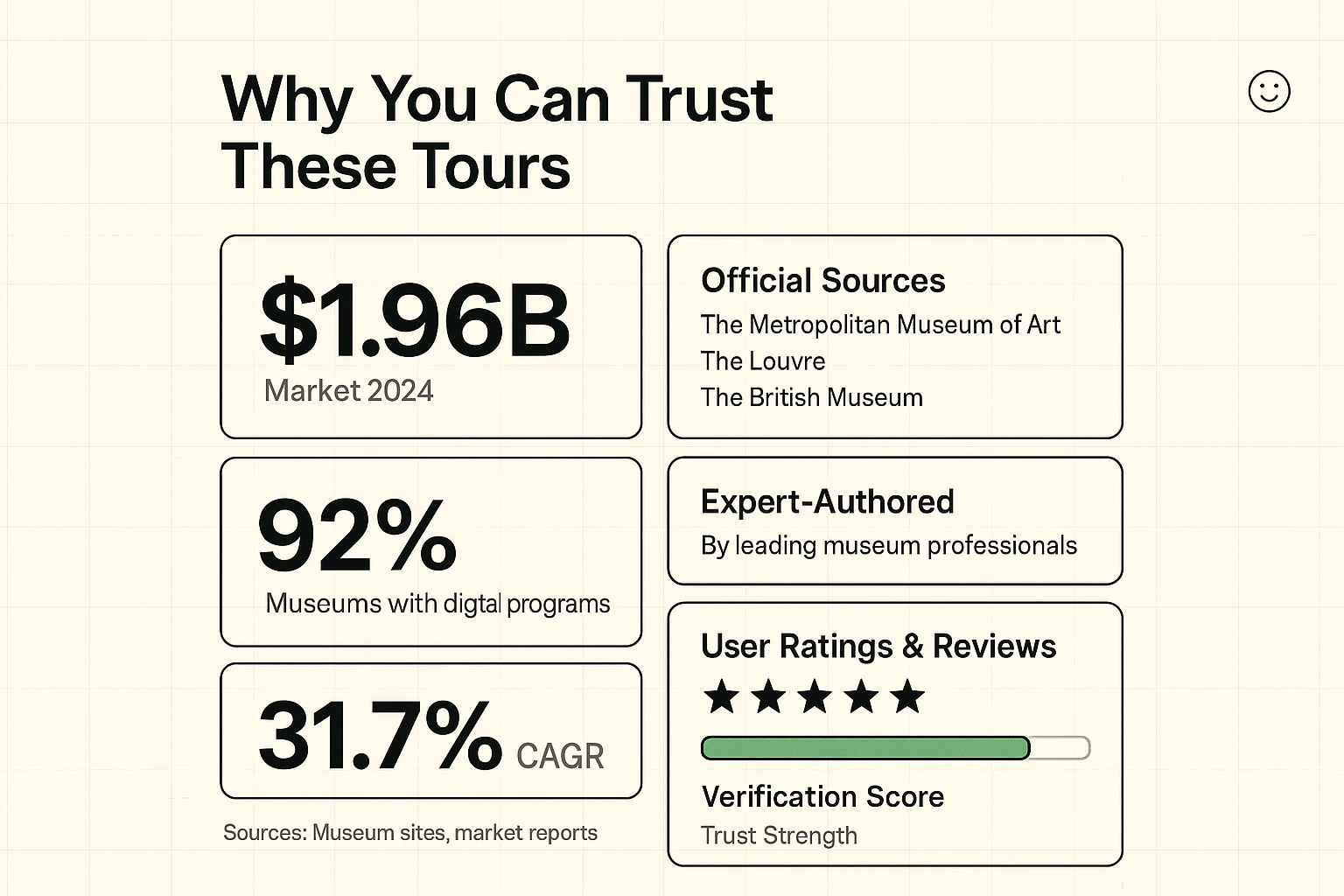
We scoured the internet to find the tours that actually work well and provide a genuine “wow” factor. Here are three distinct experiences to get you started.
If you love history, this is the gold standard. The Acropolis Museum in Athens offers a digital experience that rivals the real thing.
The British Museum has massive collections, but their physical building can be overwhelming (and crowded). Their online “Museum of the World” is a masterpiece of design.
Formerly known as the Forbidden City, this massive complex was off-limits to commoners for 500 years. Now, you can click your way right in.
Sometimes, clicking around a virtual room feels too much like work. Maybe you just want to sit back with a cup of tea and let Sir David Attenborough soothe your soul.
Streaming services have become the new travel agencies. Here is where to look:
Still not sure where to start? We’ve put together a simple decision matrix. Think of this as your travel agent asking, “Do you want to hike a mountain or sit by the pool?”
No. Any computer bought in the last 5-7 years should handle them fine. If the tour is “stuttering,” try closing other tabs in your browser.
Most are free! The British Museum and Acropolis Museum offer their main virtual experiences for free. Some third-party companies sell “live guided” tours where a person walks around with a camera while you watch on Zoom, and those cost money. But the self-guided ones are usually gratis.
If you have a smart TV, you can use the YouTube app to find “360 Virtual Tours” (though you can’t click to move around as easily). The best method is to connect your laptop to your TV with an HDMI cable. It turns your television into a giant computer monitor.
The world is vast, beautiful, and surprisingly accessible. You don’t need a passport, you don’t need to take off your shoes for security, and you certainly don’t need to worry about the currency exchange rate.
Start with one of the free museum tours mentioned above. If you find yourself getting frustrated with the navigation, switch to a documentary. The goal is enjoyment and curiosity, not mastering a new piece of software.
So, fluff that pillow, grab a snack, and head to Greece. The Parthenon is waiting, and the weather in your living room is always perfect.