Newsletter Subscribe
Enter your email address below and subscribe to our newsletter

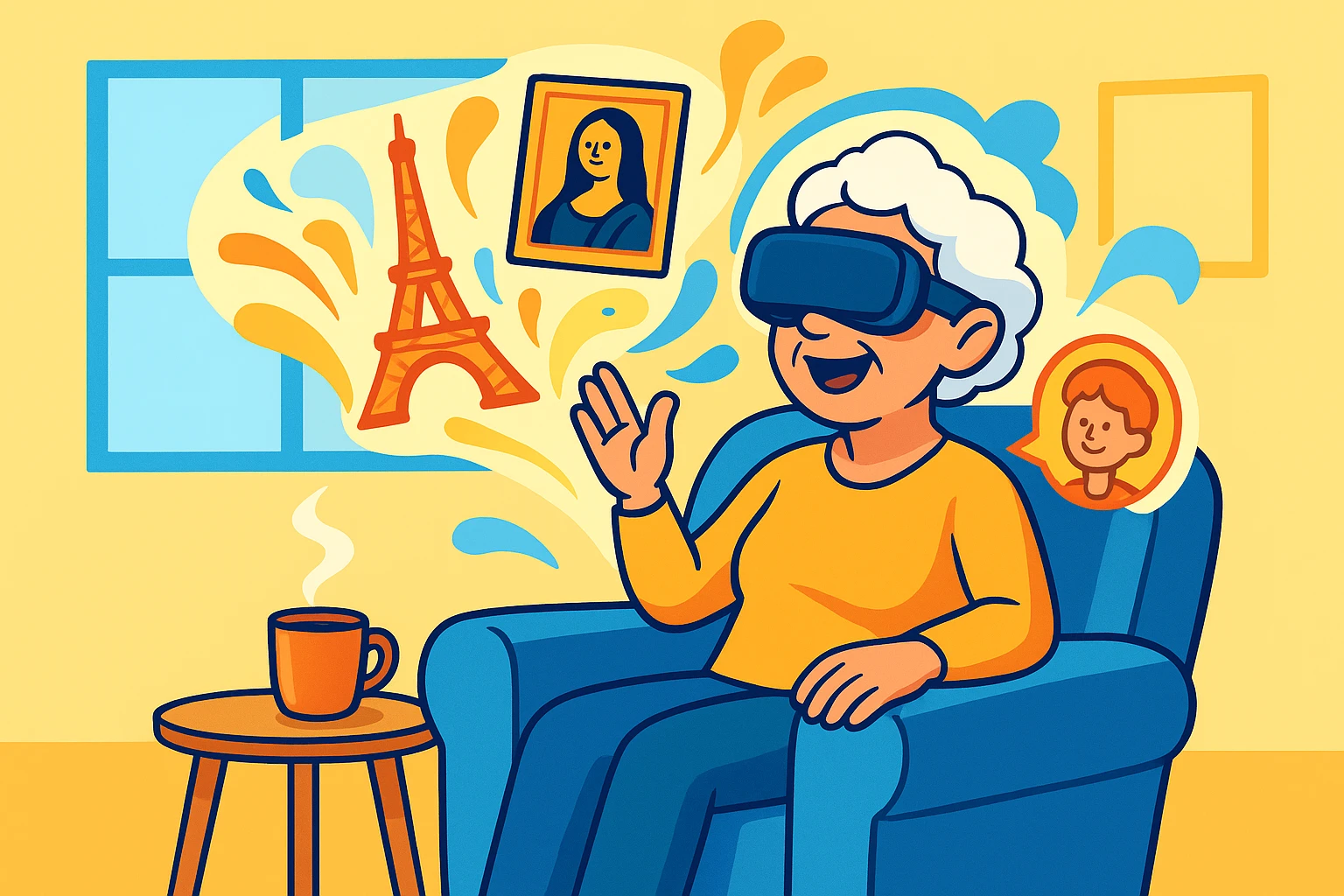
Imagine you want to visit the Louvre in Paris. Traditionally, this involves packing a suitcase, surviving a ten-hour flight wedged next to a guy who smells like aggressively aged cheese, and navigating cobblestone streets with knees that currently sound like a bowl of Rice Krispies. It’s an exhausting prospect.
What if you could skip the airport completely, stroll past the Mona Lisa from the comfort of your favorite armchair, and still make it to the kitchen in time for Jeopardy? Better yet, what if you could do it alongside your grandson who lives three states away?
Welcome to the surprisingly accessible world of Virtual Reality (VR) and Augmented Reality (AR). If you just rolled your eyes and muttered about newfangled gadgets built for teenagers, stick with me. These immersive worlds aren’t just for video games anymore.
Today, they are powerful, senior-friendly tools designed to boost mental sharpness, crush loneliness, and make daily life a little easier. Let’s strip away the tech jargon and look at how this technology is actually changing lives—and how you can decide if it’s right for you or your loved ones.
It is easy to dismiss strapping a computer to your face as a silly novelty. But the medical and scientific communities are taking immersive technology very seriously. They aren’t just looking at whether VR is fun; they are measuring how it actively improves aging brains and bodies.
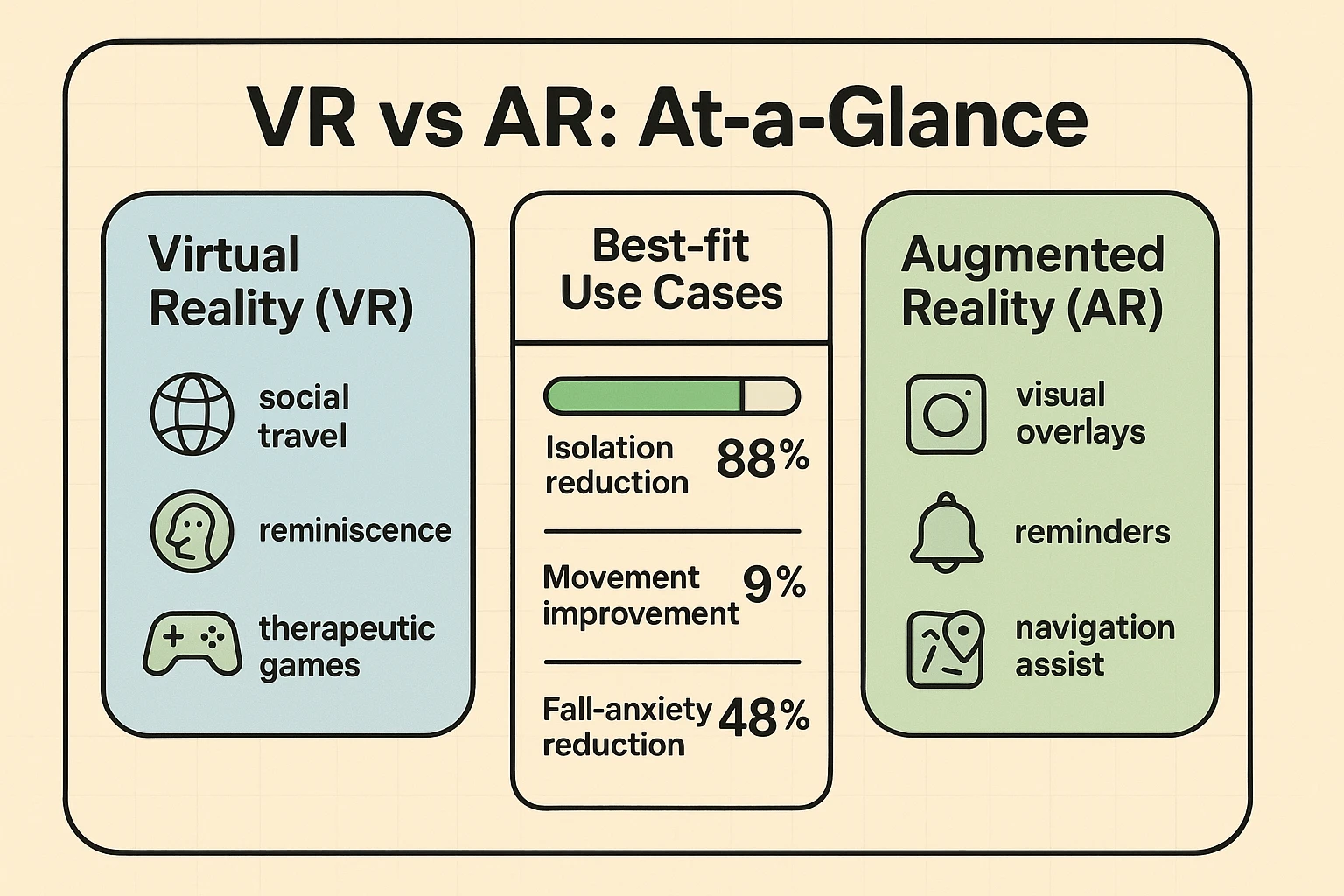
Recent scoping reviews from the National Institutes of Health and major clinical trials have uncovered some genuinely mind-blowing statistics. For example, using VR interventions for physical therapy has been shown to reduce fall-risk anxiety by a staggering 48%. It even helps seniors improve their actual physical movement speed by 9%.
Beyond the physical benefits, the mental health impacts are profound. In clinical trials focused on function-oriented VR, 24 out of 28 studies reported significant improvements in mood and quality of life. Users aren’t just distracted; they are actively engaged in cognitive exercises that improve memory recall and independent living skills.
Perhaps most importantly, between 88% and 91% of senior users report feeling significantly less isolated after using social VR platforms. In a world where loneliness is often called a silent epidemic among older adults, a tool that effectively bridges the gap between isolation and connection is nothing short of a medical marvel.
Before you start shopping, you need to know the difference between Virtual Reality (VR) and Augmented Reality (AR). Tech companies love to throw these acronyms around as if we were all born with a Silicon Valley dictionary in our hands.
Think of Virtual Reality (VR) as a magical teleportation helmet. When you put on a VR headset, your living room disappears entirely. You are instantly transported to the Grand Canyon, a virtual bowling alley, or the front row of a symphony orchestra. It is completely immersive.
Augmented Reality (AR), on the other hand, is more like wearing a pair of highly educated eyeglasses. You still see your living room, your coffee table, and your dog. But AR places helpful digital items over your real world—like projecting a bright yellow arrow on the floor to help you find the bathroom at night, or popping up a digital label over your medication bottle with large, easy-to-read instructions.
If your goal is to escape, travel, and socialize, VR is your ticket. If your goal is to get a little extra help navigating your daily routine and enhancing your independence, AR is the tool for the job.
The best part about modern immersive technology is that it has moved past fighting virtual zombies. Today’s applications are beautifully tailored to the real-life interests and needs of older adults.
One of the most popular uses is virtual travel, which allows you to explore the globe without the hassle of TSA checkpoints. But it gets even more personal with “reminiscence therapy.” Using tools like Google Earth VR, seniors can digitally “walk” down the exact street they grew up on, triggering powerful, joyful memories that are incredibly beneficial for cognitive health.
On the AR side, the technology acts as a gentle, brilliant assistant. Imagine holding up your phone (or wearing AR glasses) and having it instantly magnify text, translate a confusing sign, or remind you where you placed your keys by showing a “digital twin” of your home’s layout. It takes the frustrating little roadblocks of daily life and simply deletes them.
Companies like Rendever and Mynd Immersive have paved the way here, building platforms specifically for seniors. They strip out the confusing menus and focus entirely on shared, joyful experiences, proving that you don’t need to be a computer whiz to reap the benefits.
If you’ve ever tried to buy a TV and been paralyzed by words like “OLED,” “refresh rate,” and “HDMI 2.1,” shopping for a headset might sound terrifying. Fortunately, evaluating these devices for seniors comes down to three very simple things: comfort, simplicity, and safety.
You want a headset that doesn’t feel like you’ve strapped a cinderblock to your forehead. Look for devices with adjustable straps and soft facial interfaces that can comfortably accommodate prescription glasses.
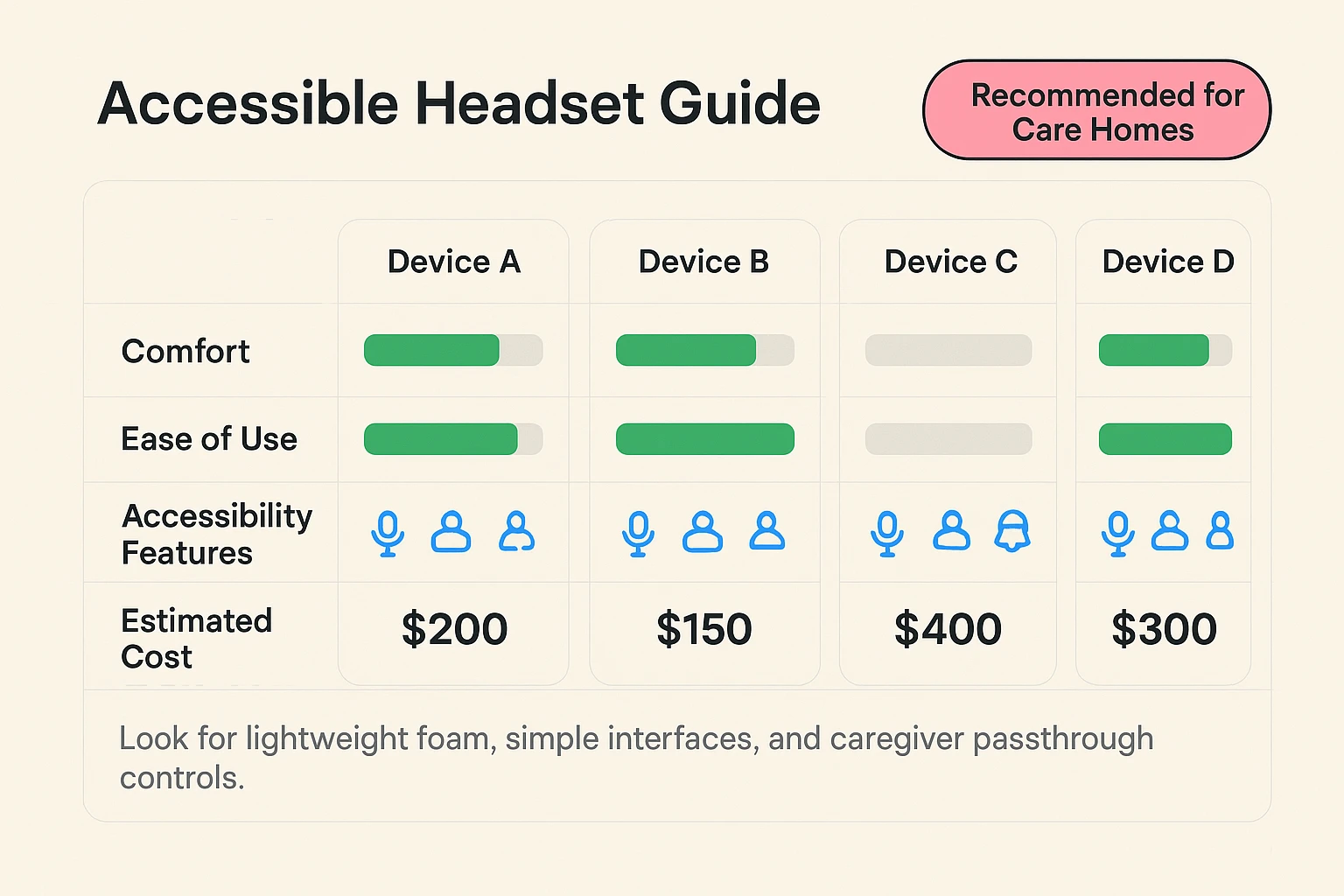
When comparing options, look closely at the user interface (UI). The best options for older adults rely on voice commands or simple point-and-click controllers, avoiding menus that look like the cockpit of a 747. For caregivers or senior living communities, specialized platforms like Rendever are brilliant because they allow one person (like a staff member or grandchild) to control the experience from a tablet while the senior simply enjoys the ride.
We cannot talk about strapping screens to our faces without discussing safety, particularly for seniors. Big Tech loves to show commercials of people jumping around their living rooms in VR, but we prefer a more dignified, gravity-respecting approach.
The golden rule of senior VR is simple: always remain seated. Using VR in a comfortable, sturdy chair completely eliminates the risk of tripping over the coffee table or losing your balance while virtually visiting the Swiss Alps.
Then there is “cybersickness,” which is essentially motion sickness caused by your eyes telling your brain you are moving while your inner ear knows you are sitting still. Fortunately, research shows cybersickness incidence is actually low-to-moderate among seniors. The trick is to start with slow, gentle experiences—think a virtual boat ride down a lazy river, rather than a digital rollercoaster—and limit initial sessions to about 10 or 15 minutes.
Not at all! Most modern VR headsets, like the Meta Quest series, are standalone. The computer is built right into the headset, meaning you don’t need any messy wires or a separate, expensive PC. You just need a standard Wi-Fi connection.
This is Senior Tech Cafe, so you know we are watching out for your data. When setting up a commercial VR headset, be mindful of privacy settings. Opt out of sharing diagnostic data where possible, and if you are using specialized senior platforms like Mynd Immersive, they generally have stricter healthcare-grade privacy standards than standard consumer gaming devices.
If you buy a consumer headset off the shelf, the initial setup can be a bit tedious (typing Wi-Fi passwords with a virtual laser pointer is nobody’s idea of a good time). We highly recommend having a tech-savvy family member do the initial account setup. Once it’s configured, turning it on and launching an app is usually as simple as turning on a television.
Technology should never make you feel left behind; it should open new doors. Virtual and Augmented Reality are finally at a point where the benefits far outweigh the learning curve. They offer a legitimate, scientifically backed way to keep the mind sharp, the spirit adventurous, and the family connected.
If you are a caregiver or a senior considering the plunge, start small. Look into senior-specific programs at your local community center, or check out videos of platforms like Rendever to see how joyous these experiences can be.
You’ve spent a lifetime navigating the real world. You’ve earned the right to explore a few virtual ones from the comfort of your favorite chair.