
Newsletter Subscribe
Enter your email address below and subscribe to our newsletter


Have you ever gotten a financial tip that sounded so good, you could almost hear a choir of angels singing?
Maybe it was a post from a distant cousin on Facebook, who suddenly looks 20 years younger and is standing next to a Lamborghini, raving about a “guaranteed” crypto investment.
He promises returns so high, you’ll be able to buy your own island and name it after your cat.
Back in the day, the worst financial advice you could get was from your brother-in-law, Gary, after he’d had one too many eggnogs at the holiday party.
Gary’s hot stock tip usually involved a company that made novelty toupees for pets. The risk was low because, let’s be honest, you weren’t actually going to invest.
But today’s bad advice is a different beast entirely. It’s slick, it’s personal, and it’s powered by Artificial Intelligence (AI). Scammers are using AI to create incredibly convincing traps, from fake investment gurus to cloned voices of your loved ones in distress.
They’ve traded Gary’s questionable toupee company for a high-tech illusion designed to separate you from your savings.
Don’t worry. You don’t need a degree in computer science to stay safe.
We’re going to pull back the curtain on these digital shenanigans, show you how to spot the fakes, and give you the tools to keep your money right where it belongs: in your pocket.
Before we dive into the scams, let’s clear something up. When you hear “AI,” you might picture a talking car or a robot that’s secretly plotting to take over the world. In reality, most AI is less “evil genius” and more “overachieving intern.”
Think of AI as a computer program that can learn patterns and create new things based on what it has learned. It can write an email, create a picture, or even mimic a person’s voice.
It’s the reason your phone can help finish your sentences and why you might suddenly see ads for garden gnomes five minutes after you searched for one.
When it comes to your money, AI is a double-edged sword. There are legitimate financial companies that use AI to help manage investments or detect fraud. But scammers use it to build their traps.
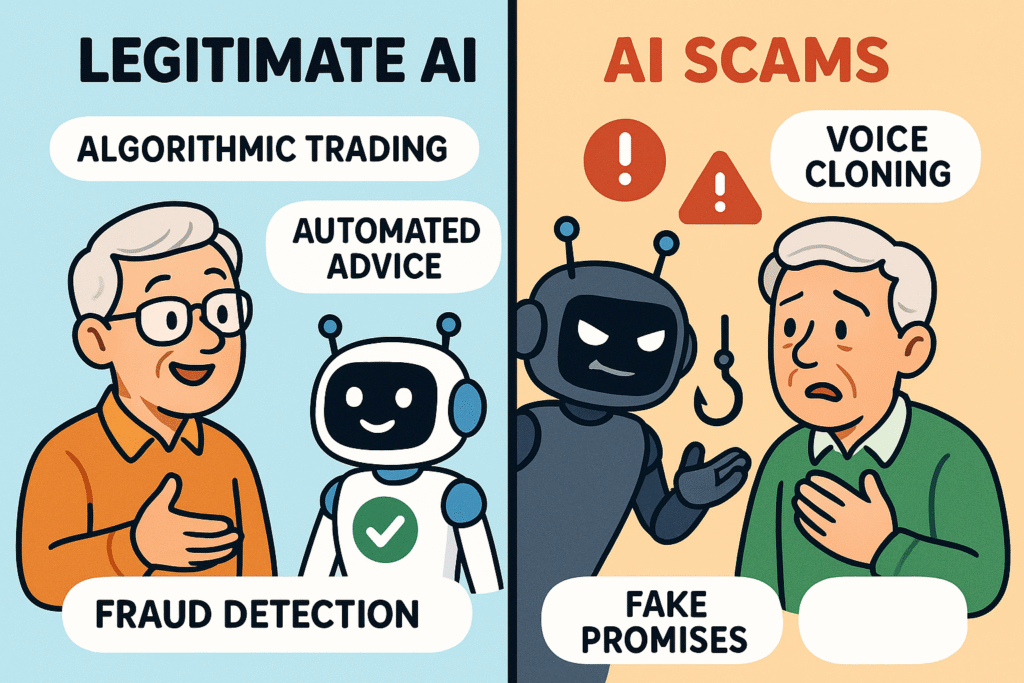
The key difference is transparency and promises. Real financial AI is a tool; it doesn’t promise guaranteed riches overnight.
Scammer AI, on the other hand, often comes wrapped in a story that’s too good to be true.
And as we all know, if it sounds too good to be true, it’s probably time to go water your plants and think it over.
So, how exactly are these digital pickpockets using AI?
They have a few favorite tools they use to make their scams believable. Once you know what to look for, they become much less convincing.
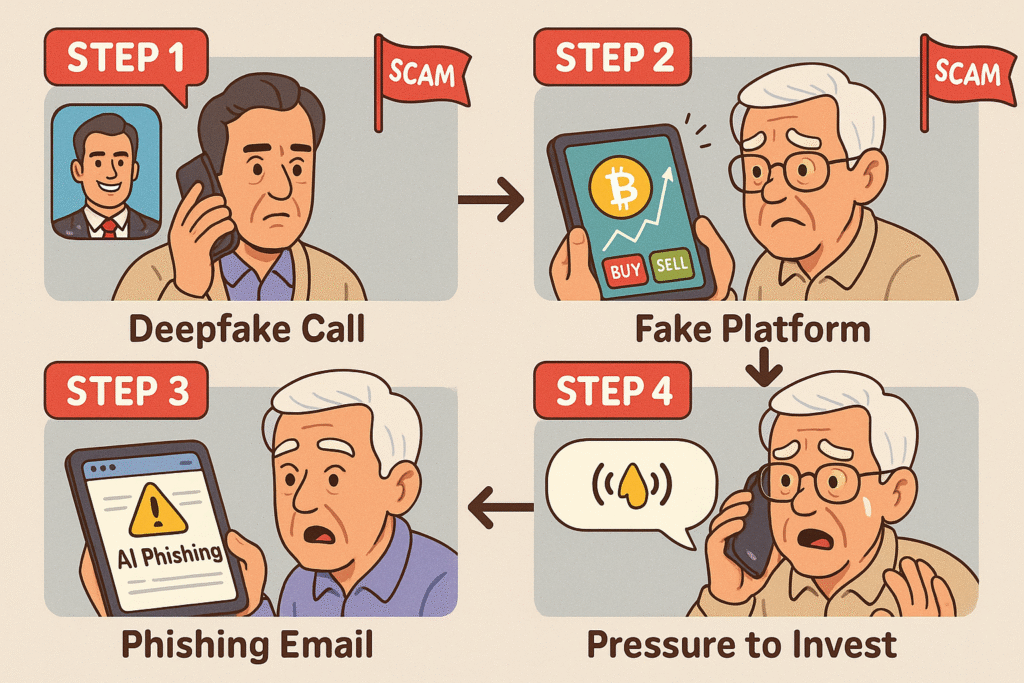
This flowchart breaks down the complex AI crypto scam process into simple, digestible steps, empowering seniors to recognize each tactic used by fraudsters.
This is the scariest one. A “deepfake” is a video, image, or recording that has been created or altered with AI to make it look or sound like someone is saying or doing something they never did.
Voice cloning is the audio version. A scammer can use a surprisingly small sample of someone’s voice—perhaps from a social media video or another recording—to create a convincing imitation.
And here’s the important part: don’t count on being able to spot the fake.
Older deepfakes sometimes had obvious giveaways—strange blinking, stiff facial movements, robotic voices, or awkward pauses. Those clues can still show up, but today’s technology can produce fakes that look and sound remarkably convincing.
The Better Red Flag: Pay attention to what the person is asking you to do.
If your “grandson” suddenly calls asking you to wire money, your “bank” wants account information, or a celebrity appears in a video promoting an incredible investment, don’t try to decide whether the voice or face looks real.
Verify it another way. Hang up and call your loved one using the number you already have. Contact your bank directly. Look up the company yourself.
When money is involved, verification beats detective work.
Remember those old scam emails filled with typos? AI has fixed that.
Scammers now use AI to write perfectly crafted emails, social media messages, and even entire websites that look incredibly professional. They can even personalize them with details they find about you online.
Red Flags:
Bank0fAmerica.com (with a zero instead of an ‘o’) or a long, jumbled address. When in doubt, type the website address yourself instead of clicking a link.Some scammers create chatbots or AI-powered accounts that pretend to be friendly financial advisors or wildly successful investors.
They may chat with you for days or even weeks, answer your questions, build your trust, and eventually introduce an “exclusive” crypto investment, trading platform, or AI-powered money-making system.
And don’t assume you’ll catch them because the conversation sounds robotic. Modern AI can carry on a surprisingly convincing conversation.
Red Flags:
The technology may be new, but the sales pitch is ancient: “Give me your money now, and I’ll make you rich.”
Feeling a little overwhelmed? Don’t be. Protecting yourself comes down to a few simple, powerful habits. Think of this as your cheat sheet for sniffing out digital rats.
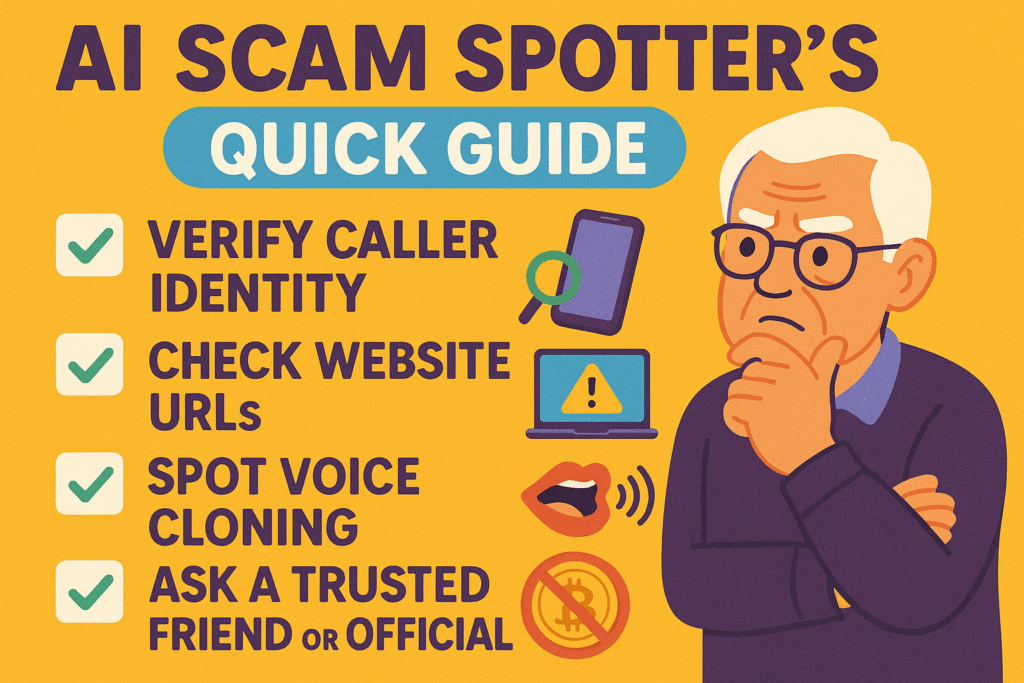
Not at all! Many reputable financial firms use AI for things like managing portfolios (often called “robo-advisors”) or analyzing market trends. The difference is that legitimate companies are transparent, registered, and will never promise you guaranteed, sky-high returns.
Act quickly.
Contact your bank, credit card company, payment service, cryptocurrency exchange, or whichever company you used to send the money. Tell them the transaction was part of a scam and ask whether it can be stopped or reversed.
Even if you paid by cryptocurrency or wire transfer and think the money is gone, it’s still worth reporting immediately. The sooner you act, the better your chances of recovering something.
Then report the scam to the Federal Trade Commission (FTC) at
ReportFraud.ftc.gov and the FBI’s Internet Crime Complaint Center (IC3).
And watch out for one more scam: anyone who contacts you afterward promising they can recover your lost money for an upfront fee. Scammers sometimes come back for a second helping by posing as “recovery experts.”
Cryptocurrency payments are attractive to scammers because they’re usually difficult or impossible to reverse.
Once you send cryptocurrency to someone, there’s no bank sitting in the middle that you can simply call and ask to cancel the payment. That makes recovering stolen money much harder.
That doesn’t mean cryptocurrency transactions are completely anonymous—many transactions are actually recorded on public blockchains and can sometimes be traced. But tracing the money and getting it back are two very different things.
Scammers only need a few seconds of audio to create a voice clone. They can get this from a voicemail message, a social media video, or anywhere else a person’s voice is recorded. That’s why the “verify, then trust” rule is so important.
Navigating the digital world can feel like walking through a minefield sometimes, but you are not powerless. The flashy tools used by scammers—AI, deepfakes, crypto—are just new packaging on an old product: the get-rich-quick scheme.
By staying calm, asking questions, verifying people independently, and remembering that nobody can legitimately guarantee sky-high investment returns with little or no risk, you can avoid a lot of these traps.
The next time you see a post about an AI-powered money-making machine, you’ll know exactly what to do: scroll right on by, and maybe give your real grandson a call, just to chat.