Newsletter Subscribe
Enter your email address below and subscribe to our newsletter

Let’s be honest about something. We all have that one drawer in the kitchen. You know the one. It holds three dead batteries, a ball of rubber bands the size of a grapefruit, a menu for a pizza place that closed in 2011, and a key that looks important but opens absolutely nothing in your current house.
When we’re gone, our families will open that drawer, sigh, and toss the whole thing in the trash. It’s a five-minute problem.
But your digital drawer? That’s a whole different beast.
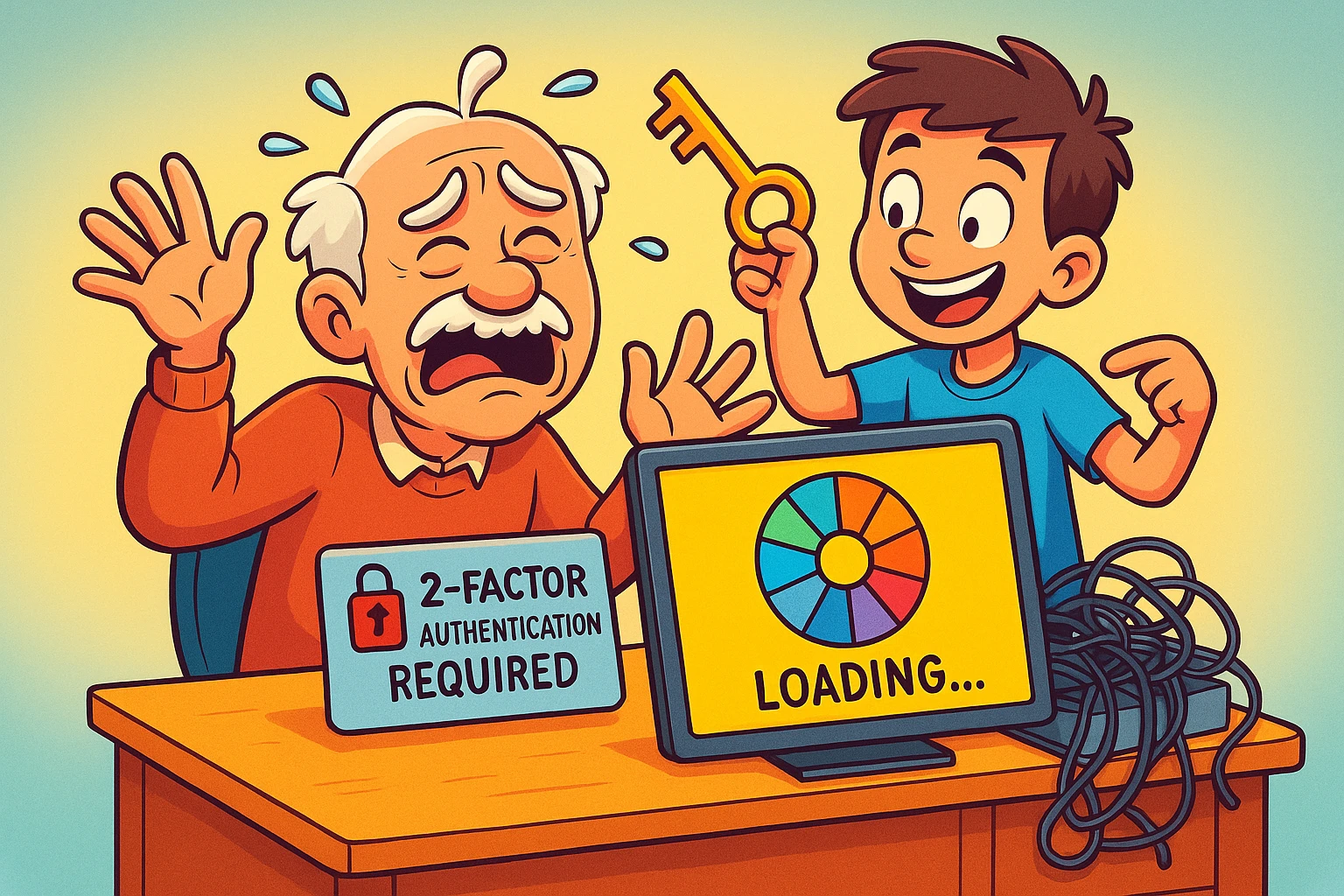
Imagine this: You’ve ascended to the great Wi-Fi in the sky. Your spouse or children are sitting at your desk, trying to pay the electric bill or find that one photo of you from the Grand Canyon trip. They click “Login.”
The screen dims. A spinning wheel mocks them. And then, the ultimate gatekeeper appears: “We’ve sent a 6-digit code to the mobile number ending in 55.”
The phone is locked. The email is inaccessible. The electric bill goes unpaid. And suddenly, your grieving family isn’t just sad; they are locked out of your life by a robot that thinks it’s protecting you.
This is why you need a Digital Executor. Not because you have secret government files, but because in 2024, “leaving the keys under the mat” doesn’t work for your Amazon account.
If you type “Digital Executor” into a search engine right now, you might get some very confusing results about video games, specifically something called Roblox.
Let’s clear the air immediately so you don’t think we’re asking you to learn how to code.
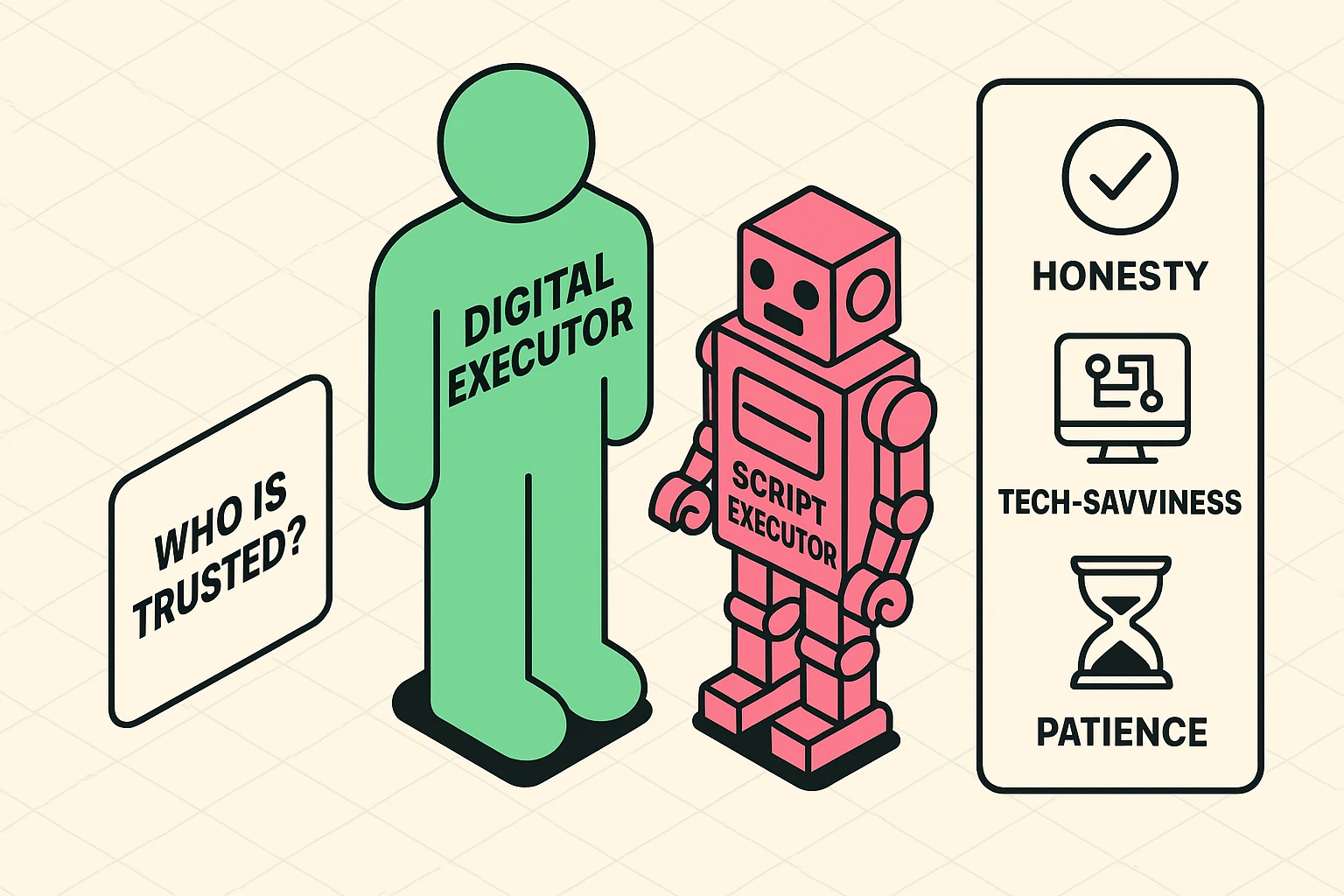
We are talking about the human being on the left. We are not talking about software scripts used by teenagers to cheat at block-based video games. If your grandson says, “I know what a script executor is!” tell him, “That’s nice, dear, but this is about my bank account, not Blox Fruits.”
This is the most common question we get at Senior Tech Cafe. “I wrote my passwords in a notebook. Isn’t that enough?”
Ten years ago? Yes. Today? Absolutely not.
Here is a nightmare scenario that is becoming surprisingly common. You are the “Chief Technology Officer” of your house. You set up the smart thermostat, the Ring doorbell, and the smart lock on the front door.
If you pass away and your spouse doesn’t have the app on their phone—or the login to your account—they might literally be unable to change the temperature in their own house. We have seen cases where families had to replace physical door locks because the “admin” was gone, and the house refused to let anyone else in.
Here is where things get a little sticky, legally speaking. Even if your daughter has your password, using it might technically be… well, illegal.
There is a law with a terrible acronym called RUFADAA (Revised Uniform Fiduciary Access to Digital Assets Act). It sounds like something a magician would shout, but it’s actually the law that governs who can touch your digital stuff.
Most Terms of Service agreements (those long documents we all scroll past and click “Agree” on) say that your account is yours and yours alone. When you die, the account dies. If your executor uses your password to log in, they could technically be violating federal hacking laws.
Real World Example: In the legal case Matter of Serrano (2017), a family wanted access to a deceased relative’s Google account. They got the contacts and calendar, but Google refused to hand over the contents of the emails because the deceased person hadn’t explicitly said, “Let them see my emails.”
A Digital Executor isn’t just someone with a password; it’s someone you’ve given permission to act on your behalf.
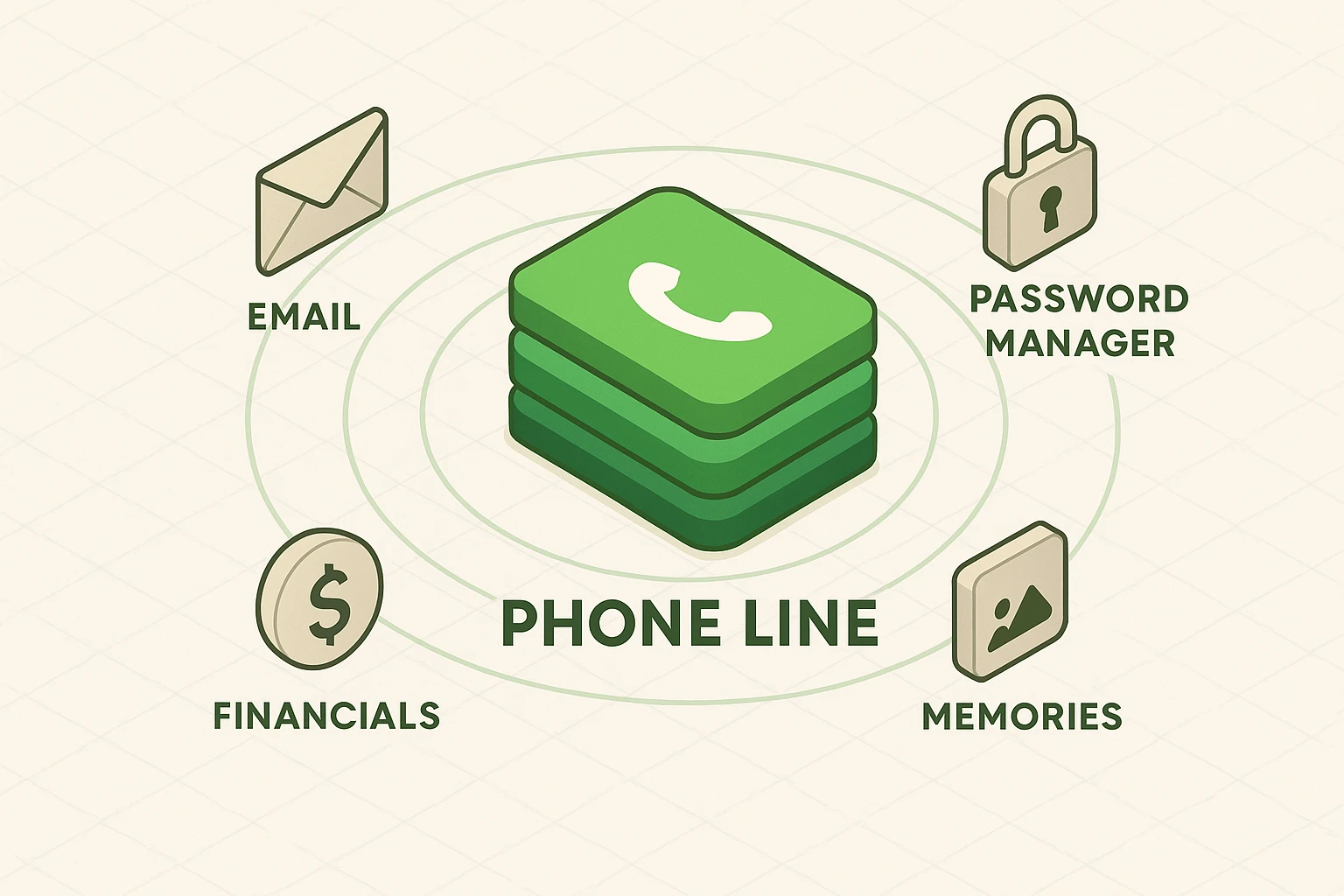
Think of your “regular” executor as the person who handles the physical stuff: the house, the car, the collection of commemorative plates.
Your Digital Executor handles the invisible stuff. Their job includes:
This is the hardest part. Your instinct is probably to pick your spouse or your oldest child. But is that the right move?
Choosing a Digital Executor requires a very specific set of skills. They need the patience of a saint and the tech skills of… well, at least a teenager.
Pros: You trust them implicitly.Cons: If they struggle to change the input on the TV remote, asking them to navigate Two-Factor Authentication (2FA) and cloud backups during a time of grief is a recipe for immense frustration.
Pros: They know what a “password manager” is and they can navigate an iPhone blindfolded.Cons: Do you want them seeing everything? Your emails? Your search history? Your private messages? The “Techy Nephew” is effective, but make sure you are comfortable with what they might find.
You don’t have to name your Digital Executor in your will as the primary boss. You can name a “Co-Executor” or simply draft a letter of instruction that designates a “Tech Assistant” to help the main executor. This gives your spouse the authority, but allows the techy nephew to do the heavy lifting under supervision.
You don’t always need a fancy legal document. The Big Tech companies have actually built tools to help you, but they hide them deep in the settings menus.
If you have an iPhone or iPad, this is mandatory. You can designate a “Legacy Contact.” When you pass away, this person provides a death certificate to Apple and receives a special digital key. This gives them access to your photos, messages, and notes without needing your passcode.
Google has a “Dead Man’s Switch.” You tell Google: “If I haven’t logged in, watched a YouTube video, or checked email for 3 months, assume I’m gone.”Google will then automatically email your chosen contact with a link to download your data.
You can choose someone to manage your account after you pass. They can pin a post to your profile (like a funeral announcement) and update your profile picture, but they cannot read your private messages.
Please don’t. Wills become public records when they go through probate. That means anyone—including identity thieves—could potentially read your Will and see “My password is ‘Fluffy123’.” Keep your passwords in a Password Manager or a separate, secure document referenced in the Will.
If you own Bitcoin or other crypto, this is critical. If you lose the “private key” (a long string of random words), that money is gone forever. No bank can reset it. For crypto, you absolutely need a specific digital plan, often involving a hardware wallet stored in a physical safe.
Legally, yes. There are services that claim to manage this for you, but ultimately, a human being needs to be the one to interact with the lawyers and the software companies.
You don’t have to solve this today. But you can start.
Take five minutes this afternoon to do one thing: Set up the Legacy Contact on your phone. It’s free, it’s built-in, and it ensures that the thousands of photos of your grandkids, your garden, and your pets don’t vanish into the digital void.
Technology is supposed to make our lives easier. With a little bit of planning, it can make things easier for the people we leave behind, too.