Newsletter Subscribe
Enter your email address below and subscribe to our newsletter

Enter your email address below and subscribe to our newsletter

Remember planning a vacation back in the day? It was a full-contact sport. You’d spend weeks wrestling with travel brochures that weighed more than a Thanksgiving turkey, squinting at maps with print so small you’d need a microscope and a prayer, and calling hotels to ask questions like, “Exactly how many flights of stairs are between the lobby and Room 203? Please be specific. My knees have an attorney.”
The result was often a three-ring binder full of printouts, confirmations, and a vague sense of dread. You’d created a travel plan so complex it could have been used to launch a satellite. All you wanted was a relaxing trip to see some nice scenery, not a part-time job as a logistical coordinator.
Well, what if I told you that you can now have a personal travel agent who is infinitely patient, has read every travel guide ever written, and works for free? It’s called Artificial Intelligence (AI), and before your eyes glaze over, this isn’t about robots taking over the world. It’s about making your world bigger, one perfectly planned, stress-free trip at a time.
Think of an AI assistant like ChatGPT or Google’s Gemini as a super-smart librarian. You can walk up and ask it anything, and it will instantly scan a library bigger than the entire planet to give you an answer. When it comes to travel, you’re not just getting a list of links; you’re getting a customized itinerary built around your specific needs.
But let’s be honest, the term “Artificial Intelligence” can sound intimidating, like something that requires a password you can’t remember and a 200-page manual. So let’s clear up a few common worries right off the bat.
Not at all. Using these tools is as simple as having a conversation. You just type what you’re looking for in plain English. There are no confusing buttons or complicated menus. If you can write an email, you can use an AI planner.
This is a great question. Think of AI as an incredibly enthusiastic and knowledgeable, but occasionally forgetful, research assistant. It’s fantastic for generating ideas and creating a first draft. But it can sometimes get details like opening hours or specific addresses wrong. We’ll show you a foolproof method to double-check the important stuff.
You don’t need to share your name, address, or financial information to plan a trip. You’re just having a conversation about travel ideas. It’s no different than reading a travel blog, except the blog is talking back to you.
Absolutely not! It replaces the frustration of planning. It handles the tedious parts—like sifting through hundreds of hotel reviews—so you can focus on the fun parts, like dreaming about which Parisian bakery to visit first.
Let’s put this to the test. Instead of just talking about it, let’s plan a hypothetical 5-day trip to the beautiful city of Lisbon, Portugal. The secret to getting great results from AI is learning how to ask the right questions, or what the tech folks call “prompts.”
The magic is in the details. A vague prompt gets a vague answer. A specific prompt gets a masterpiece.
See the difference? You told the AI exactly what “senior-friendly” means to you.
Now, let’s drill down. You can ask follow-up questions to refine the plan.
The AI will now act like a concierge, narrowing down the options and giving you the links you need to verify everything and see photos.
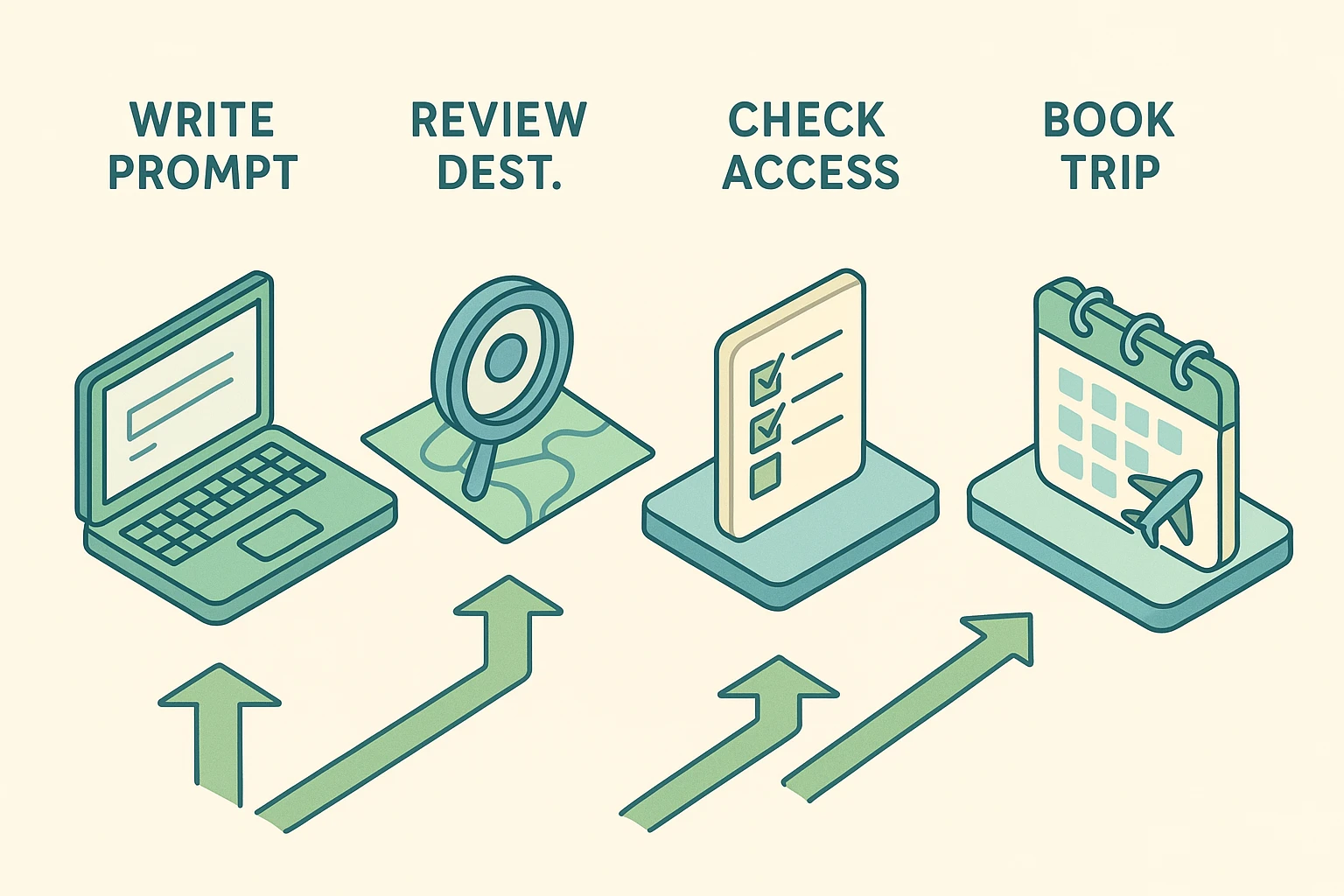
You can continue this conversational planning for your entire trip.
Once you have your flights and hotels sorted, you can explore using AI for seniors to store and retrieve documents like tickets and confirmations, keeping everything organized in one digital spot.
Remember how we said AI can sometimes get things wrong? Here’s how you become the boss of your AI assistant with a simple, three-step method we call the “Verification Sandwich.”
This simple process gives you the best of both worlds: the speed and power of AI combined with the accuracy and common sense of a real human being—you!

Ready to try it yourself? Here are a few sample prompts you can copy, paste, and adapt for your dream trip. Just fill in the blanks!
“Plan a 7-day, accessible trip to [City Name]. Focus on art museums with elevators and benches, historical sites with guided tours suitable for seniors, and a classical music concert. Find a hotel in a central, quiet neighborhood near a metro station with an elevator.”
“I want to visit [National Park or Region]. Design a 4-day trip focused on scenic drives, accessible viewpoints, and easy walking trails (less than 1 mile, mostly flat). Suggest a cozy lodge or cabin with ground-floor rooms and a restaurant on-site.”
“Suggest three quiet, relaxing beach towns in [State or Country] for a 1-week stay in [Month]. I’m looking for a hotel or rental directly on the beach with a walk-in shower and no stairs to enter. Please also suggest restaurants with outdoor seating and sunset views.”
Planning a trip can even spark new interests before you leave home. AI can be a fantastic partner for diving into creative hobbies for seniors, like learning about the history of the art you’re about to see.
It’s a tool like ChatGPT or Google Gemini that you can talk to in plain English to get travel ideas, itineraries, and recommendations tailored specifically to your needs.
Yes, the basic versions of the most popular AI assistants are free to use. They are more than powerful enough for all your travel planning needs.
In short, the AI has read virtually the entire internet—travel blogs, guides, reviews, you name it. It uses that massive knowledge base to piece together answers to your questions in a conversational way.
This is a critical point: use AI for planning, not for booking. When you’re ready to buy a plane ticket or reserve a hotel room, always go directly to the official airline or hotel website. This ensures your payment information is secure and you get accurate confirmation.
The days of wrestling with heavy brochures and confusing websites are over. With an AI assistant, you have a powerful tool that puts you in the driver’s seat. It handles the grunt work, respects your needs, and helps you craft a journey that’s truly your own.
So go ahead, dream big. Think about that trip you’ve always wanted to take. Your new, tireless travel agent is waiting to help you plan it, one simple question at a time.