Newsletter Subscribe
Enter your email address below and subscribe to our newsletter

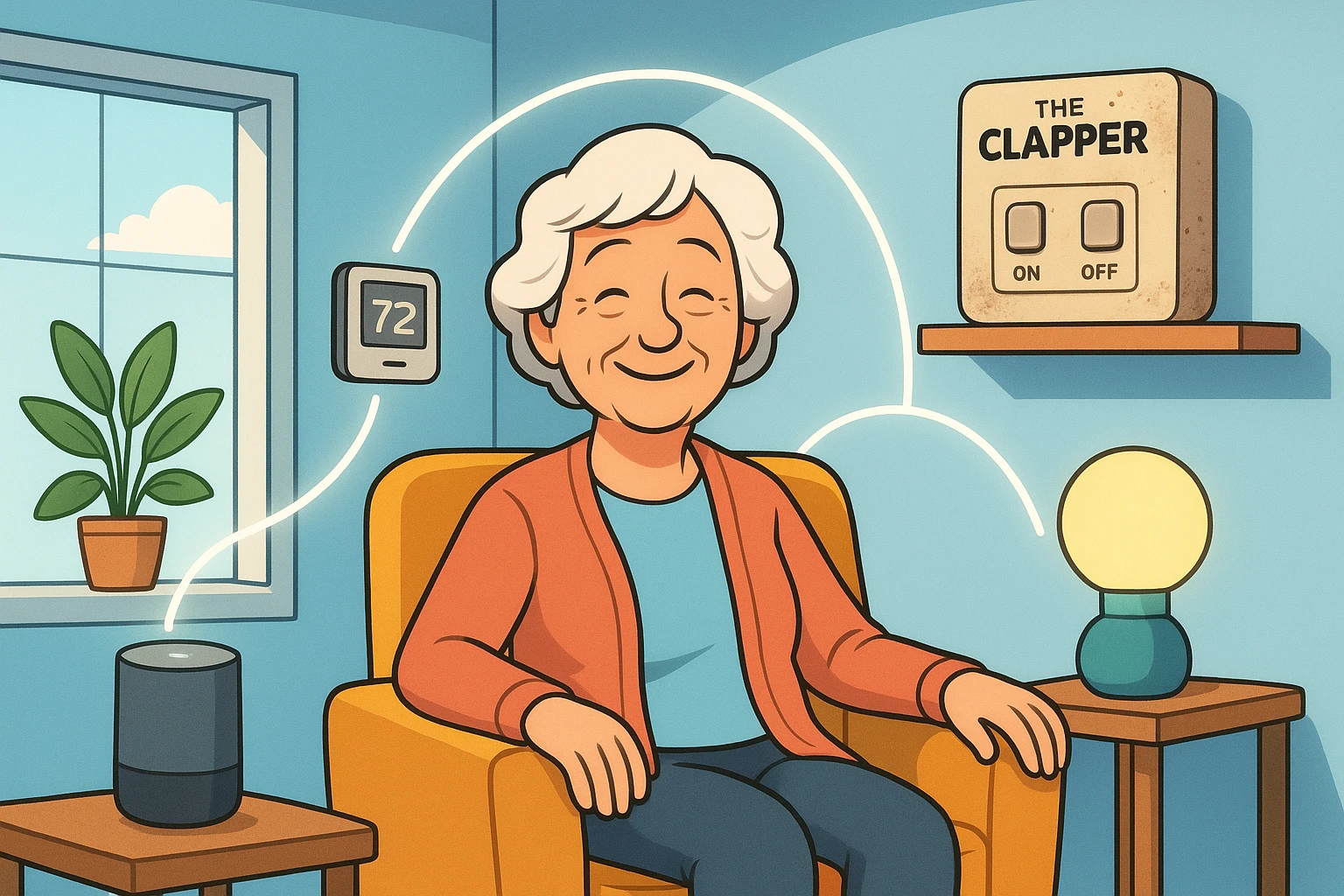
Remember the good old days when the absolute peak of home automation was “The Clapper”? You would clap your hands twice, the living room lamp would turn on, and for a brief, shining moment, you would feel like an all-powerful wizard.
Fast forward to today, and we have refrigerators that can text you when you’re low on milk. We have doorbells that stream video to your phone. We even have vacuums that drive themselves around the house, occasionally terrorizing the family dog.
It’s all wonderful, but let’s be honest: it can also be incredibly overwhelming. You don’t want to feel like you need an advanced degree in computer science just to turn up the thermostat. You just want a home that keeps you safe, comfortable, and independent for as long as possible.
If you are currently staring down the barrel of the smart home market and wondering how to piece together a system that actually makes sense, you are in the right place. Let’s cut through the tech-bro jargon and look at how a smart home ecosystem can be the ultimate tool for future-proofing your independence.
Let’s talk about the elephant in the room: living alone as we get older isn’t always a walk in the park. Sometimes, it’s a precarious walk to the bathroom at 2:00 AM in the pitch dark.
Beyond the physical risks, there’s also the emotional toll. According to recent studies from Duke-NUS Medical School, approximately 34% of seniors report feeling lonely. When you live alone, the silence can sometimes get a little too loud.
This is exactly where technology steps in. We aren’t talking about replacing human connection with robots. We are talking about building a digital safety net that bridges the gap, keeps you connected to your family, and acts as an invisible caregiver that never sleeps (and never criticizes your television choices).
You might hear tech experts throwing around the term “IoT” or “Internet of Things.” It sounds like a bad sci-fi movie, but it simply means everyday objects that connect to the internet to share information.
A smart home ecosystem is when these gadgets actually talk to each other. Instead of having one app for your lights, one for your locks, and one for your thermostat, an ecosystem ties them all together under one boss.
Think of it like an orchestra. A smart bulb is just a guy playing the triangle. But a smart home ecosystem is the conductor, ensuring the triangle, the violins, and the cellos all play a beautiful symphony together.
If there’s one thing that keeps seniors (and their adult children) up at night, it’s the fear of a fall. The good news is that smart home technology has evolved far beyond those old “I’ve fallen and I can’t get up” buttons that you had to remember to wear.
Today, we have discreet motion sensors that can be placed along baseboards. According to research published in PubMed Central, integrating these smart motion sensors is directly linked to a reduced incidence of falls and a much quicker emergency response time.
Imagine waking up in the middle of the night. As soon as your feet hit the floor, the sensors detect your movement and automatically turn on a soft, dimly lit pathway straight to the bathroom. No fumbling for switches, no tripping over the cat. It’s just seamless, invisible protection.
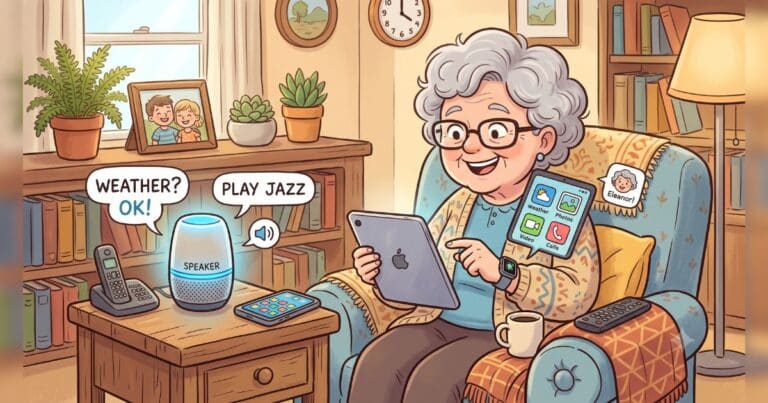
Let’s give a round of applause for voice-activated assistants like Amazon Alexa and Google Assistant. Currently, these are among the most adopted smart home aides for seniors, and for good reason.
Voice control is the ultimate accessibility tool. You don’t have to fiddle with tiny buttons on a smartphone screen or navigate confusing menus. You simply use your voice.
You can say, “Turn off the living room lights,” “Remind me to take my medication at 10 AM,” or “Call my daughter.” It’s like having a highly efficient butler who is always listening, never complains about the hours, and doesn’t roll their eyes when you ask what the weather is for the fourth time today.
A smart home isn’t just about safety; it’s also about convenience and cost savings. Smart thermostats and smart plugs are brilliant little devices that learn your habits and adjust accordingly.
A smart thermostat knows when you’ve gone to bed and can lower the temperature automatically. It knows when you are out of the house and stops wasting money heating an empty living room.
Smart plugs can turn any “dumb” appliance into a smart one. Worried you left the coffee pot on? You can check your phone and turn the plug off from the grocery store. It saves energy, saves money, and most importantly, saves your sanity.
This is where things get really fascinating. The best smart ecosystems use artificial intelligence (AI) to learn your unique routines and adapt to your preferences.
If you always turn the heat up to 72 degrees and turn on the news at 7:00 AM, the house will eventually just start doing it for you. It’s personalized automation tailored exactly to your life.
This kind of predictive technology is a game-changer. It means your home isn’t just reacting to your commands; it’s anticipating your needs. This creates an environment where aging in place feels natural, supportive, and effortless.
Now, let’s talk about the dark side of the moon: privacy. We at Senior Tech Cafe don’t blindly cheerlead for Big Tech. Inviting internet-connected cameras and microphones into your house requires a healthy dose of caution.
How do you know these devices aren’t selling your data or vulnerable to hackers? This is a massive evaluation hurdle for many seniors.
To see how this should be handled, we can look globally to places like Singapore, which is setting the gold standard. Their Cyber Security Agency developed a brilliant “Cybersecurity Labelling Scheme” that rates smart devices on their security hygiene, making it incredibly easy for consumers to know what’s safe to buy.
When you build your ecosystem, stick to major, reputable brands that offer two-factor authentication (2FA) and clear privacy policies. Turn off data-sharing features in the settings, and remember: you are in control. If a device asks to share your data with “third-party partners,” politely decline.
If you need reassurance that this technology is legitimate and not just a passing fad, look at how major health and housing organizations are adopting it.
Returning to our Singapore example, their government’s Ministry of Health (MOH) and the HDB Smart Enabled Home initiative are actively baking this technology right into senior housing. They aren’t just testing it; they are relying on it to transform senior care.
When international health ministries and housing boards endorse smart ecosystems to boost senior adoption confidence, it’s a clear signal. This isn’t just a gimmick to play music; it is a vital healthcare and independence tool.
So, how do you choose? If you’re comparing options, it helps to categorize them into three levels based on your needs, technical comfort, and budget.
1. The Basic Setup (The Toe-Dipper)
2. The Integrated System (The Sweet Spot)
3. The Premium Ecosystem (The Full Sci-Fi)
Ready to take the plunge? Here is your plain-English battle plan.
Step 1: Check your Wi-Fi. Smart devices are like teenagers; they are completely useless without a strong internet connection. Make sure your home router is up to date and reaches the rooms where you plan to put devices.
Step 2: Pick one “Brain.” Do not buy an Alexa speaker, an Apple TV, and a Google Nest thermostat. They do not like to talk to each other. Pick one ecosystem (Amazon, Google, or Apple) and make sure everything you buy says “Works with [Your Chosen Brain]” on the box.
Step 3: Call for backup. There is zero shame in asking a tech-savvy grandkid, a neighbor, or a professional service like Best Buy’s Geek Squad to help with the initial setup. Once it is set up, it’s yours to easily command.
Most smart locks have standard keyholes as backups, and devices will simply revert to being “dumb” until the power returns. You won’t be trapped in your house, we promise.
Only if you let them. You control the permissions. You can give a trusted caregiver access to motion sensor data (so they know you’re up and moving) without giving them access to indoor cameras.
Smart speakers listen for a “wake word” (like “Alexa” or “Hey Google”). They are not constantly recording everything you say, despite the rumors. However, you can and should go into the app settings and turn off the option that allows the company to “review audio for quality improvement.”
Future-proofing your independence doesn’t mean transforming your living room into the bridge of the Starship Enterprise overnight. It means taking small, strategic steps to make your environment safer and more forgiving.
Start small. Buy a single voice assistant and a couple of smart lightbulbs. Get used to the feeling of asking the room to turn the lights off for you. Once you realize how much easier it makes your evening routine, you might just find yourself ready to add a smart lock or a thermostat to the mix.
Technology should serve you, not intimidate you. By choosing the right smart home ecosystem, you get to stay the master of your domain—while letting the house do a little bit of the heavy lifting.