
Newsletter Subscribe
Enter your email address below and subscribe to our newsletter


By Chris Clark, founder of Senior Tech Cafe
AI voice scams use artificial intelligence to copy someone’s voice from a short recording, then call you pretending to be that person, usually a grandchild or other relative who needs money right now.
The phone rings, and it’s your grandson, Timmy. At least, it sounds exactly like Timmy, except he sounds like he’s calling from inside a wind tunnel during a national kazoo convention. And he’s in trouble. Big trouble.
“Grandma? I’m in jail in Tijuana,” he whispers. “I got into a little fender bender, and I need you to wire $2,000 for bail. Please don’t tell Mom and Dad, they’ll kill me!”
Your heart plummets to your sensible shoes. Your sweet Timmy, who can’t even parallel park in your driveway, is now an international fugitive. Before you can ask what he was doing in Tijuana when he’s supposed to be in sophomore biology in Ohio, he’s already giving you wiring instructions.
Hold the phone. Literally. Before you raid the emergency fund you’ve been saving for a new set of patio furniture, know this: that might not have been Timmy. It’s the old grandparent scam, supercharged for the 21st century.
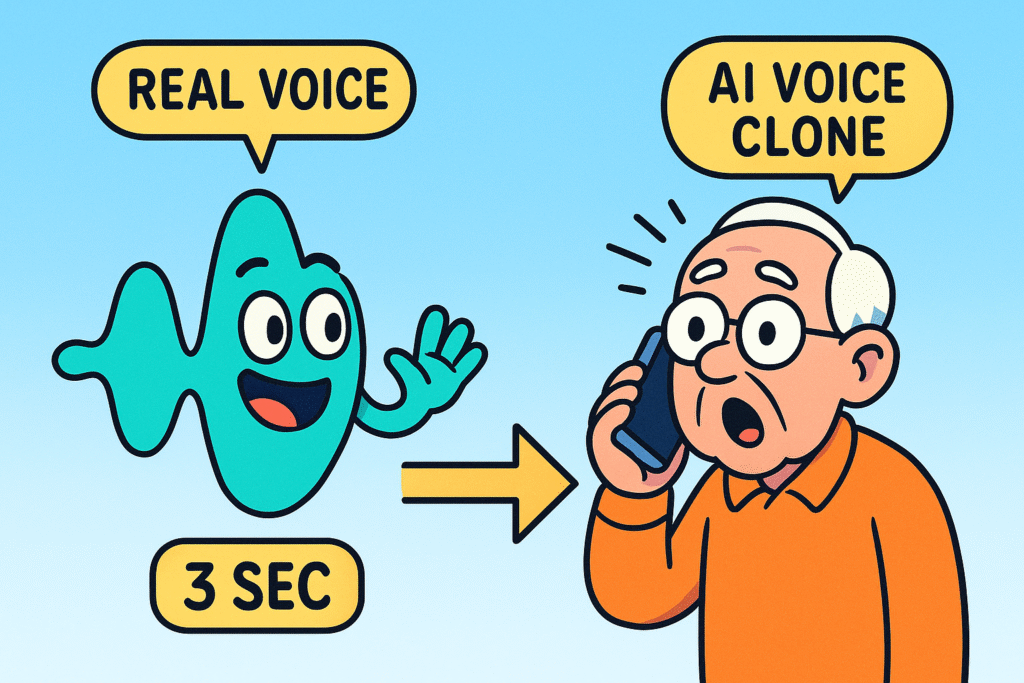
A voice cloning scam turns a few seconds of someone’s real voice into a fake that can say anything. It used to be that you could trust your own ears. Now a scammer doesn’t need to be a master of disguise. They just need a computer and a snippet of audio.
Think of a super-smart parrot that can mimic not just a few words, but someone’s entire way of speaking: their pitch, their accent, even the little sigh they do when they’re annoyed. That’s what AI can do now.
Scammers take a short sample of a person’s voice, often from a social media video or a public post, and use it to create a convincing fake. A few seconds of clear audio can be enough. That’s shorter than it takes to decide which channel to watch.
Voice clones are the audio cousin of the deepfake, and they’ve made the classic grandparent scam far more convincing. They turn up in robocalls too. Since 2024 the FCC has treated AI-cloned voices in robocalls as illegal without your consent, which bothers scammers not one bit.
The Myth: “Oh, I’d know right away if it was a robot. It would sound all choppy and fake, like those automated calls that try to sell you a car warranty.”
The Reality: While some cheap AI fakes might sound a bit off, the sophisticated ones are shockingly realistic. They can cry, sound panicked, and express emotion.
Believing you can spot a fake just by listening is like thinking you can outrun a cheetah because you jog on weekends. It gives you a false sense of security, which is exactly what scammers want.
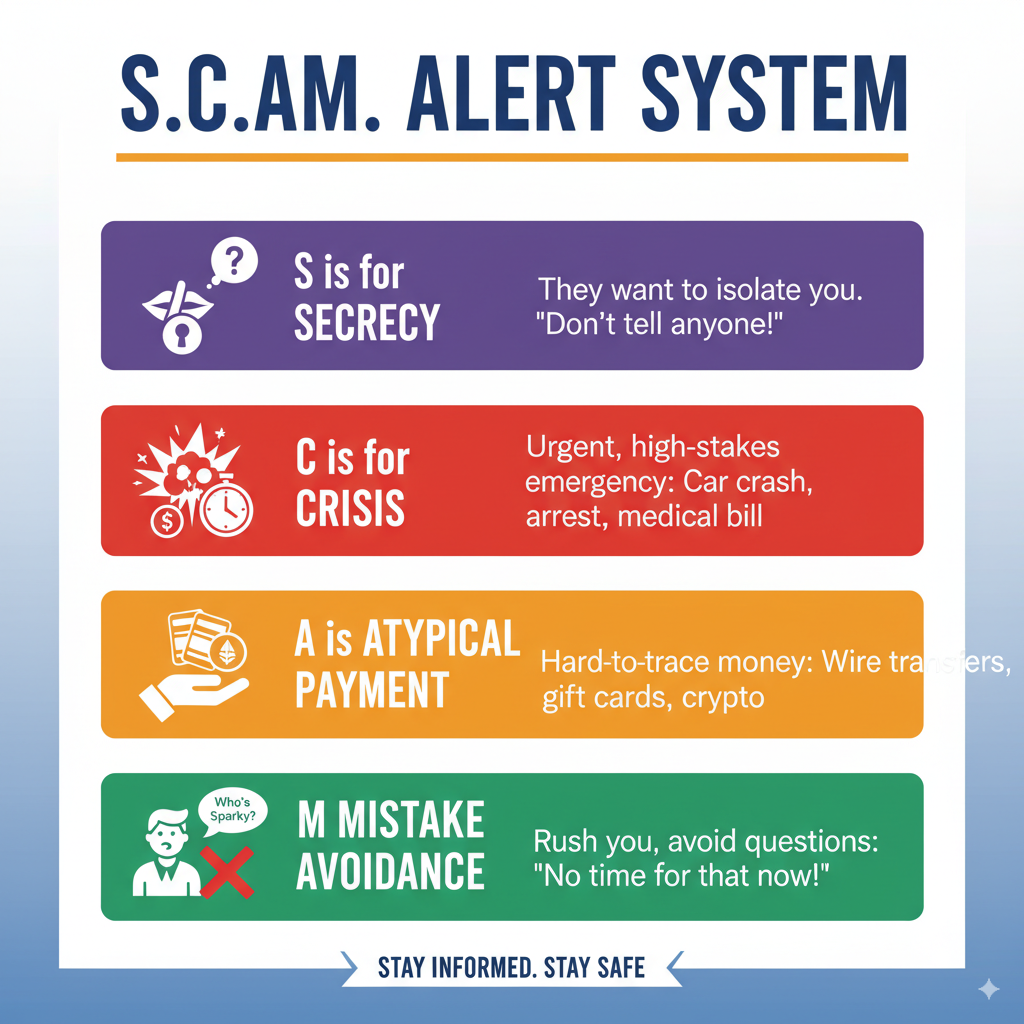
You spot AI voice scams by the script, not the voice. If a caller who sounds like family is in a sudden crisis, wants money in a hard-to-trace way, begs you to keep it secret and won’t answer simple personal questions, it’s a scam until you’ve confirmed otherwise by calling them back yourself.
Since your ears can be fooled, rely on your brain. Scammers follow a predictable script designed to short-circuit your logic and trigger your emotions. Recognize the script and don’t play along. Think of it as your personal S.C.A.M. Alert System:
When you spot these signs, use your secret weapon: the Active Pause. Before you do anything, stop and take a slow breath. That small pause gives your calm, logical brain time to catch up with your racing heart.
Once you’ve taken your Active Pause, it’s time to verify. This isn’t rude; it’s smart.
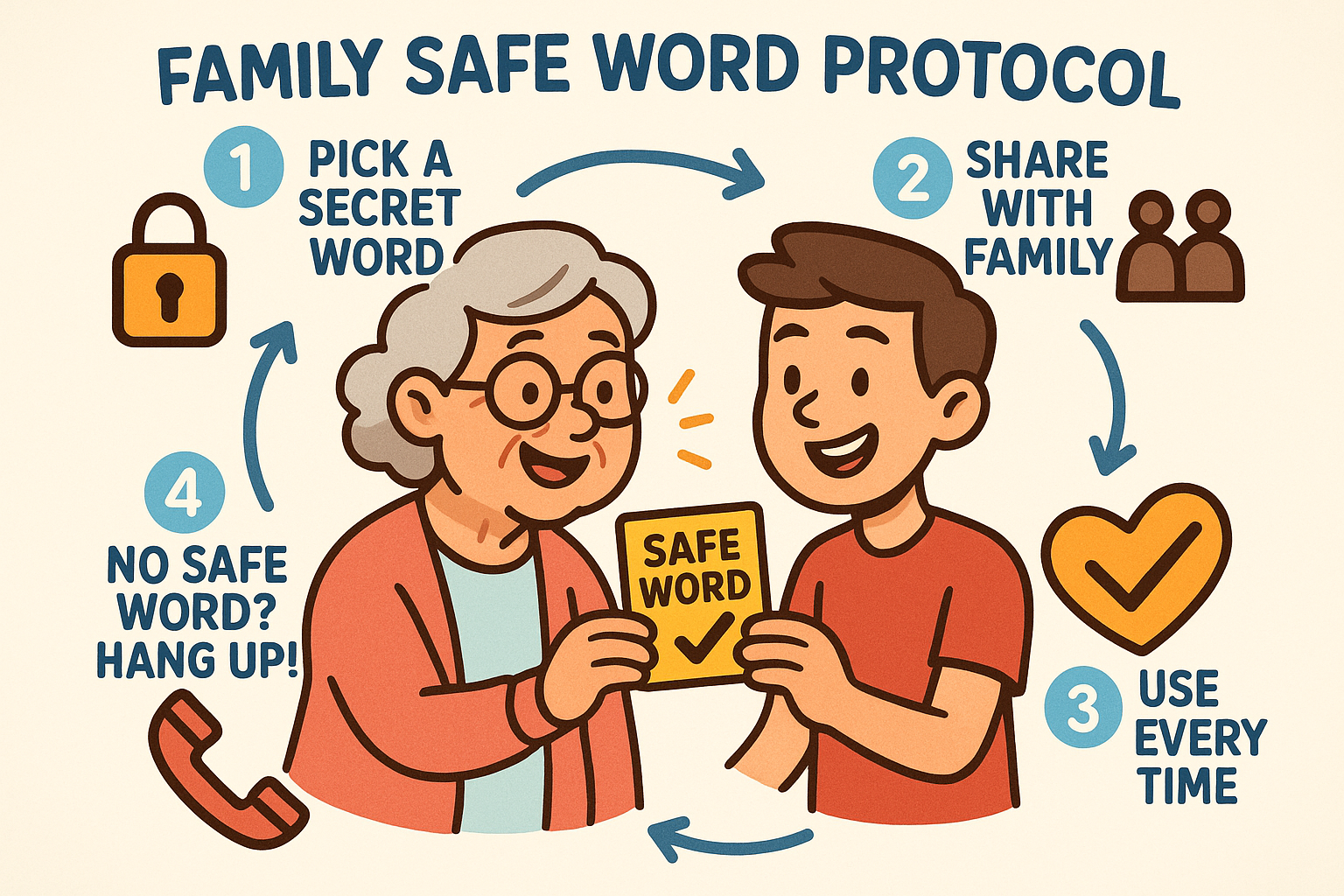
The best defense is a good offense. Instead of just reacting to scams, you can build a fortress of security around your family with one simple, powerful tool.
This is easier than programming a VCR and a hundred times more useful. A safe word is a secret word or phrase that only your immediate family knows. The FBI recommends exactly this defense against voice cloning.
Make it something a scammer could never guess. Not “password.” Not “1234.” Think of an inside joke or a funny memory. Maybe it’s “Waffles,” the name of the hamster you had in 1978. Or “Leaky Faucet,” in honor of that one disastrous family vacation.
Here’s how to use it:
If the person on the other end doesn’t know the word, gets confused or tries to brush it off, you know it’s a scam. Hang up.
It’s also wise to be mindful of your family’s digital voice. Scammers often find voice clips on public social media profiles, so encouraging everyone to set their accounts to private is a great step. Our online safety guide for seniors covers the rest.
The one ring scam doesn’t need AI at all, just your curiosity. Your phone rings once, then stops. No message. Just a missed call from a number you don’t recognize. It’s also called the wangiri scam, from a Japanese phrase meaning “one ring and cut,” because that’s where it first took off.
Your curiosity is piqued. What if it was the doctor’s office? Your grandchild’s school? Ed McMahon rising from the grave to finally deliver that sweepstakes check?
That’s the trap. Scammers use auto-dialers to ring thousands of phones once each, like a digital game of ding-dong ditch. When you call back, you’re connected to an international number that charges a per-minute fee on top of international rates. Some play hold music or a recording to keep you on the line while the meter runs.
The golden rule: don’t call back. Treat an unknown number like that mysterious container in the back of the fridge, and leave it alone. If it matters, they’ll leave a message.
Your phone can help. On an iPhone, open Settings, tap Apps, then Phone, and under Screen Unknown Callers choose Silence to send unknown numbers straight to voicemail. On an Android phone with Google’s Phone app, tap the three dots, then Settings, then Caller ID & spam (called Spam and Call Screen on some phones) and turn on spam filtering. Menu names vary by phone and software version, and here’s our full guide to silencing unknown callers.
If you already called back, check your next phone bill line by line. If you see charges you don’t recognize, ask your carrier to remove them. If that doesn’t work, file complaints with the FTC and the FCC.
AI voice scams use artificial intelligence to copy a real person’s voice from a short recording, then call you pretending to be that person, usually a grandchild or other relative in trouble. The caller asks for money fast, often by wire transfer, gift card or cryptocurrency, and begs you to keep it secret. Hang up and call back.
Anywhere it’s public: a video on Facebook, a story on Instagram, a clip on TikTok, even a voicemail greeting. Many people share moments of their lives online, and a few seconds of clear audio can be enough for a scammer to clone a voice. Setting accounts to private makes that harder.
A wangiri scam is a phone scam where your phone rings once and stops, hoping you’ll call back. The name is Japanese for “one ring and cut.” Calling back connects you to an expensive international number that charges per minute on top of international rates. Don’t return one-ring calls from numbers you don’t recognize.
You may be charged for an international call plus a per-minute fee, and the scammer may keep you on hold to run up the bill. Check your next phone bill line by line. If you see charges you don’t recognize, ask your carrier to remove them, then report it to the FTC and FCC.
Don’t panic, and don’t send money. Try their parents, another relative or a close family friend, then wait a few minutes and try again. A real emergency will still be an emergency in 15 minutes. A scammer’s urgency tends to fade the moment you hang up and start checking.
Technology changes fast, but the fundamentals of staying safe don’t. These scams are built to make you feel panicked, isolated and helpless. Don’t let them. Remember three things:
Share this with your friends and family. And if a scam ever does slip through and someone gets into an account, here’s how to recover a hacked account and lock things back down.
The next time you get a frantic call from “Timmy,” you’ll be ready. And you can save that emergency fund for what really matters: a beautiful new set of patio furniture.