Newsletter Subscribe
Enter your email address below and subscribe to our newsletter


Technology tips for seniors can reduce unwanted calls without making everyday communication harder. Think of your phone number the way you think of your home address.
Keep your main number for family, close friends, health care, banks, and account recovery.
For shopping quotes, marketplace listings, dating, travel reservations, contests, and other short-term contacts, consider a secondary number or a service that masks the real one.
No option makes you anonymous. But separating high-trust and low-trust contacts limits how widely your main number spreads.
Most of us have carried the same ten digits for decades. That number has been written on raffle tickets, warranty cards, pizza orders, and one regrettable timeshare presentation.
Nobody is asking you to give it up. The idea is to decide on purpose who gets it from here.
Your number spreads through more doors than you would guess:
You cannot un-ring that bell for the number you already have. You can absolutely decide where it goes next.
Start with the free features your phone and carrier already offer: silence unknown callers, label suspected spam, block repeat offenders, and remove the number from public social profiles.

Number-masking features inside ride-share, delivery, and marketplace apps are the next choice, because they keep the conversation inside the service.
A secondary-number app can help when a separate number is genuinely useful.
Before you subscribe, compare monthly cost, call and text support, voicemail, number expiration, account security, data collection, cancellation rules, and whether the service works for the person you actually need to reach.

You reach for the lowest shelf first, every time. The free shelf is already in your pocket and solves more than most people expect.
The middle shelf is the masking built into apps you already use. Uber, Lyft, DoorDash, and most marketplace apps route the driver or the buyer through a relay number, so the person on the other end never sees your real one.
The top shelf is a paid second number, and it is the only one with a monthly bill attached.
Whichever shelf you land on, review app permissions before you hand a new app anything. A privacy app that wants your entire address book has earned a raised eyebrow.
The cheapest privacy tool is usually the one already sitting in your Settings app.
A secondary number is useful for selling an item, requesting insurance or home-service quotes, trying a dating service, making temporary travel arrangements, or joining a group that does not need permanent access to your main number.
It is not the best choice for a bank, primary email account, Social Security account, medical portal, or any service that may need long-term recovery access.
Those accounts have to reach you years from now. Some organizations reject virtual numbers for verification, so keep your main number current on critical accounts and review recovery information whenever your carrier or number changes.
Here is the test worth applying. Ask whether you would mind if this number stopped working eighteen months from now.
Selling a treadmill? You will not care one bit. Locked out of your bank because the verification code went to a number you canceled two years ago? You will care enormously.
That second scenario ruins entire afternoons. If it has already happened to you, here is how to recover an account without an old phone number.
That last part matters. Updating a recovery number is easy today and nearly impossible after the number is gone.
Do not assume a secondary or temporary number can call 911, receive every short code, or remain assigned forever.
Emergency capability varies by service, so use your regular mobile or landline connection for emergency calls unless the provider explicitly documents 911 support.
Numbers may be recycled after cancellation, which can expose future messages if an account still uses the old number.
The service provider can still hold account and usage data, and the other person may identify you from voicemail, message content, or linked profiles.
A second number reduces exposure. It is a curtain, not a disguise.
Short codes are those five- and six-digit numbers your bank and pharmacy text you from. Plenty of them refuse to deliver to app-based numbers, so the code you are sitting there waiting for simply never arrives.
The 911 limitation is the one to take seriously. The FCC guide to VoIP and 911 service explains why internet-based calling handles emergencies differently from your regular phone line.
Use it for privacy, then. Just do not ask it to be a witness protection program.
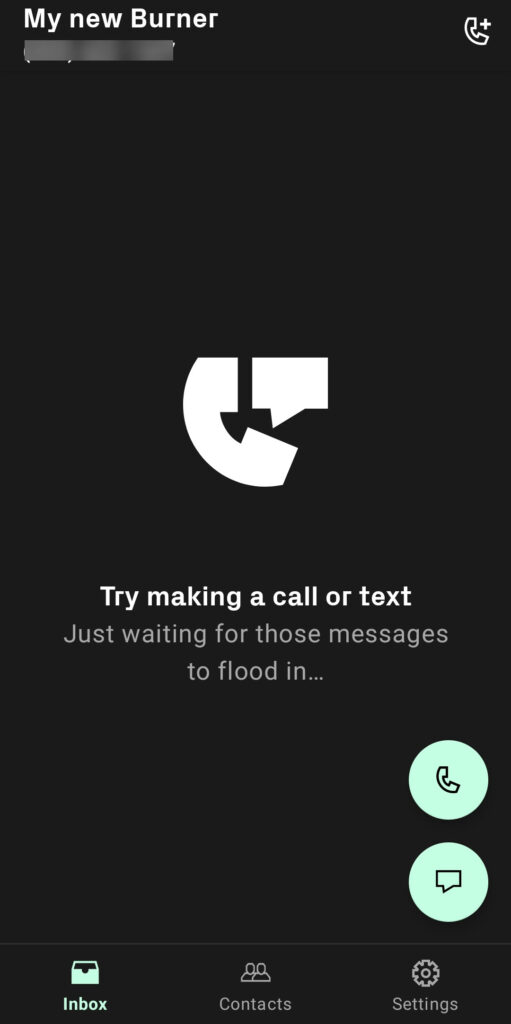
Seven steps. Do them in this order and you will not have to undo anything later.
None of that requires being good with computers. It just requires doing the steps in order.
Step 3 is the one scammers count on you skipping. Search results for popular apps are crowded with copycats, so go straight to the official store listing or type the provider’s web address yourself.
Step 5 saves the most grief. Send yourself a text and place one real call before that number goes on a Marketplace listing.
A number you never tested is a number that will fail you on a Saturday.
Use your phone’s built-in spam filtering, block repeated callers, and ask your carrier about network-level call labeling.
Register a personal number at https://www.donotcall.gov/ to reduce lawful telemarketing; the registry does not stop criminals who ignore the law.
Never press a key or call back just because a recording promises removal.
If a caller claims to represent a bank, government agency, or company, hang up and call through a number from a statement, card, or official website. Hanging up is always allowed.
Report persistent scam calls at https://reportfraud.ftc.gov/.
Pressing 9 to be removed from a list does one thing reliably. It confirms a real human answers at this number, which is worth actual money to the people calling you.
For the wider picture, our online safety and privacy guide for seniors covers the email and text versions of these same tricks.
You do not need a new phone, a new number, or a technical streak to make this work. You need one decision about who gets your main number, and a plan for everyone else.
Turn on the free spam controls this week. Register on the Do Not Call list while you are at it.
Then, if you sell things online, date, travel, or shop around for quotes, look at a secondary number with clear eyes about what it does and does not do.
Your phone number has followed you around for decades. It is allowed to be a little more private for the rest of them.
You are not being paranoid. You are being selective.
Service prices, trial periods, included numbers, app-store fees, spam controls, and privacy terms change.
Check the provider’s own pricing or help page before you sign up, then check it again before the first renewal.
A price you read in an article months ago is a starting point, not a promise.
If you cannot confirm the current terms on the provider’s official site, treat the service as an option worth a look rather than a settled choice, and do not assume a fixed price stays fixed.
Keep your main number for trusted people and critical accounts, remove it from public profiles, use your phone’s built-in spam controls, use in-app number masking when it is available, and consider a secondary number for lower-trust or temporary contacts. Every place you skip is one less list your number lands on.
Emergency calling varies by service and may be unavailable or limited. Use a regular mobile or landline connection for 911 unless the secondary-number provider explicitly documents emergency support. This is the one place where convenience should lose. Check the provider’s official help page before you rely on that number in an emergency.
Usually no. Banks, primary email, medical portals, and other critical accounts need a stable recovery number, and some services reject virtual numbers outright. Keep your recovery information current on those accounts. A temporary number that expires can shut you out of the exact account you most need to reach later.
The registry can reduce calls from lawful telemarketers, but criminals may ignore it. Keep using spam filtering, verify callers independently, block repeat numbers, and report fraud attempts. Think of it as a fence that keeps honest people off your lawn. The callers already breaking the law were never going to read the sign.