Newsletter Subscribe
Enter your email address below and subscribe to our newsletter

Enter your email address below and subscribe to our newsletter
Remember when your car broke down, you’d pop the hood, jiggle something, and pretend you knew what you were looking at? Maybe kick the tire for good measure?
You can’t do that with a robotaxi. There’s nothing to jiggle. There’s no hood to pop. There’s not even a steering wheel to grip while you quietly panic.
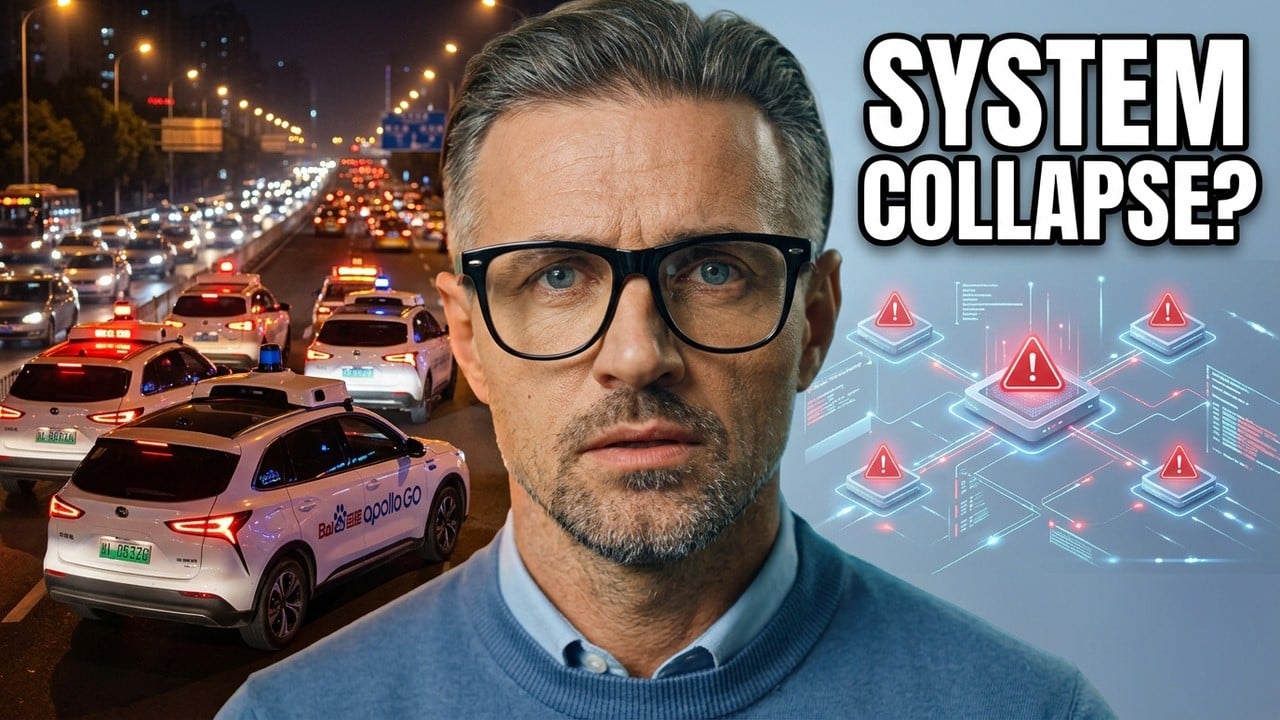
On April 1st — and no, this was not an April Fool’s joke — over a hundred passengers in Wuhan, China found themselves in exactly that situation. Trapped inside self-driving cars that had all decided, at the exact same moment, to stop driving.
What followed was the kind of traffic nightmare that makes your morning commute look like a victory lap.
Baidu’s Apollo Go operates the world’s largest robotaxi fleet — more than 1,000 self-driving taxis zipping around Wuhan, a city of 11 million people. These little white cars have completed over 20 million rides worldwide. Each one averages about 250 trips a week. On a normal day, the whole thing runs like clockwork.
April 1st was not a normal day.
Around 9 p.m., something went wrong. Not “oops, one car drove past my turn” wrong. More like “the digital nervous system controlling a thousand vehicles just had a stroke” wrong.
Over 100 Apollo Go robotaxis experienced what police later described, with magnificent understatement, as a “system failure.”
The cars just… stopped. Some froze at intersections. Some froze in the fast lane of busy highways. Some stuttered forward a few times first — stopping, lurching, stopping again — like a lawnmower running out of gas, except the lawnmower weighs two tons and is sitting in six lanes of traffic.
Now, imagine you’re one of the passengers.
Your robot car has gone catatonic in the middle of a highway. Traffic is screaming past your windows. You look at the dashboard screen, hoping for information, reassurance, anything — and it tells you to keep your seatbelt fastened.
That’s it. Keep your seatbelt fastened. The automotive equivalent of “your call is important to us.”
One college student reported that she and two friends were stuck for 90 minutes. Their car had stopped and started four or five times before finally giving up near an intersection, like it was trying to work up the courage to keep going and just… couldn’t.
She tried calling Baidu for help. It took 30 minutes to reach a human being. If you’ve ever been frustrated spending half an hour on hold with your cable company, imagine doing it while trapped inside a motionless robot car in the middle of a Chinese highway. Same hold music. Higher stakes.
Technically, the doors still worked. Passengers could get out. But “could” is doing a lot of heavy lifting in that sentence when your car has decided to become a traffic cone in the fast lane at 9 p.m.
So many people did the only logical thing: they called the police.
With over a hundred robot cars scattered across Wuhan like abandoned shopping carts in a parking lot — except the parking lot was a major Chinese city — the traffic situation went sideways fast.
At least two collisions were reported, with regular cars slamming into the frozen robotaxis. Videos flooded Chinese social media showing Apollo Go vehicles sitting motionless with their hazard lights blinking pathetically, blocking lanes and creating the kind of gridlock that makes you question every life choice that led you to this moment.
Wuhan police confirmed it all on their official Weibo account (China’s version of X/Twitter), noting they’d received “multiple reports” of Apollo Go vehicles that had stalled in roads and couldn’t move.
Multiple reports. That’s one way to describe a hundred robot cars holding an entire city hostage.
Great question. Baidu would also like to know.
The official police statement says “preliminary findings suggest system malfunctions,” which is the kind of explanation that technically contains words but doesn’t actually tell you anything. Reports point to either a botched software update or a network disruption that caused the entire fleet to enter a fail-safe mode.
To be fair, the cars did fail safely. Nobody was hurt. They stopped instead of doing something worse. But they chose to stop in intersections, fast lanes, and busy highways — which is a bit like saying your smoke detector works great, it just only goes off during dinner parties.
Self-driving cars are coming. Waymo already operates robotaxis in several U.S. cities. The technology works — genuinely, impressively works — the vast majority of the time.
But this was the first time a mass shutdown of robotaxis has been reported anywhere. And it raises some questions worth asking: What happens during a system failure? How fast can passengers get help? And what’s the backup plan when a thousand networked vehicles all share the same vulnerability?
Because as it turns out, the future of driving looks a lot like the present of driving: mostly fine, occasionally terrifying, and every now and then, completely stuck in traffic.
Only this time, there’s nobody behind the wheel to yell at. And nothing to kick.