Newsletter Subscribe
Enter your email address below and subscribe to our newsletter


By Chris Clark, founder of Senior Tech Cafe
Safe online shopping for seniors starts before anything goes in the cart. Three things settle most of it.
Confirm you actually reached the real seller. Read the return policy. And pay with something that lets you dispute the charge.
The first one matters more than people think. Type a familiar store’s address yourself rather than following an unexpected email, text, social post or sponsored ad. Ads get bought by anybody.

And if the seller, the price or the checkout request gives you pause, close the page and buy it somewhere else.
Walking away costs nothing.
Twelve checks, and they get faster with practice.
Type the store address yourself. Inspect the domain for misspellings. Confirm the seller has contact details that actually work.
Read the shipping and return terms before you buy, not after. Compare the price against established retailers. Look for reviews somewhere the seller doesn’t control.
Don’t buy on public Wi-Fi. Use a unique password for the account. Turn on two-factor authentication.
Pay by credit card or a protected wallet. Refuse any demand for gift cards, a wire, or cryptocurrency. And save the receipt.
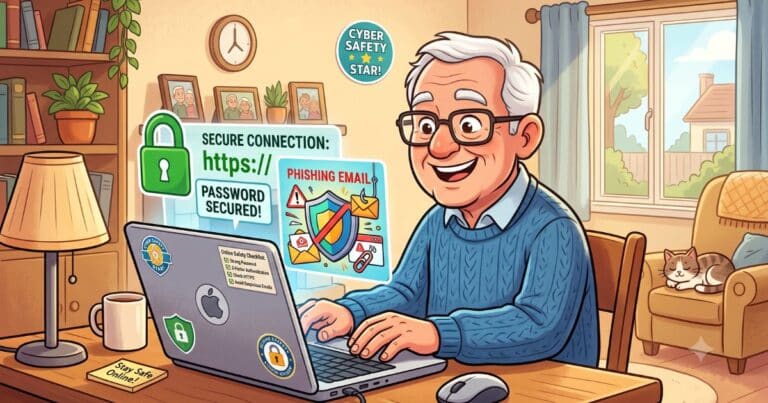
One note on the padlock, because it confuses everybody. HTTPS is real encryption and it’s worth having. It says nothing at all about whether the seller is honest. Plenty of fake stores have one.
Start with the exact web address, not the page design. It’s the one thing you can check in about four seconds.
Our guide on how to check whether a website is legitimate covers this in more depth.
Scammers copy logos and product photos in minutes. A pretty storefront is the easiest part to fake. What they can’t easily fake is a domain spelled correctly that’s been around for years.
Then search the store name alongside “scam,” “complaint,” and “return policy,” and read whatever comes back from anywhere other than the seller’s own site.
Check that the listed phone number, email and physical address actually work. Call the number. It takes a minute.
Good signs: a clear refund policy and a price that makes sense.
Bad signs: missing contact details, text copied from somewhere else, a countdown clock, and every single item being deeply discounted. Nobody runs a real business that way.
AI can produce polished product photos, persuasive descriptions, friendly customer-service replies and a batch of convincing reviews, all in minutes.
Our guide on how AI creates fake stores and reviews goes deeper on what to look for.
So treat a professional appearance as presentation, not proof.
Look at the things that are harder to manufacture. Does the review language repeat itself? Do the reviewer histories look like real people buying varied things? Do the product photos turn up on unrelated sites? Does the business have any history beyond a few weeks of ads?
And don’t let a countdown clock or an AI-selected deal hurry you past the seller and payment checks.
Hurry is what they’re selling. The product is incidental.

A credit card gives you the strongest practical route to dispute an unauthorized or undelivered purchase. That’s the main reason to prefer one.
PayPal, Apple Pay and Google Pay can also limit how much card information the seller ever sees. Read each one’s buyer-protection terms before relying on it, because they differ.
A debit card is weaker here, because a loss hits money already sitting in your bank account rather than a credit line.
And never pay an unfamiliar seller by gift card, wire transfer, cryptocurrency or a personal payment-app transfer.
Those are cash. Cash doesn’t come back.
Start with the money, then work outward.
Contact your card issuer or payment provider using the number in their official app, on your statement, or on the back of the card. Ask about stopping or disputing the transaction.
Change the shopping-account password, and change it anywhere else you used the same one.
Keep the screenshots and receipts, and watch that account for further charges over the next few weeks.
Report the seller at ReportFraud.ftc.gov, and at IC3.gov if it was internet-enabled financial crime.
If personal information was exposed, place fraud alerts or credit freezes through the official credit-bureau sites.
And you’re not the first person this has happened to. Not remotely.
For the wider picture, our online safety for seniors guide covers the habits that stop scams before they start.
No. HTTPS encrypts the connection between your browser and the site, and scammers can obtain certificates just as easily as anyone else. The padlock means the envelope is sealed, not that the sender is honest. Check the domain, the seller’s history, contact details and return terms before entering a card number.
A credit card, in most cases, because it gives you a practical dispute process for unauthorized or undelivered purchases. Protected digital wallets also limit what card details a seller ever sees. Avoid gift cards, wires and cryptocurrency with unfamiliar sellers. If a seller insists on one of those, that insistence is your answer.
Contact your card issuer or payment provider on an official number and ask about stopping or disputing the payment. Then save your evidence, secure the affected accounts, and report the fraud. Do it in that order, and do it before you’ve got every detail straight. Acting quickly matters more than being thorough.