Newsletter Subscribe
Enter your email address below and subscribe to our newsletter

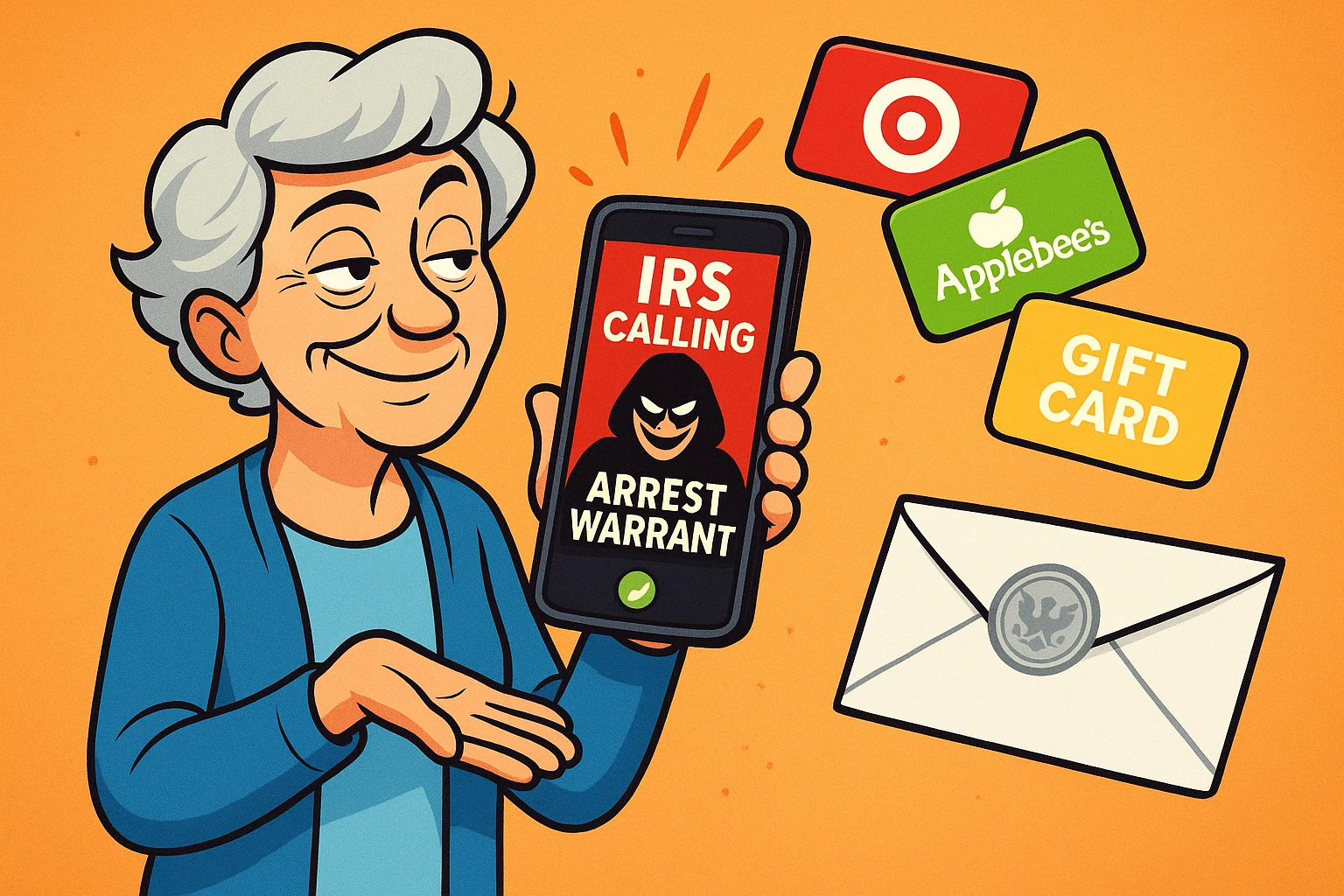
You’re sitting in your favorite chair, maybe watching Jeopardy, when the phone rings. The caller ID boldly announces: “Internal Revenue Service.”
You pick it up, and a robotic-sounding man named “Officer Steve” informs you that a warrant has been issued for your arrest. The only way to stay out of federal prison, Steve explains, is to immediately pay a fine using $5,000 worth of Target gift cards.
Suddenly, your heart rate rivals a teenager at a Taylor Swift concert. You start mentally packing for the slammer, wondering if neon orange will clash with your complexion and if they allow electric toothbrushes in the cell block.
Take a deep breath. Unpack your bags. The IRS does not want your gift cards, and Officer Steve is actually a scammer sitting in a boiler room halfway across the world.
Government impersonation scams are a billion-dollar industry, relying entirely on catching you off guard and sending you into a panic. The good news is that once you know their playbook, these scammers become about as threatening as a leaky garden hose.
Let’s look at exactly how to separate the real government notices from the outright frauds.
If you are on the phone with a “government official” right now and feeling completely overwhelmed, I want you to do one simple thing: Hang up.
You do not need to say goodbye. You do not need to politely decline. Your telephone is not a hostage situation, and slamming the receiver down (or furiously tapping the red button on your smartphone) is your absolute right. Scammers use fear to short-circuit your brain’s logical thinking.
Once you hang up, take a ten-second breather. A legitimate government agency will never demand immediate payment over the phone under the threat of police action. If it’s truly the IRS, Social Security Administration, or Medicare, they have plenty of bureaucratic, entirely un-scary ways to reach you.
When it comes to communication, Uncle Sam is delightfully old-school. He loves paper, he loves envelopes, and he loves keeping the U.S. Postal Service busy.
This brings us to the “Rule of One”: The government has one primary way to initiate contact with you, and that is through the mail. The IRS, Medicare, and the SSA will not send you an unsolicited text message with a link. They will not slide into your Facebook messages. And they certainly won’t call you out of the blue demanding your bank routing number.
If you owe money, there will be a paper trail. You will receive multiple letters in the mail long before anyone from the government ever picks up a telephone.
Okay, so what if you actually do receive a letter? Scammers have figured out how to buy stamps, too, so a piece of paper in your mailbox isn’t automatically gospel truth.
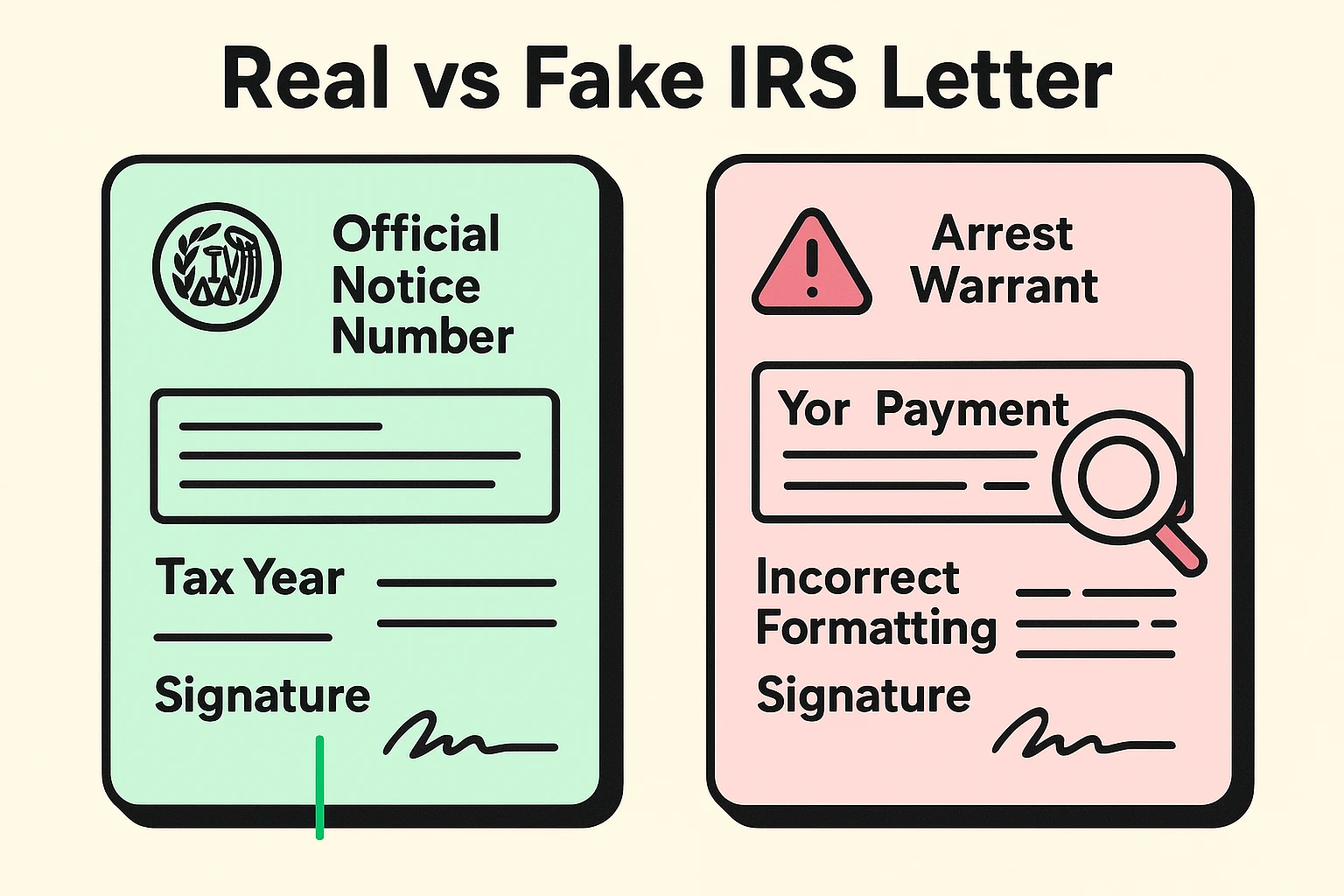
Real government letters are boring, professional, and highly coded. An official IRS notice will feature the Department of the Treasury seal and a specific “Notice Number” (like CP2000 or LTR 12C) usually printed in the top right or bottom corner. You can actually look these codes up on the official IRS website to see what they mean.
Fake letters, on the other hand, often look like they were typed by a caffeinated squirrel. They might have spelling errors, slightly off-center logos, or use giant red font that screams “URGENT,” making it look more like a flyer for a used car blowout sale than a federal document. If you’re still unsure, you can safely check their website to find official contact numbers—never use the phone number printed on a suspicious letter.
To make things even easier, here are a few words and phrases that legitimate government agencies will never use, but scammers love:
“But the caller ID literally said ‘Internal Revenue Service’!” This is the number one reason people fall for phone scams. Unfortunately, caller ID is about as trustworthy as a chocolate teapot.
Through a technology called “spoofing,” scammers can type absolutely anything they want into the caller ID screen. They can make the number look like it’s coming from Washington D.C., your local police department, or even your own neighborhood.
Think of caller ID like a novelty name tag. Just because someone slaps a sticker on their shirt that says “Batman” doesn’t mean they own the Batmobile. Never trust the screen. If you’re worried the call might be real, hang up, look up the agency’s official 1-800 number yourself, and call them directly.
There is one specific scenario that confuses even the most tech-savvy seniors, and we need to clear it up. Sometimes, the IRS does use private collection agencies to gather long-overdue taxes.
However, you can easily verify this using the “Two-Letter Rule.” Before a private debt collector ever contacts you, the IRS will send you a letter explicitly stating that your case has been assigned to a specific private agency. Then, the private agency will send you their own letter.
If a “debt collector” calls you out of the blue, and you never received that first warning letter directly from the IRS, it’s a scam. Hang up and enjoy the rest of your day.
Yes, absolutely! If you are ever in doubt, you can call the official IRS customer service line at 1-800-829-1040. You can also create a secure account on IRS.gov to view your tax records, balance, and official notices online without ever talking to a human.
Nope. This is a very common scam. Medicare is not currently issuing new plastic or “chip” cards. If someone calls asking for your current Medicare number to “issue your new card,” hang up. They are trying to steal your identity to bill the government for fake medical services.
First, take a breath. It happens to the best of us. Next, immediately contact the three major credit bureaus (Equifax, Experian, and TransUnion) and ask them to place a “fraud alert” or “credit freeze” on your file. Then, visit IdentityTheft.gov to report the theft and get a step-by-step recovery plan.
Scammers are starting to use Artificial Intelligence to clone the voices of government officials, or even your own grandchildren, making the scam sound incredibly realistic. The best defense? Establish a secret “safe word” with your family. If the person on the phone can’t provide the safe word, you’ll know it’s a robot in disguise.
Dealing with technology and scammers can sometimes feel like playing an endless game of digital whack-a-mole. But remember, your greatest weapon is time. Scammers want you to rush; legitimate agencies want you to read the fine print.
The next time you receive a threatening call or a suspicious letter, channel your inner detective. Look for the notice numbers, check for those silly red flag words, and always verify contact numbers independently. By slowing down and using these tools, you transform yourself from a potential victim into a scammer’s worst nightmare: an educated, unshakeable senior.