Newsletter Subscribe
Enter your email address below and subscribe to our newsletter


Imagine walking into a family wedding reception. The band strikes up your absolute favorite song, and your brain screams, “Let’s do the twist!” But your knees politely decline the invitation, suggesting a nice sit-down with some lukewarm ginger ale instead.
For decades, the backup plan for uncooperative legs has been the traditional metal walker. You know the one. It looks like a piece of leftover scaffolding, usually accessorized with neon green tennis balls on the back legs. It screams “medical patient” rather than “stylish senior ready to hit the dance floor.”
But the world of mobility aids has quietly undergone a massive technological revolution. We are officially entering the era of smart walkers, exoskeletons, and automated wheelchairs. These aren’t just rolling frames anymore; they are active, robotic dance partners designed to keep you independent, safe, and moving with confidence.
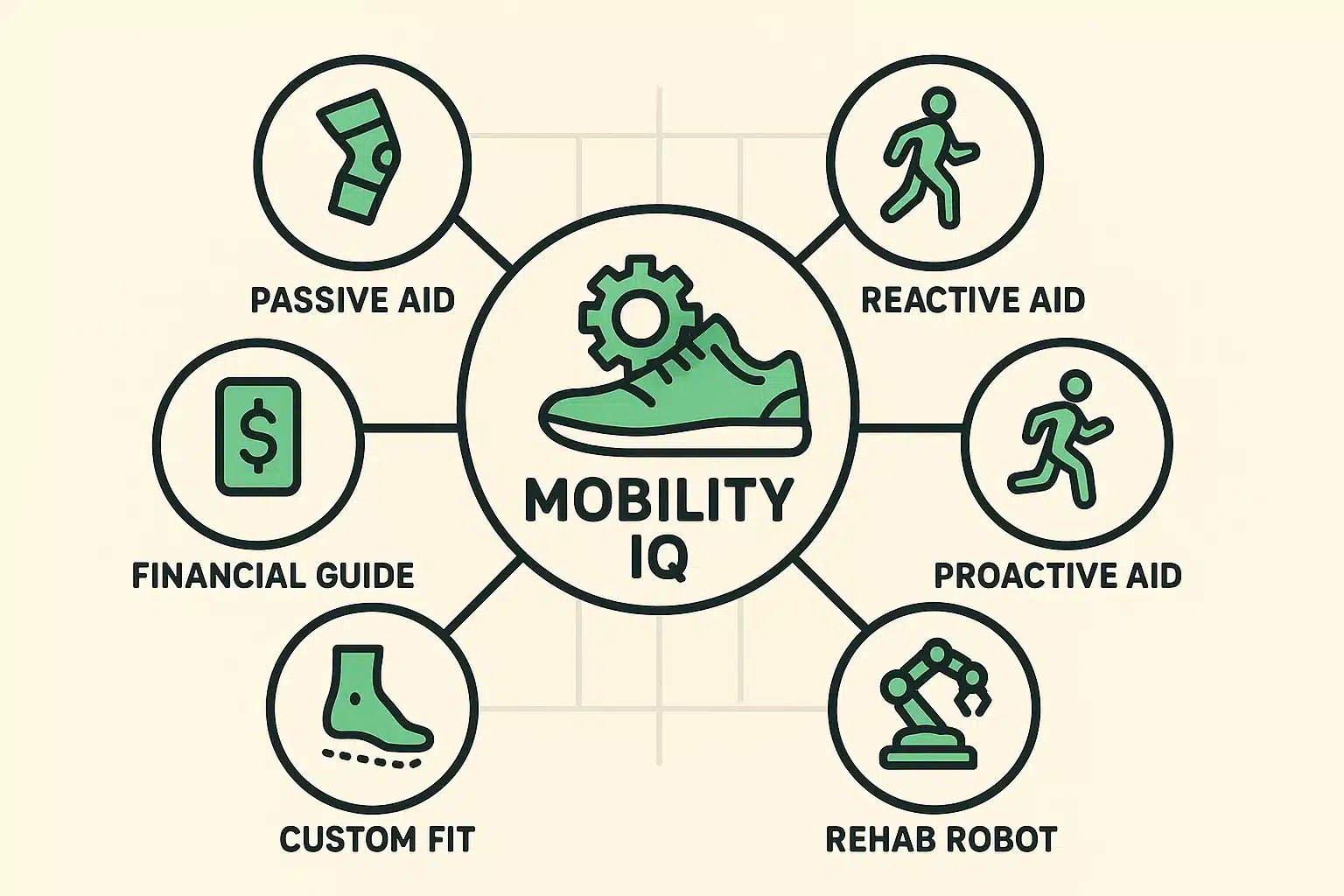
To understand this new world, we need to upgrade our “Mobility IQ.” It helps to look at mobility devices not by their price tags, but by their “Degree of Assistance.”
First, we have Passive devices. These are your standard canes and traditional custom-fitted walkers, like the Uniscan. They only move when you push them, much like a stubborn mule.
Next are the Reactive devices, which we call “The Ergonomic Specialists.” Devices like the Nuvio One fall into this category. They use brilliant structural engineering to react to your body weight, keeping you upright rather than hunched over.
Finally, we have the Proactive devices. These are “The Power Partners,” like the Camino smart walker, and “The Rehab Robots,” like MileBot. These high-tech marvels actually anticipate your movements, provide motorized boosts, and actively prevent you from taking a tumble.
If you’ve ever felt like your current walker has a mind of its own (usually when it’s veering into a rosebush), you’ll appreciate a walker that actually has a brain.

Smart walkers rely on three main components to keep you moving smoothly. First are the Sensors. Instead of tennis balls, these walkers use Lidar (laser radar) and ultrasonic sensors. It’s the same technology self-driving cars use to avoid hitting fire hydrants.
Next is the AI, or Artificial Intelligence. This is the “brain” that analyzes your walking pattern in real-time. Finally, we have the Actuators, which are essentially tiny robotic muscles tucked inside the wheels to help push or pull as needed.
When these three work together, they create something engineers call “shared control.” Instead of feeling like you are dragging a heavy cart, it feels like holding hands with a supportive partner. The robot “feels” your weight distribution and reacts instantly, smoothing out your stroll.
Now, I know what you’re thinking. “If this thing has sensors, batteries, and robotic muscles, isn’t it going to weigh a ton?” You’re not wrong to ask.
Traditional walkers weigh around 5 to 10 pounds, while a robotic walker can weigh anywhere from 19 to 25 pounds. Lifting it into the trunk of a car will require a bit of elbow grease. However, actually walking with it is a completely different story.
This brings us to the magic of Auto-Boost. Because the wheels are motorized, the walker propels itself forward as you step, making it feel practically weightless. It takes the physical exhaustion out of walking up a steep driveway.
Even better is the Hill-Symmetry auto-braking feature. If you’ve ever gone down a hill with a standard rollator, you know the terrifying “runaway shopping cart” effect. Smart walkers automatically detect the incline and apply the brakes for you, ensuring you stroll down the hill instead of sprinting down it.
Let’s talk about the dreaded “walker stoop.” If you use a traditional folding walker, you might notice you spend a lot of time hunched forward, looking at the ground like you’re constantly searching for a dropped penny.
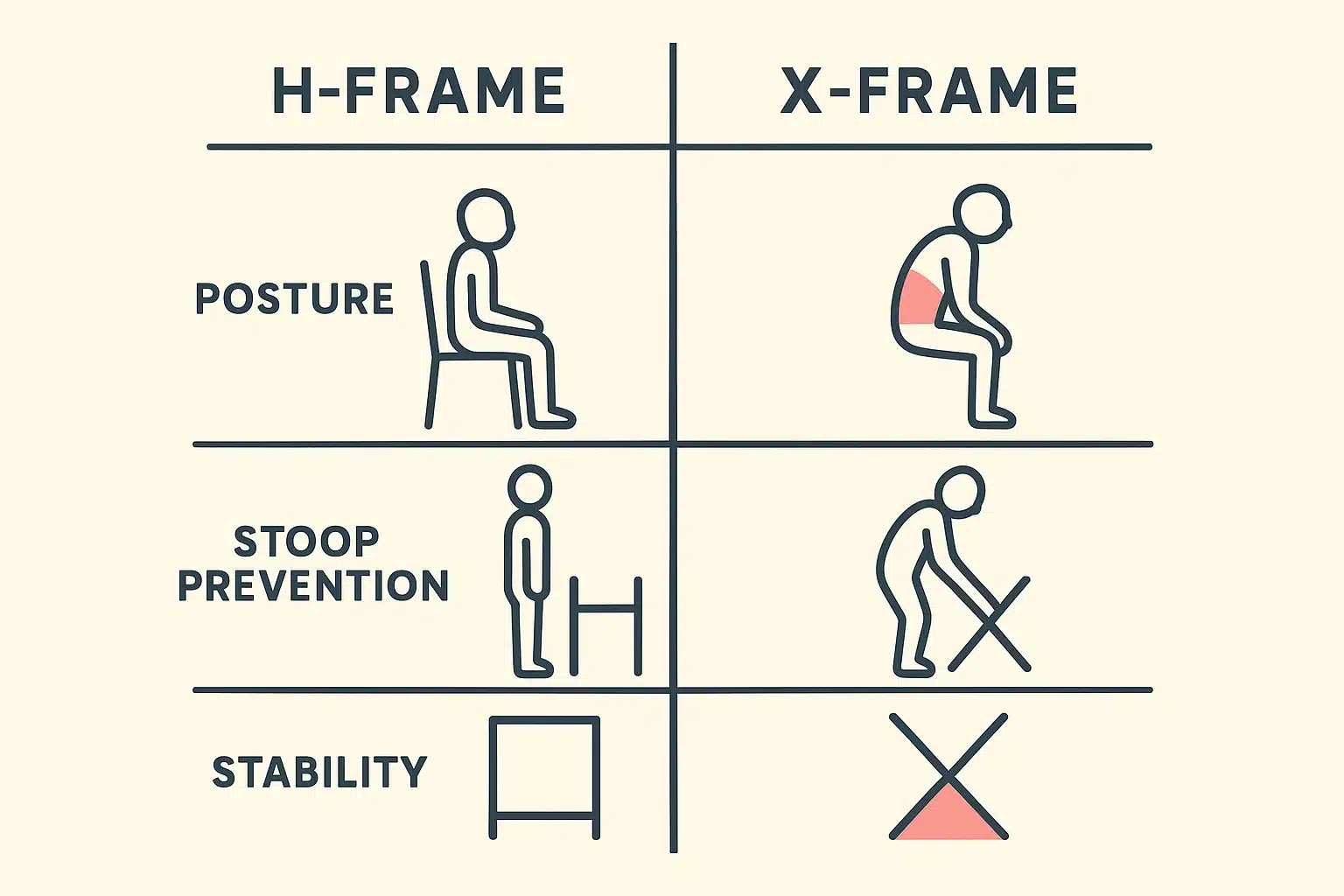
This is largely due to the classic “X-Frame” design of standard rollators. While they fold up nicely, they force you to stand slightly behind the device to avoid kicking the wheels. This ruins your posture and can cause serious lower back pain.
Enter the H-Frame design, seen on ergonomic specialists like the Nuvio One. This design removes the crossbar from the bottom, allowing you to step inside the frame rather than behind it. You can stand up straight, engage your core, and look at the beautiful scenery ahead of you instead of your shoelaces.
Your new smart walker isn’t just helping you move; it’s quietly taking notes. Brands like Camino feature companion apps that track over 22 different “gait metrics.”
While that sounds like something out of a sci-fi movie, it’s incredibly useful. The walker tracks your step symmetry, stride length, and walking cadence. Why does this matter? Because a sudden change in how you walk is often the very first early warning sign of a potential fall or a shift in your neurological health.
Of course, at Senior Tech Cafe, we always remind you to read the fine print! If your walker comes with an app, check the privacy settings. You want to make sure your walking data is going to your doctor or physical therapist, not being sold to advertisers who want to sell you orthotic shoes.
One of the biggest anxieties seniors have about advanced mobility aids is traveling with them. Can you take a lithium-ion-powered walker on an airplane?
The short answer is yes, but you need to be prepared. Because of the battery, these devices fall under specific FAA and TSA guidelines. You’ll generally need to remove the battery and carry it with you into the cabin. Always print out the manufacturer’s TSA compliance checklist before heading to the airport to avoid arguing with a security agent.
Then there is the financial elephant in the room. Smart walkers are an investment, often costing between $750 and $3,000. Fortunately, there are “Financial Roadmaps” available. Look into Medicare Step-down programs, and check if your auto manufacturer has a reimbursement program (like the Infiniti Mobility Assist program), which sometimes helps cover the cost of mobility aids if you buy a new car.
A standard walker has four legs with rubber tips (or tennis balls) and must be lifted slightly with each step. A rollator has wheels on all four legs, hand brakes, and often a little seat. Think of a walker as a trusty cane times four, and a rollator as a very slow, comfortable bicycle you push.
You aren’t just buying aluminum tubes anymore; you are buying Lidar sensors, lithium-ion batteries, electric motors, and advanced software. You’re basically buying a very slow, very safe, highly customized electric vehicle.
It’s complicated. Medicare typically covers standard “durable medical equipment” (like basic walkers) under Part B. For high-tech robotic devices, they rarely cover the full cost outright. However, your doctor can submit a letter of medical necessity for specific rehab-focused models, which might get you partial coverage.
Transitioning from a traditional mobility aid to a smart robot isn’t a sign of giving up. It’s the exact opposite. It’s utilizing modern technology to reclaim your energy, protect your posture, and expand your horizons.
Whether you need the H-frame ergonomics of a Nuvio, the motorized auto-boost of a Camino, or the rehab-focused power of a MileBot, there is a device out there waiting to be your new dance partner.
Take your time researching, ask your physical therapist for their opinion, and don’t be afraid to embrace a little high-tech help. After all, the dance floor is calling, and it’s time to show those knees who’s boss.