Newsletter Subscribe
Enter your email address below and subscribe to our newsletter


Stop!! Before you hit “Buy Now” to pick up that knee cream that lets you dunk like LeBron James. Or miracle glasses that claim to see the future. Or a $12 pillow that promises “inner peace.”
If a product sounds like it was designed by wizards, tested by Olympic athletes, and blessed by monks, chances are you’re looking at a scam.
Sure, the website may look like it was built by NASA, the product photos are shinier than a car commercial, and the reviews read like people just discovered immortality. “I threw away my walker and ran a marathon” one gushes. “After one sip, my dog learned Spanish!” swoons another.
It feels like you’ve found the Fountain of Youth on clearance at Walmart. But before you grab your credit card, let’s pause.
Back in the day, scammers needed actual talent: a smooth accent, a convincing sob story, maybe even a fake mustache.
Today? They just need Wi-Fi and a decent laptop.
They’re using Artificial Intelligence (AI) to build entire fake stores, complete with fake products and fake five-star reviews, faster than you can say “too good to be true.”
Think of AI as a digital chameleon. It can create convincing text, realistic images, and even entire websites in minutes.
This new technology is making online shopping scams harder to spot than ever before. But don’t worry.
This is part of our ongoing series on AI Safety and Digital Skepticism for seniors. In this article, we’re going to pull back the curtain and show you the scammer’s new bag of tricks for shopping, and turn you into a digital detective.
First, let’s get one thing straight: AI isn’t some evil robot overlord from a science fiction movie.
At its core, generative AI is a powerful tool that learns patterns from huge collections of text, images, and other examples, then uses those patterns to create something new.
It can write an email, design a picture, or even code a website.
For legitimate businesses, this is fantastic. For scammers, it’s a dream come true. Here’s why AI has supercharged their shady operations:
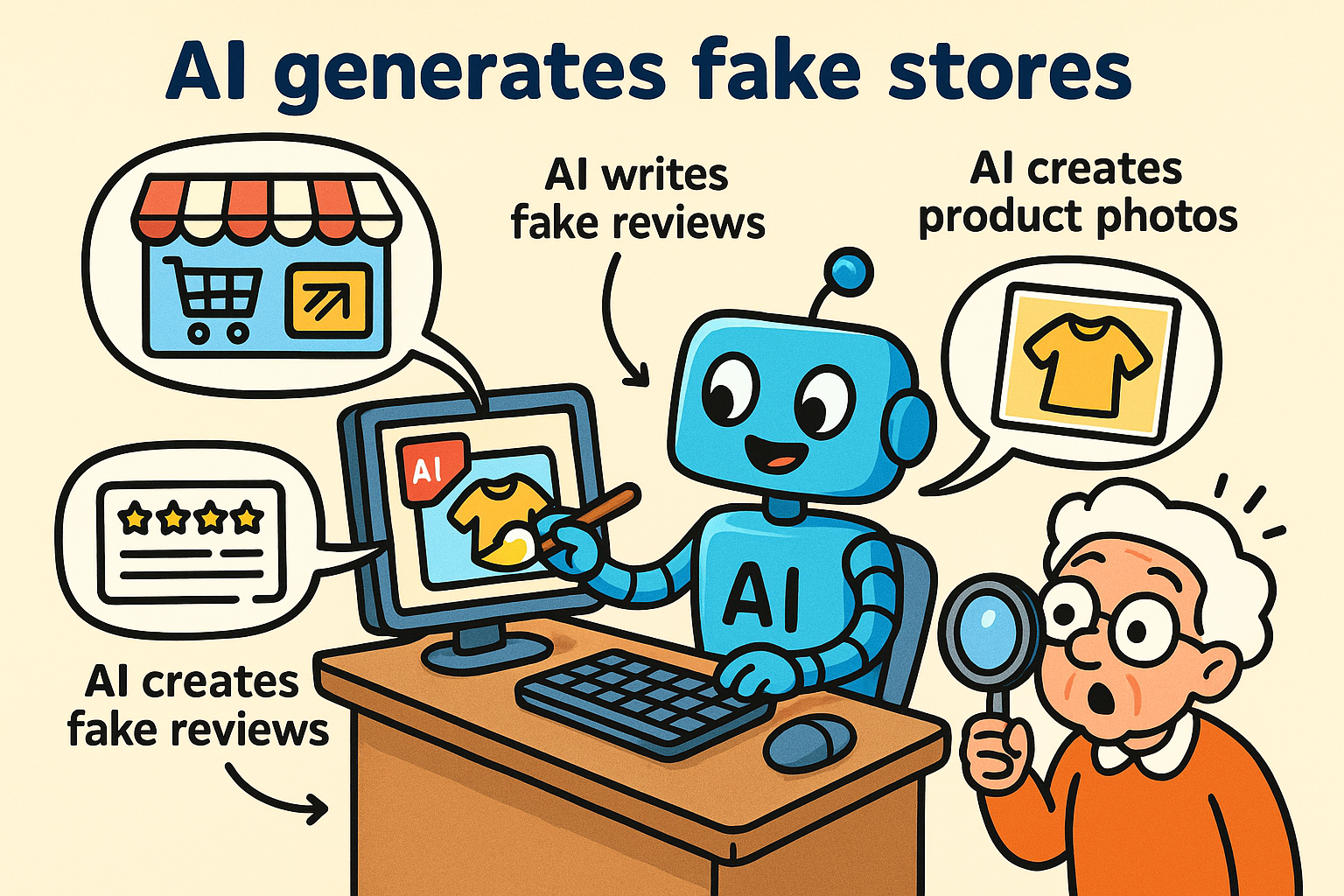
An AI-powered scam is like a movie set. From the front, it looks real. But the moment you peek behind the curtain, you see it’s all made of cardboard and wishful thinking. Here’s how to start peeking.
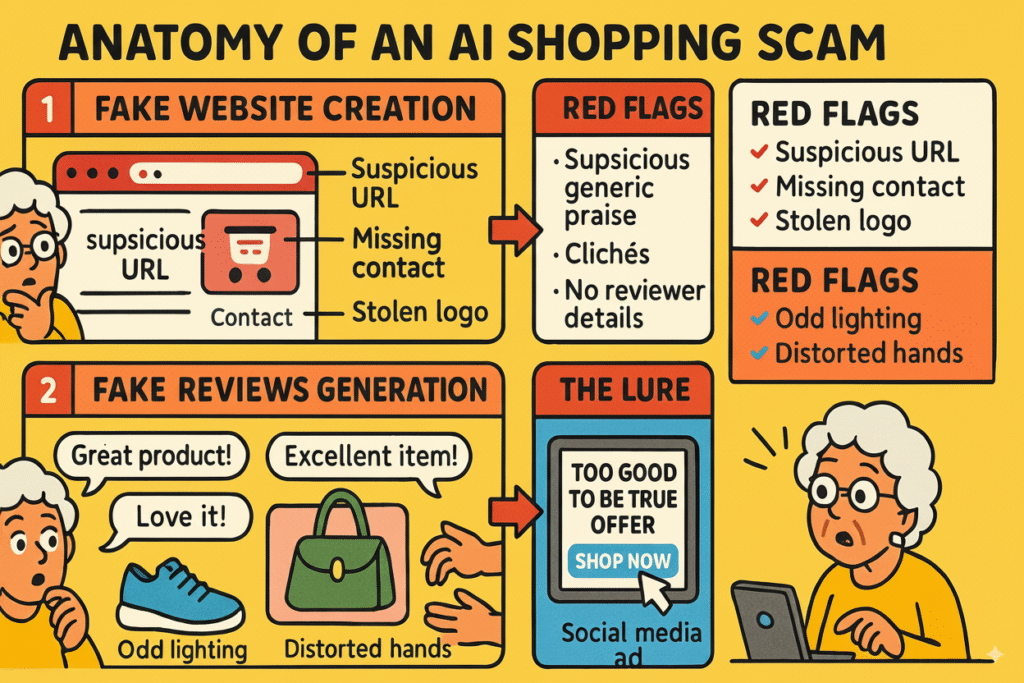
Scammers use AI to whip up slick, modern-looking websites in a flash. But they often miss the small details.
Your Red Flag Checklist:
It can generate piles of reviews that sound convincing at first glance. The tricky part is that AI-written reviews are getting harder to spot, so don’t rely on just one clue. Look for patterns.
Your Red Flag Checklist:
You’d think a photo is hard to fake, but AI can now create images from scratch. It’s good, but it’s not perfect. It still makes some rookie mistakes.
Your Red Flag Checklist:
These clues are useful, but don’t rely on them alone. AI images are getting better.
The worst part is that scammers are now combining these AI tools to create even more devious traps, often aimed directly at seniors.
They use AI to identify topics you care about—like joint pain, retirement planning, or staying connected with grandkids—and then create targeted social media ads that lead you to their fake stores.
These sites are filled with convincing articles about “miracle” health products or “revolutionary” mobility aids.
Some are even experimenting with AI-powered chatbots for “customer service.” You think you’re talking to a helpful representative, but it’s just a computer program designed to take your money.
Okay, that’s enough of the scary stuff. The good news is that a little bit of healthy skepticism is like a superpower in the online world. You don’t need to be a tech genius to stay safe. You just need a simple plan.
1. Verify, Verify, Verify. This is your new mantra. Before buying from an unknown site, open a new tab and search for the company’s name plus words like “scam,” “review,” or “complaint.” Real customer experiences will pop up quickly.
2. Trust Your Gut. If a deal feels too good to be true, it is. Close the tab. Go have a cup of coffee. You’ll thank yourself later.
3. Pay with a Credit Card, Not a Debit Card. Credit cards usually give you stronger fraud and dispute protections. If something goes wrong, you can contact the card company and ask how to dispute the charge or start a chargeback. A debit card pulls money directly from your bank account, and getting it back can be harder.
Be extra suspicious if a seller pushes you to pay with gift cards, wire transfers, cryptocurrency, Zelle, Venmo, Cash App, or another payment app. Real stores do not need you to pay like you’re sneaking ransom money across a border.
4. Never Click on Links in Unsolicited Emails or Ads. If you see an amazing deal from a store you know, don’t click the link in the ad. Go directly to that store’s official website by typing its address into your browser yourself. This is especially important for deals that show up out of nowhere and pressure you to act fast.
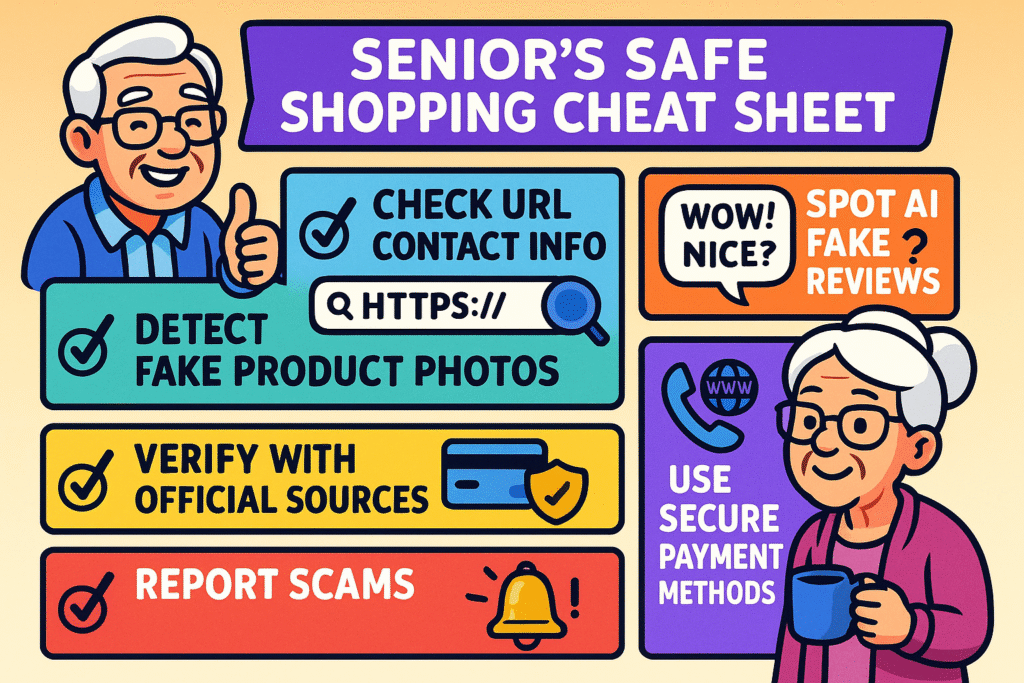
Your Cheat Sheet to Safe Shopping
Before buying from an unfamiliar website, ask yourself:
If two or more answers make you uneasy, close the tab.
While using AI for marketing isn’t illegal, creating fake reviews to deceive customers is. The Federal Trade Commission (FTC) considers this a deceptive practice, and they are cracking down on it.
Scammers often target seniors because they believe older adults may have more savings, may be more trusting, and might be less familiar with the latest digital “tells” of a scam. They craft ads for products related to health, wellness, and financial security to prey on common concerns.
Antivirus software is great for stopping viruses and malware, but it can’t tell if a website is lying to you. A fake store isn’t a virus; it’s a deception. That’s why your own critical thinking is the most important security tool you have.
First, don’t be embarrassed—it happens to millions of people. Immediately call your credit card company to report the fraud and ask them to reverse the charge. Then, report the scam to the FTC at ReportFraud.ftc.gov. This helps authorities track down the criminals and protect others.
The digital world can sometimes feel like the Wild West, but it’s also a place of incredible connection and convenience. By learning to spot the robot snake oil salesmen, you can navigate it with confidence and enjoy all the good things the internet has to offer. Happy (and safe) shopping!!