Newsletter Subscribe
Enter your email address below and subscribe to our newsletter

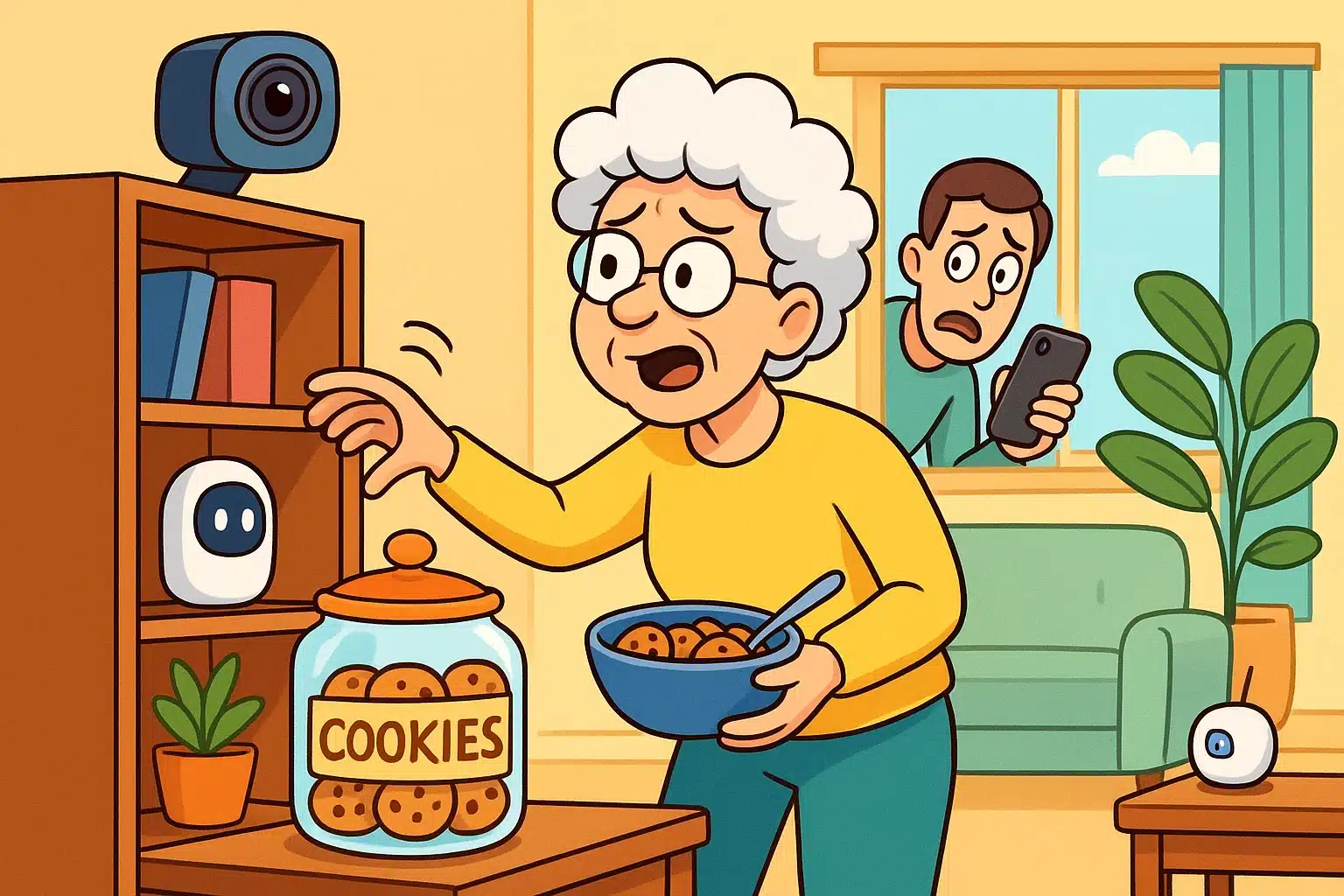
Imagine this: Your adult daughter, bless her heart, has decided that because you recently celebrated a milestone birthday, you are suddenly made of fine porcelain. She wants to install so many cameras and sensors in your house that your living room will have better surveillance than a Las Vegas casino vault. You, on the other hand, just want to eat your midnight bowl of cereal in your underwear without feeling like you’re starring in a reality TV show called CSI: Grandparent.
If this sounds familiar, you’ve just collided head-first with the “Privacy Paradox.” It’s the universal tug-of-war between a family’s well-meaning desire to keep you safe and your absolute right to privacy and independence in your own home. It’s a tricky tightrope to walk, right up there with trying to program a VCR in 1994 or remembering what password you used for your utility bill account.
The good news? Technology has evolved way past the creepy “Big Brother” cameras. Today, we’re going to look at how to balance peace of mind with personal privacy, so everyone can sleep a little easier at night.
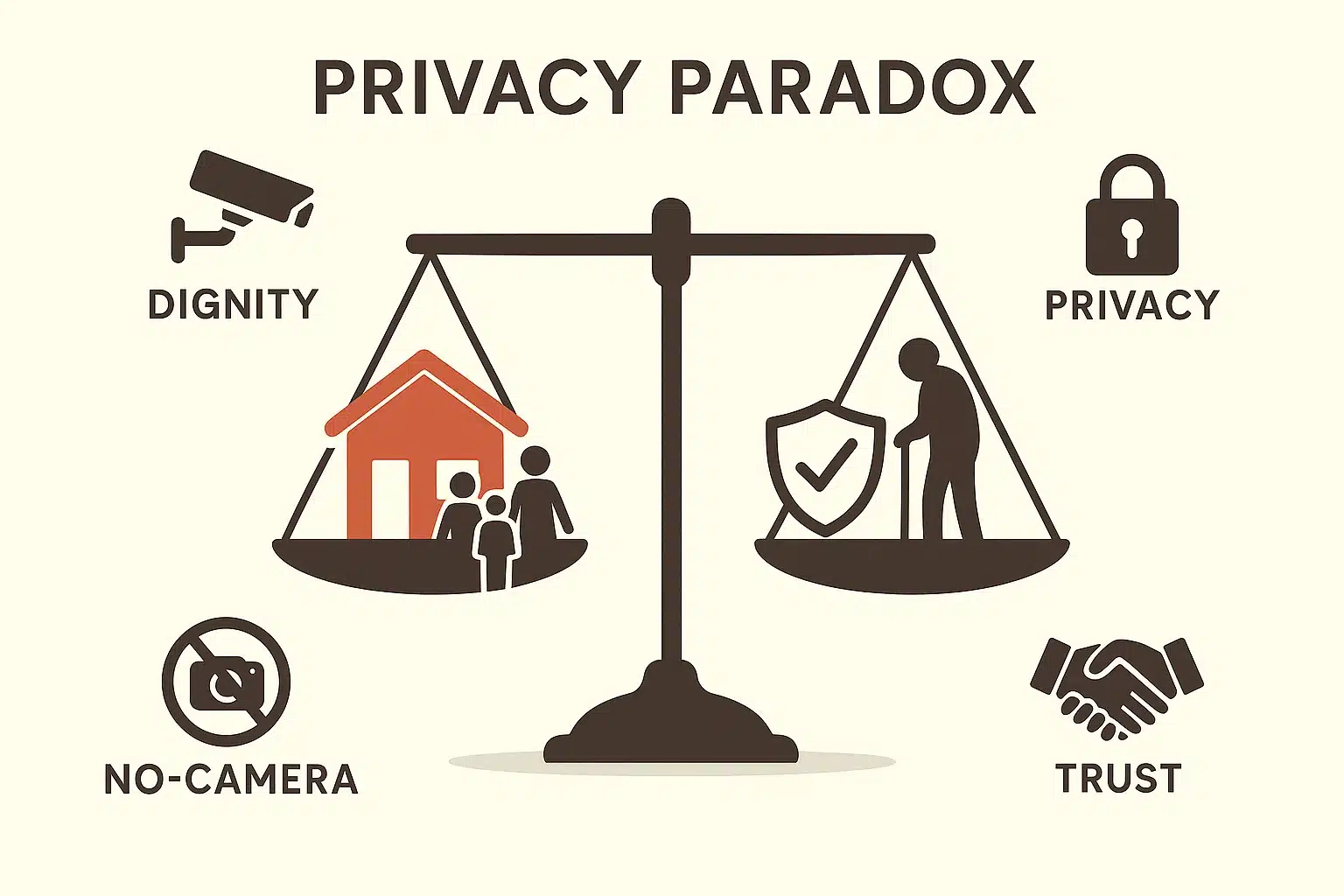
There is an unspoken rule in the caregiving world known as the “40/70 Rule.” It suggests that when the children hit 40 and the parents hit 70, it’s time to have a serious talk about the future. The problem is, this talk usually centers entirely around safety, completely ignoring something experts call the “Dignity of Risk.”
The Dignity of Risk is a fancy clinical term for a very simple concept: you have the right to make choices that involve a little bit of risk. Whether that’s deciding to climb a small step stool to reach your favorite coffee mug or eating a second slice of cake, taking away all risk also strips away our identity and autonomy. When families push back on a senior’s independence in the name of safety, seniors often reject the technology entirely.
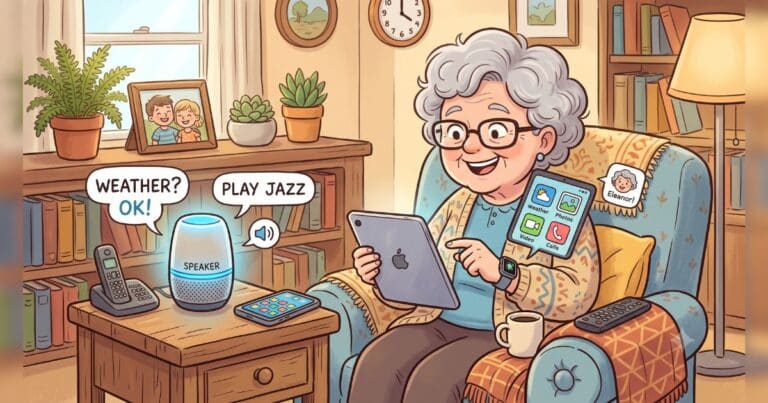
Here is the ultimate “Aha!” moment for both seniors and their families: Smart home monitoring shouldn’t be a leash; it should be an independence tool. If a few well-placed, private sensors can prove to your anxious children that you are perfectly fine, they will call to check on you less. You actually gain more freedom.
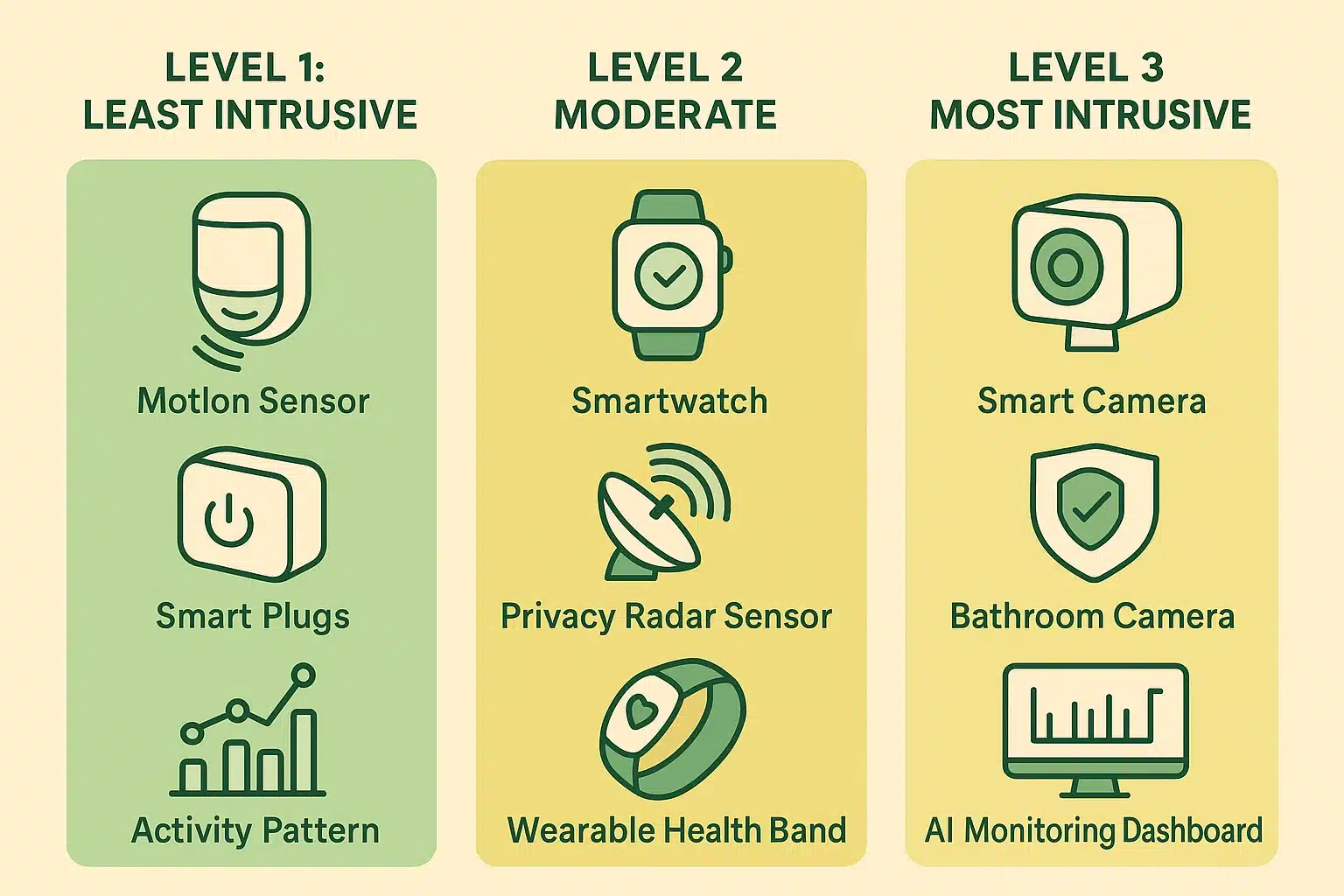
Not all smart home tech is created equal. To help families compromise, we use a “Spectrum of Monitoring” framework. This moves from the least intrusive “Environmental Awareness” to the most intrusive “Visual Surveillance.”
This level uses passive data to track routines, not people. Think of motion sensors in the hallway or smart plugs attached to the coffee maker. If the motion sensor triggers at 8:00 AM and the coffee maker turns on at 8:15 AM, your family knows you’re up and moving. No cameras, no microphones, just the comforting data that your morning routine is happening as usual.
This is where technology gets really clever. We all know the biggest risk area in a home is the bathroom, but putting a camera in there is a massive violation of the “Bathroom Boundary.” Enter radar and Lidar technology. Instead of using a lens to capture a video of you, these tools bounce invisible radio waves around the room.
The software translates these waves into a simple stick figure or a “blob” of data. It can tell if that blob has suddenly fallen to the floor and needs help, but it couldn’t tell you what color robe you’re wearing or what you look like. It’s all the safety of fall detection with 100% of your privacy intact.
Smart cameras and video screens are the heavy artillery of monitoring. Generally, these should be restricted to the outside of the house, like a video doorbell to see who is on the porch. Inside the house, cameras should only be used in common areas if there is a severe medical or cognitive need, and only with everyone’s explicit agreement.
The fastest way to destroy trust in a family is the “Surprise Installation.” This is when adult children sneak a camera onto the bookshelf while visiting for Thanksgiving. Not only is this wildly disrespectful, but it almost guarantees the senior will unplug the device the minute the kids drive away.
Before introducing any smart home tech, families need to have an open conversation. The focus should be on how the technology empowers the senior to stay in their home longer, not on the family’s anxiety. It’s also crucial to vet any technology before bringing it into your living room.
You wouldn’t let a strange salesperson sit on your couch without verifying who they are, and you should treat tech companies the same way. Before buying a device, make sure you check their website to ensure they are a legitimate company with a clear privacy policy. You want a device that alerts your family to an emergency, not one that sells your daily routine to advertisers.
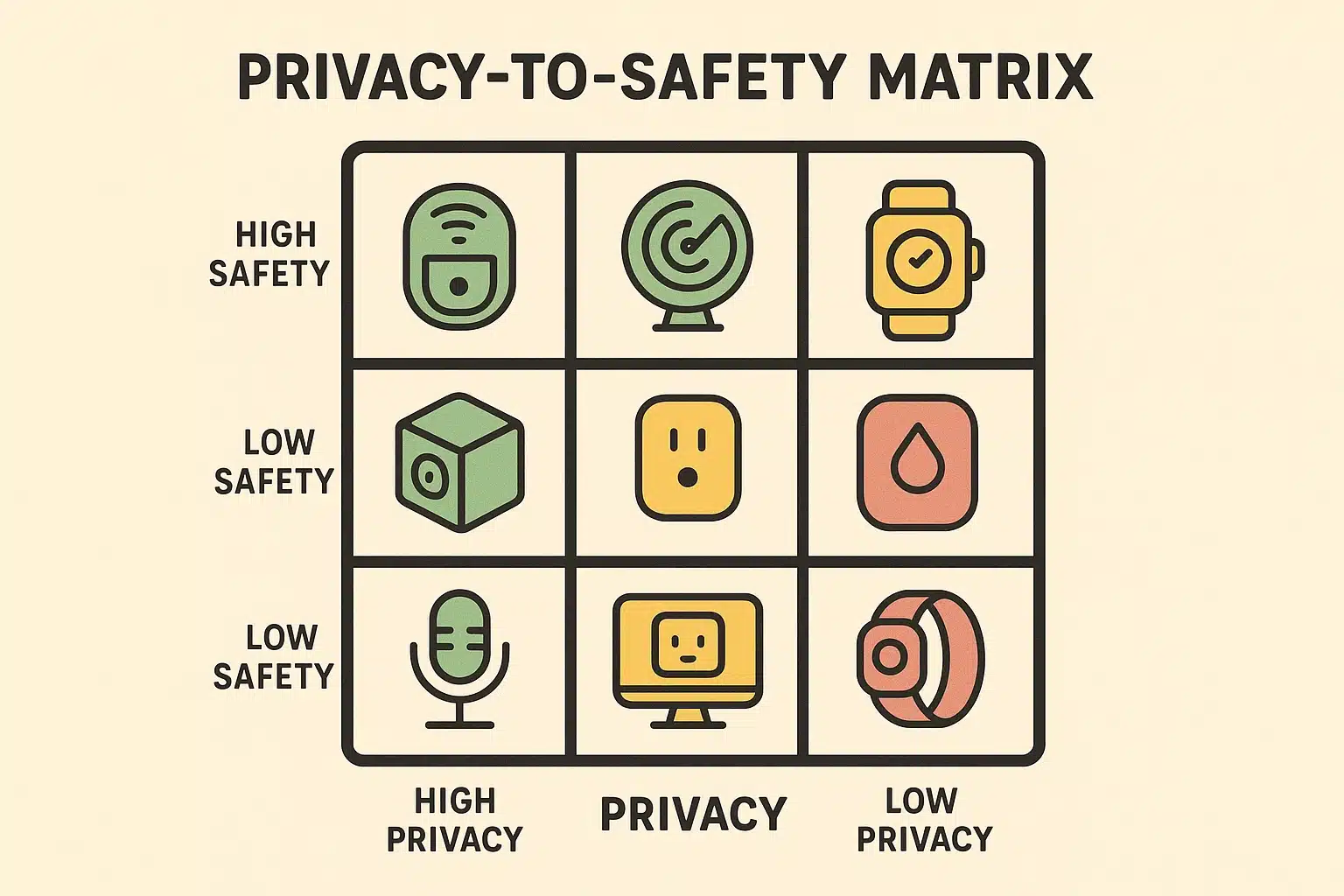
Focus on “ambient sensors.” Contact sensors on medicine cabinets, motion sensors on the stairs, and smart plugs on frequently used appliances provide excellent daily routine data without ever recording an image or a sound.
Radar-based sensors (often mounted on the wall or ceiling) are highly private because they don’t use optics (lenses). Smartwatches and medical alert pendants are also excellent, provided the senior is willing to wear them consistently.
This depends entirely on the company’s Terms of Service. Always look for companies that explicitly state they do not sell user data to third parties and allow you to delete your history upon request.
Laws vary wildly from state to state regarding “Granny Cams” or sensors in care facilities. Some states require explicit consent from roommates and facility management. Always consult the specific facility’s handbook and your state’s elder care laws before installing anything.
Navigating the Privacy Paradox doesn’t have to end in a family feud. By focusing on the Dignity of Risk and choosing technology that respects personal boundaries, you can create a living space that is both safe and entirely your own. After all, your home is your castle—even if that castle now has a motion sensor on the drawbridge.
To continue making technology work for you instead of against you, keep exploring our guides on how to outsmart your smart devices and stay securely independent.