Newsletter Subscribe
Enter your email address below and subscribe to our newsletter

When you hear the words “AI robot in a nursing home,” your brain probably jumps to one of two places.
Either it pictures something out of a Black Mirror episode. A cold, blinking metal box, calculating exactly how soon you’ll stop being useful to society. Or it pictures the kind of well-meaning gadget that gets wheeled into a common room once, malfunctions during the third sing-along, and ends up in a closet next to the Wii nobody ever set up.
Neither of those is Abi.
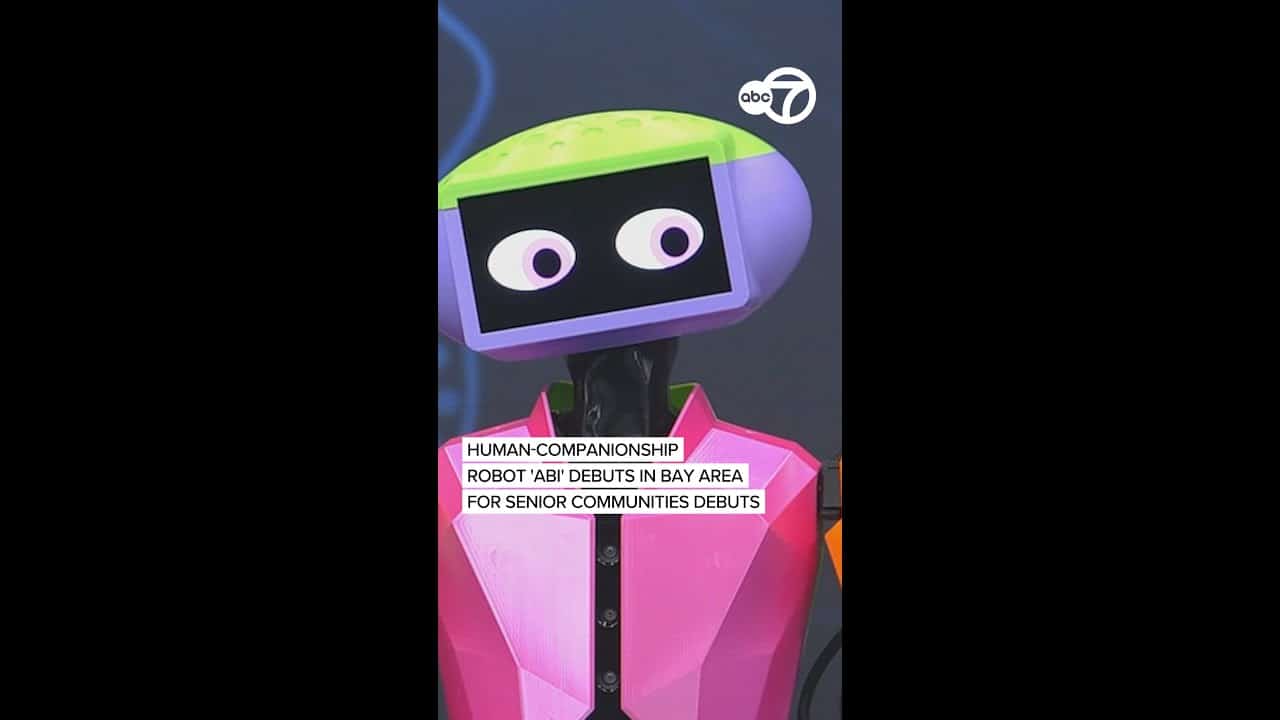
Abi is four feet tall. She’s painted in green, purple, pink, and orange. She has the personality of a slightly mischievous niece. And her left hand is a bubble machine.
Yes. A bubble machine.
Abi is the brainchild of Grace Brown, a 26-year-old Australian who built the first version of her during Covid lockdowns. Brown was a university student in Melbourne, suddenly cut off from her family, lonely enough that she decided to build herself something to keep her company. Something that could, in her words, “give her some semblance of a hug.”
That early prototype evolved into Abi, the four-foot AI companion now deployed across 15 senior care homes in the Melbourne area. Last year, Brown’s company, Andromeda Robotics, raised $17 million to bring Abi to the United States, with the first American facility expected to receive its Abi in the next few months. (The full story is over at Upstarts Media.)
What does Abi actually do?
She blows bubbles. She runs music quizzes, plays a clip and asks residents to guess the artist. She hosts jukebox singalongs. She remembers each resident’s name and their previous conversations. She can dance, although in fairness, her dance moves are limited. She sways. She moves her arms and head. She gives it a real go.
She also speaks 90 languages.
Which turns out to be the part nobody saw coming.
At one care home in a Melbourne suburb called Ashwood, there’s a gentleman who primarily speaks Mandarin. According to Cameron McPherson, the CEO of the senior care group that runs his home, this gentleman now sees Abi once a week. They recite poems together. They tell stories. The robot remembers everything they talked about last time and picks up where they left off.
“She’s really brought out the fun side of this gentleman,” McPherson says. “They have a beautiful relationship.”
That’s not the kind of sentence you expect to read about a four-foot robot and a 90-year-old man who speaks the wrong language for his nurses.
Across 104 tracked sessions between February 2024 and December 2025, McPherson’s team found that 88% of those sessions involved someone speaking a language other than English with Abi. Twenty-two different languages in total. The 74% positive reaction rate is the headline number. But the more interesting one is buried underneath it: a lot of these residents finally had someone, something, that could meet them in their own words.
The number that got Brown started is worth sitting with for a second.
In Australia, where they’ve been studying this, 40% of senior care residents receive no visitors. None. Not for birthdays. Not for holidays. Not at all.
That’s the part of senior living that nobody likes to talk about. Especially the families who put their parents in a home and then quietly stopped showing up.
Brown didn’t build Abi to replace the people who should be visiting. She’s very specific about that. Abi isn’t a substitute for your grandkids. She’s a substitute for the silent afternoons in between visits, the ones where the TV is on but nobody’s really watching, where the lunch tray has been cleared and dinner is four hours away.
And in those gaps, a friendly, bubble-blowing, multilingual, slightly sassy four-foot robot is, it turns out, very welcome company.
There’s a moment in every article about new technology where the writer is supposed to say something cautionary. Robots can’t replace people. AI is no substitute for human connection. Be careful out there.
All of that is true. And Brown will be the first to tell you so.
But sometimes the more honest thing to say is this: the alternative was never “human connection.” The alternative was a quiet room.
And in a quiet room, a robot that remembers your name, speaks your language, and occasionally shoots bubbles at you is, by any reasonable standard, a friend.