
Newsletter Subscribe
Enter your email address below and subscribe to our newsletter

By Chris Clark, founder of Senior Tech Cafe
Investment scams are schemes that talk you into handing over money for an investment that doesn’t exist, usually with a promise of big, guaranteed returns and a reason you have to act now.
Remember the good old days of scams? A foreign prince would politely email you, offering thirty squillion dollars in exchange for your checking account number. You’d have a good laugh, hit delete, and go about your day feeling like a cybersecurity genius.
Today’s scammers don’t write in broken English, and they certainly don’t claim to be royalty. They wear sharp digital suits, pose as financial gurus, and build fake investment platforms that look more professional than your actual bank’s website. It’s enough to make you want to stuff your life savings inside your mattress, right next to your collection of slightly expired coupons.
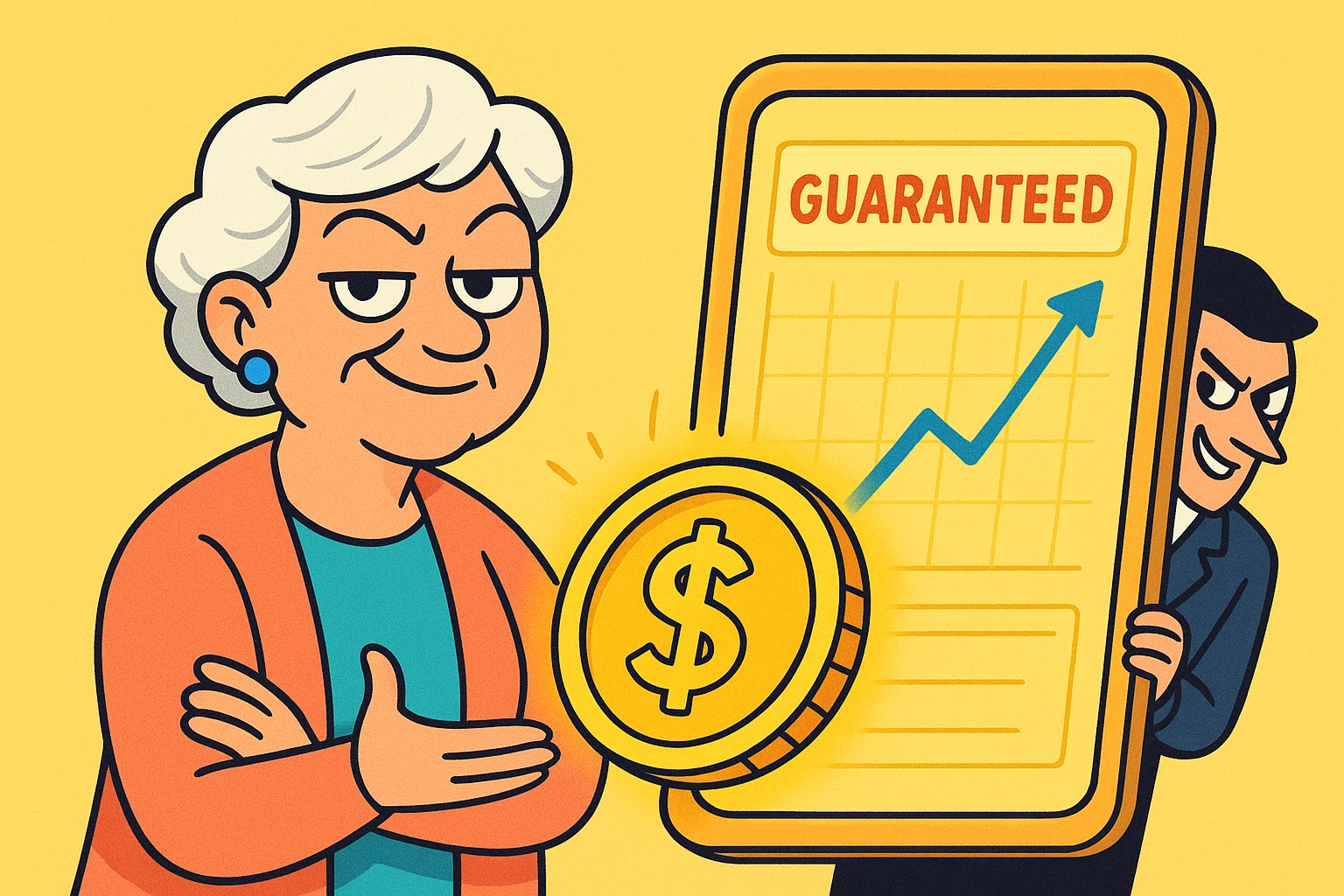
Before you start ripping the stuffing out of your Sealy Posturepedic, let’s get one thing straight. Scammers don’t target you because you’re gullible. They target you because you’ve spent a lifetime working and saving, and that’s exactly what they want. You aren’t vulnerable. You’re valuable.
We’ve all heard it: “If it sounds too good to be true, it probably is.” That’s still the best test for investment fraud, but it needs an upgrade. In real investing, risk and reward sit on opposite ends of a seesaw. The higher the possible return, the higher the risk.
So if someone promises a “guaranteed” 20% return while regular savings accounts pay a fraction of that, the seesaw is broken. “Guaranteed” and “high return” can’t exist in the same sentence unless you’re reading a fairy tale. Real investments go up and down, and legitimate financial professionals tell you about the risks.
Scammers, on the other hand, love the word “guaranteed.” They also love urgency and secrecy. If a new online friend tells you about a can’t-miss opportunity but insists you act right now and keep it from your family, your internal alarm bells should be ringing loud enough to wake the neighbors.
You recognize investment scams by the pitch, not the product. A stranger contacts you first, promises high returns with little or no risk, rushes you, asks you to keep it quiet, and wants payment in crypto, a wire transfer or gift cards. Any one of those is reason to stop. Two or more, and you can be sure.
It starts with how they reach you. A legitimate broker is never going to casually message you on WhatsApp or LinkedIn with a tip on the next big cryptocurrency. If you get an unsolicited message offering financial advice, treat it like an uninvited raccoon in your garage: back away slowly and lock the door.
Don’t reply, not even to say “no thank you.” Answering tells the scammer your number or account is live, and you’ll hear from them again.
Then look at how they want to be paid. If your new “broker” asks you to fund your investment with cryptocurrency, a wire transfer or (heaven forbid) gift cards, slam the brakes. Legitimate investment firms don’t ask you to buy gold bars or Bitcoin to open a retirement account.
Here’s a common misconception: if an investment app is in the Apple App Store or Google Play, it must be safe. Sadly, no. Scammers are good at slipping copycat apps past the security guards, and some skip the app store entirely and send you a download link.
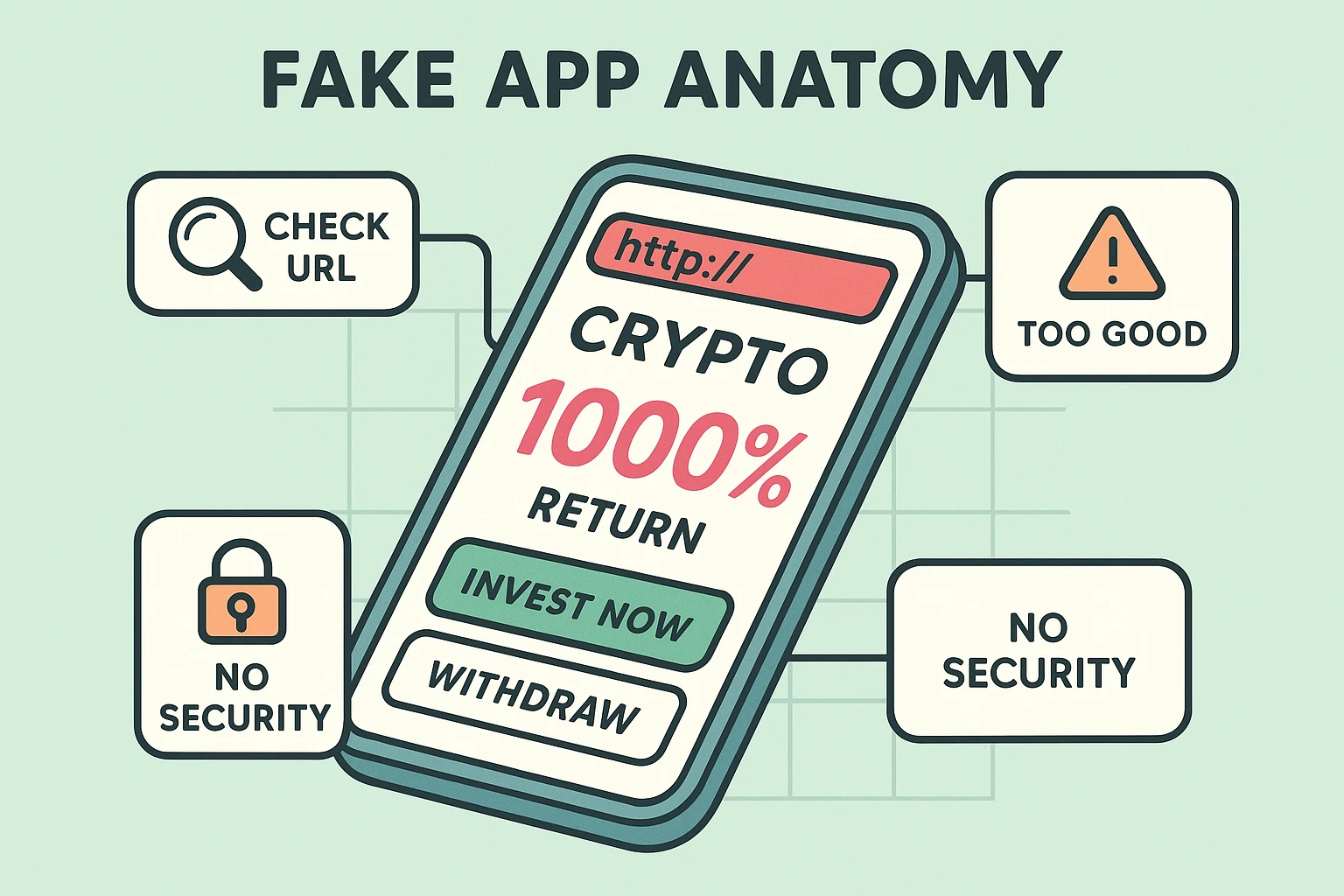
These fake apps look just like real trading platforms. They show you beautiful charts and a growing balance, but the numbers are entirely made up. Here’s how to spot a fake app before you install one. And before you download any financial app, check their website on an ordinary web browser to make sure there’s a real company behind it.
I know, “pig butchering” sounds like a terrible name for a barbecue joint. Unfortunately, it’s what investigators call one of the most devastating financial scams around. The name comes from fattening a hog before slaughter, and it’s a psychological long game.
It usually starts with a “wrong number” text. “Hi Jim, are we still on for golf tomorrow?” You politely reply, “Sorry, wrong number.” Instead of apologizing and leaving, the scammer says, “Oh, you seem so nice! Let’s be friends.” Over the next few weeks or months, they chat about life and family and, eventually, their amazing success trading cryptocurrency. It works a lot like a romance scam, and sometimes it is one.
Once you trust them, they show you a trading website or app. You invest $100. A week later, they let you withdraw $150. You think, “Wow, this is real!” By letting you win a little, they butcher your skepticism, paving the way for the big deposit.
And when you try to take the big money out? Suddenly there’s a “tax” or a “fee” to pay first. There’s always one more. That’s the moment the balance on the screen turns out to be imaginary.
Crypto scams steer you to cryptocurrency for one simple reason: once it’s sent, it’s very hard to get back. There’s no bank in the middle you can call to cancel the payment.
The pitch comes in a few flavors. A slick website promises a “proprietary crypto trading system” with guaranteed returns. A friendly contact walks you through buying crypto on a real exchange, then has you send it to their platform. Or you’re told to feed cash into a cryptocurrency ATM, the kind you now see in gas stations and convenience stores, to “protect” or “invest” your savings.
The flavors differ. The ending doesn’t. Nobody legitimate will ever tell you to withdraw your savings and push them into a crypto ATM, and a real investment firm doesn’t need you to buy crypto before it can take your money. If crypto is the only way to pay, you’ve found the scam.
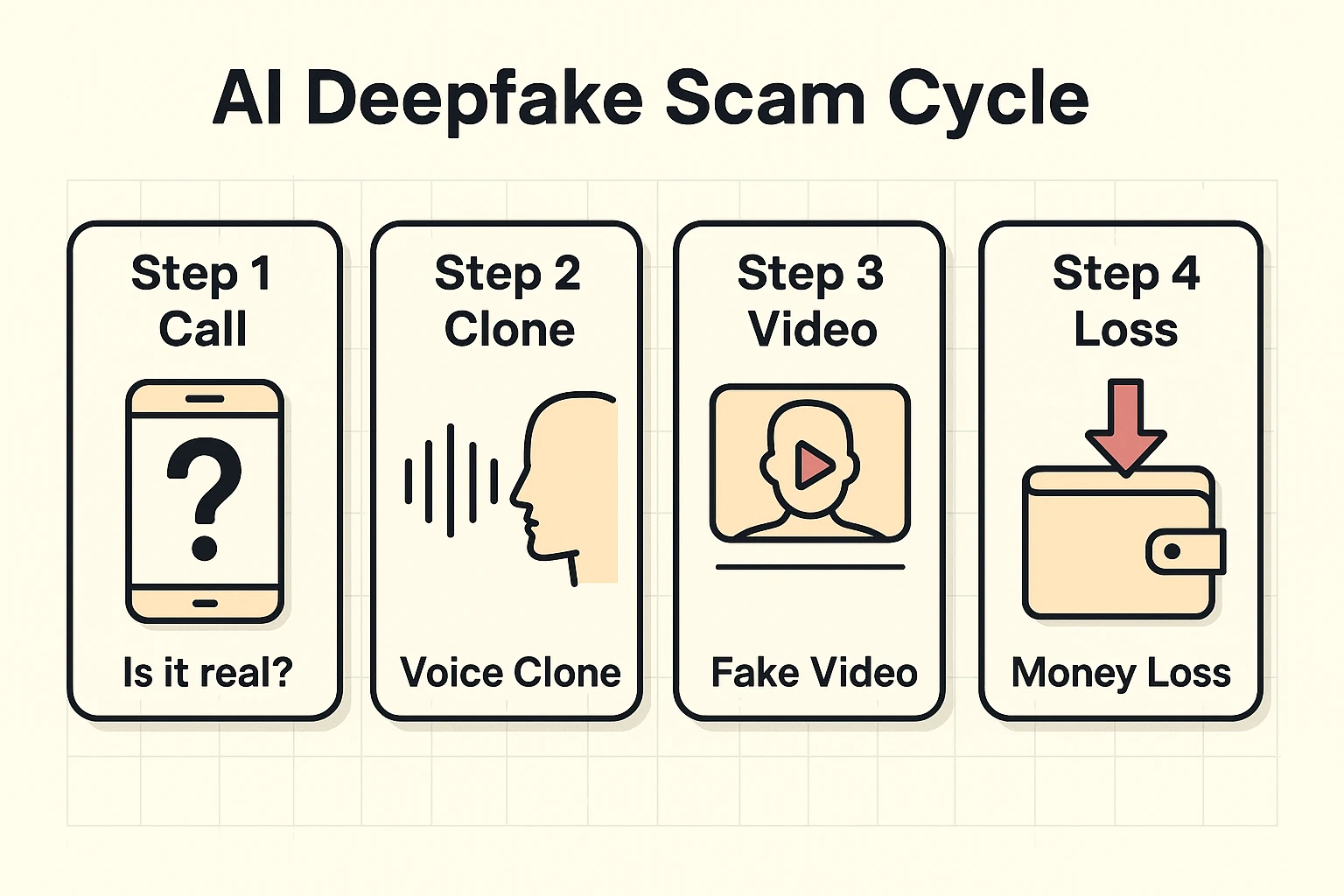
If fake apps and long-con texts weren’t enough, we now have artificial intelligence. Scammers need only a few seconds of audio, often pulled from a social media video, to clone a voice.
That means a phone call that sounds exactly like your grandson, begging for bail money, or a video of a famous billionaire endorsing a new crypto coin. These fakes are called deepfakes, and deepfake scams are getting harder to spot by eye or ear every year.
So don’t try to decide whether the face or voice looks real. Pay attention to what it’s asking you to do. A celebrity urging you to invest, or a relative who needs money wired right now, is the red flag, however convincing they sound. If you get a strange call from a loved one asking for money, hang up and call them back on the number you already have saved. Here’s more on how AI voice scams work.
Some scammers skip the face altogether and use chatbots: AI-powered accounts that pose as friendly financial advisors or wildly successful investors. They’ll chat for days or weeks, answer every question, and eventually introduce an “exclusive” crypto platform or AI money-making system. Don’t count on them sounding robotic. Modern AI carries on a surprisingly convincing conversation.
The technology is new. The sales pitch is ancient: “Give me your money now, and I’ll make you rich.”
The goal isn’t to make you afraid of technology. It’s to turn you into the auditor of your own wealth. Your greatest weapon against scammers isn’t software. It’s time.
Scammers use urgency because they know that if you stop to think, the whole illusion falls apart. So adopt the 24-hour rule. However amazing an investment sounds, or however panicked a caller seems, say: “I never make financial decisions on the spot. I’ll look at this tomorrow.”
Use those 24 hours well:
A legitimate investment will still be there tomorrow. A scammer disappears the moment they realize they’re dealing with an informed auditor.
Act quickly. The sooner you move, the better your chances of stopping a payment or recovering part of it.
A crypto wallet is an app or account that holds cryptocurrency instead of ordinary money. Most people don’t need one. If an online friend or a stranger on the phone tells you to open a crypto wallet so you can invest with them, stop right there. That request is one of the clearest signs of a crypto scam.
Sometimes, if you act fast. Call your bank, card company or the crypto exchange you used right away and ask them to stop or reverse the payment. Crypto and wire transfers are hard to recover. Beware of anyone who later offers to recover your money for a fee: that’s a second scam.
Report investment fraud to the FTC at ReportFraud.ftc.gov, the FBI’s Internet Crime Complaint Center at ic3.gov, and the SEC through its online tip form at sec.gov. Keep the messages, receipts and account details. A report may not bring the money back, but it helps investigators track the groups running these schemes.
No. Many reputable firms use AI to manage portfolios or spot fraud, and robo-advisors are a legitimate, regulated service. The difference is that real firms are registered, explain the risks and never promise guaranteed, sky-high returns. If an AI trading system comes with a guarantee and a stranger attached, it’s an investment scam.
Scammers want cryptocurrency because it’s hard to reverse. Once you send it, there’s no bank in the middle you can call to cancel the payment. Crypto transfers can sometimes be traced on public records, but tracing money and getting it back are two very different things. Anyone who insists on crypto is a red flag.
The flashy tools (AI, deepfakes, crypto) are just new packaging on an old product: the get-rich-quick scheme. Navigating the digital financial world doesn’t have to feel like walking barefoot through a room full of Legos. A healthy dose of skepticism and a 24-hour pause will protect your nest egg better than any app.
For the rest of the checklist, from passwords to phone scams, start with our online safety guide for seniors. Stay curious, stay cautious, and never let anyone rush your wallet.