Newsletter Subscribe
Enter your email address below and subscribe to our newsletter


Have you ever ordered a single pair of sensible walking shoes online, only to suddenly receive phone calls from people trying to sell you a walk-in bathtub, a reverse mortgage, and a timeshare in Florida? You didn’t tell anyone about the shoes. You didn’t broadcast your purchase on the evening news. Yet somehow, the entire telemarketing world knows exactly who you are and where you live.
If this sounds familiar, you are not losing your mind. You are simply experiencing the annoyance of your “Data Shadow.” Your Data Shadow is the invisible, sprawling trail of digital breadcrumbs you leave behind every time you do something as innocent as subscribing to a magazine or entering a grocery store raffle.
Today, we’re going to talk about the companies scooping up those breadcrumbs—called data brokers—and exactly how you can tell them to kindly mind their own business.
Think of data brokers as the digital version of that neighborhood gossip who peers through the blinds and knows everyone’s business. Except, instead of just whispering over the fence, they package your life into a neat little file and sell it to the highest bidder. These aren’t mysterious hackers sitting in dark basements. They are boring, legally operating companies in ordinary office buildings.
Let’s say you subscribe to a bird-watching magazine. That one simple action can cast a massive Data Shadow. Within weeks, the magazine might share your info, and suddenly ten different data brokers know your address, your age, and your deep affinity for the majestic North American Bluejay.
This is one of the main ways scammers find people to target. People-search websites make names, ages, addresses, and phone numbers easy to look up. For someone planning a scam, that’s quite a shopping list.
Now that we know who is hoarding our data, it’s time to start cleaning house. But before we begin, let’s talk about a major trap called the “Identity Catch-22.” When you ask a company to delete your data, some sneaky sites will ask you to upload a copy of your driver’s license or provide your Social Security Number to “verify” it’s you.
Don’t hand over your Social Security Number for a routine people-search removal!
Giving a data broker your Social Security Number to prove your identity is like giving a burglar the keys to your house to prove you live there. Many removals need only basic details to find your listing, plus email or phone confirmation. Deletion requests can require additional identity checks. If a site asks for a driver’s license, ask whether there’s a less sensitive way to verify you before uploading it.
Here is how we tackle the cleanup process in three simple phases.
Places like Whitepages, Spokeo, and Intelius are the storefronts of the data broker world. They’re useful places to start, especially if searches for your name bring up listings on those sites.
You can scroll to the very bottom of their homepages and look for a tiny link that says “Do Not Sell My Info” or “Opt-Out.”
Follow the site’s removal instructions—you may need to find your listing and copy its web address first. Complete any email or phone confirmation it requests. Hitting “Submit” isn’t always the finish line.
It feels like you need a magnifying glass to find these links, which is entirely by design. They really don’t want you to leave the party!
Depending on where you live, you might have the law on your side. States like California, Vermont, and Oregon have created Data Broker Registries to help citizens fight back.
California residents now have a useful shortcut: DROP, a free state tool that sends one deletion request to registered data brokers. Brokers began processing those requests on August 1, 2026, and must keep checking for newly collected information. Some information, including publicly available records, is exempt. Even this broom doesn’t reach every corner.
Even if you don’t live in those states, the privacy landscape is shifting rapidly. It is always worth searching online for your specific state’s privacy rights to see what legal leverage you might have over these companies.
There is a big difference between “opting out” and “deleting” your data. Opting out tells the broker, “You can keep my file in your dusty cabinet, but you have to stop selling it.” Deleting tells them, “Take my file, shred it, and throw the confetti out the window.”
When available, request both deletion and an opt-out from future sale or sharing. One asks them to empty the cabinet; the other tells them to stop peddling its contents. Some information may be legally exempt from deletion.
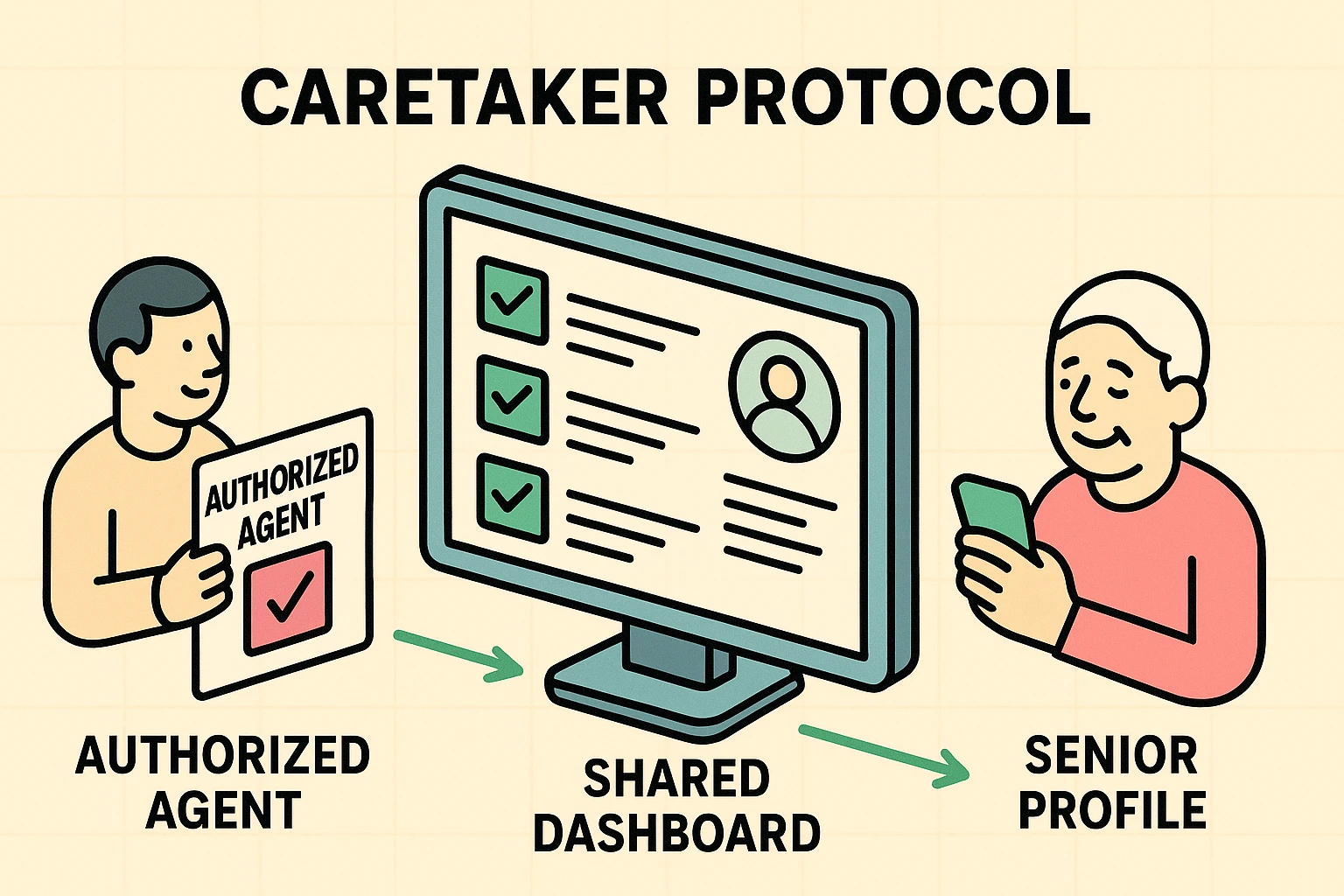
If reading about privacy laws and opt-out forms makes you want to take a nap, I have great news. You don’t have to do this alone. In fact, many seniors enlist their adult children to act as their “Privacy Caretakers.”
There is a wonderful option called an “Authorized Agent.” Where this is available, you can give your son, daughter, or trusted friend written permission to submit these deletion requests on your behalf. Some companies may also ask you to confirm it’s really you.
Then someone else gets to wrestle with the forms while you do something more enjoyable. Which is almost anything.
Your kids can set up a shared dashboard or spreadsheet, track the removal requests, and handle all the annoying tech work. It’s a fantastic way for them to help protect you without needing to hover over your shoulder every time you use the computer.
Here is the frustrating truth about data brokers: deleting your information is not a one-and-done deal. It is an ongoing chore, much like mowing the lawn or cleaning the gutters.
You might successfully delete your profile today, but if you sign up for a new grocery store rewards card next month, that information could find its way back to a broker and help create a new profile.
This is the re-listing problem: your information can grow right back like stubborn digital weeds. There’s no fixed schedule, which is why checking once and declaring victory doesn’t always work.
This means you, or your designated Privacy Caretaker, should ideally do a 90-day audit. Set a reminder on your calendar every three months to go back to Whitepages and Spokeo to make sure your name hasn’t miraculously reappeared.
There is another option: hire a service to handle the removal requests and follow-up checks for you.
I use both Optery and DeleteMe, and I consider both worthwhile investments.
Since using them, I’ve definitely noticed fewer spammers bothering me. And I’ve seen a HUGE decrease in my personal information showing up when I Google my name, address, and other details.
I’m not claiming I’ve become invisible. But searching for myself no longer feels quite so much like finding my personal file on a table at a yard sale.
These services look for your information on the data-broker sites they cover, submit removal requests, and keep checking for information that reappears. You’re paying for the legwork—and for someone to keep doing it after you’ve lost all interest in filling out another form.
You don’t need to copy my two-subscription approach. Compare the sites each service covers, the price, and the reports showing what it has actually removed. Optery also offers a free account that helps you find exposed information and tackle removals yourself.
No service can erase every mention of you online or guarantee a silent phone. My results are my experience, not a promise. But for me, less exposure and fewer interruptions have been worth the money.
I have other things to do. Those digital weeds can be somebody else’s gardening project.
While scrubbing your data shadow is crucial, you also need to set up a good perimeter defense. The best way to keep your info safe is to be stingy about giving it out in the first place. Consider setting up a “burner” email address—a free, secondary email you only use for store discounts and newsletters, keeping the junk away from your real inbox.
If you are exploring new digital checkout methods, make sure you understand how to securely manage a paze account before jumping in. Similarly, it’s wise to understand how to recover your security settings if disaster strikes, such as navigating a two factor authentication lost phone situation.
Finally, keeping your personal details off the public internet gives scammers less information to work with. But scams like wangiri calls—those annoying calls that ring once and hang up—can still reach you through mass dialing. The key defense is simple: don’t return an unfamiliar one-ring call.
Often, yes—even in states with privacy laws. Those laws can restrict what companies do with your information and give you rights to opt out or request deletion, but they don’t ban every sale. This is exactly why being proactive about your digital privacy is so important.
It can be worthwhile if you’d rather pay someone to handle repeated removal requests and follow-up checks. I use Optery and DeleteMe and have found both worth the money. Doing it yourself—or with help from someone you trust—is also an option. The main trade-off is subscription cost versus your time and effort.
No. It may reduce unwanted calls, and I’ve personally noticed fewer spammers bothering me. But scammers can still use numbers they already have or reach you through mass dialing. Think of removal as taking down a glowing neon sign pointing at your house—not disconnecting the road.