Newsletter Subscribe
Enter your email address below and subscribe to our newsletter

Picture this: You’re shuffling through today’s mail. Between the electric bill and a coupon for a pizza place you’ve never visited, you spot it. A thick, official-looking envelope featuring a majestic bald eagle, a gold foil seal, and your name in bold letters.
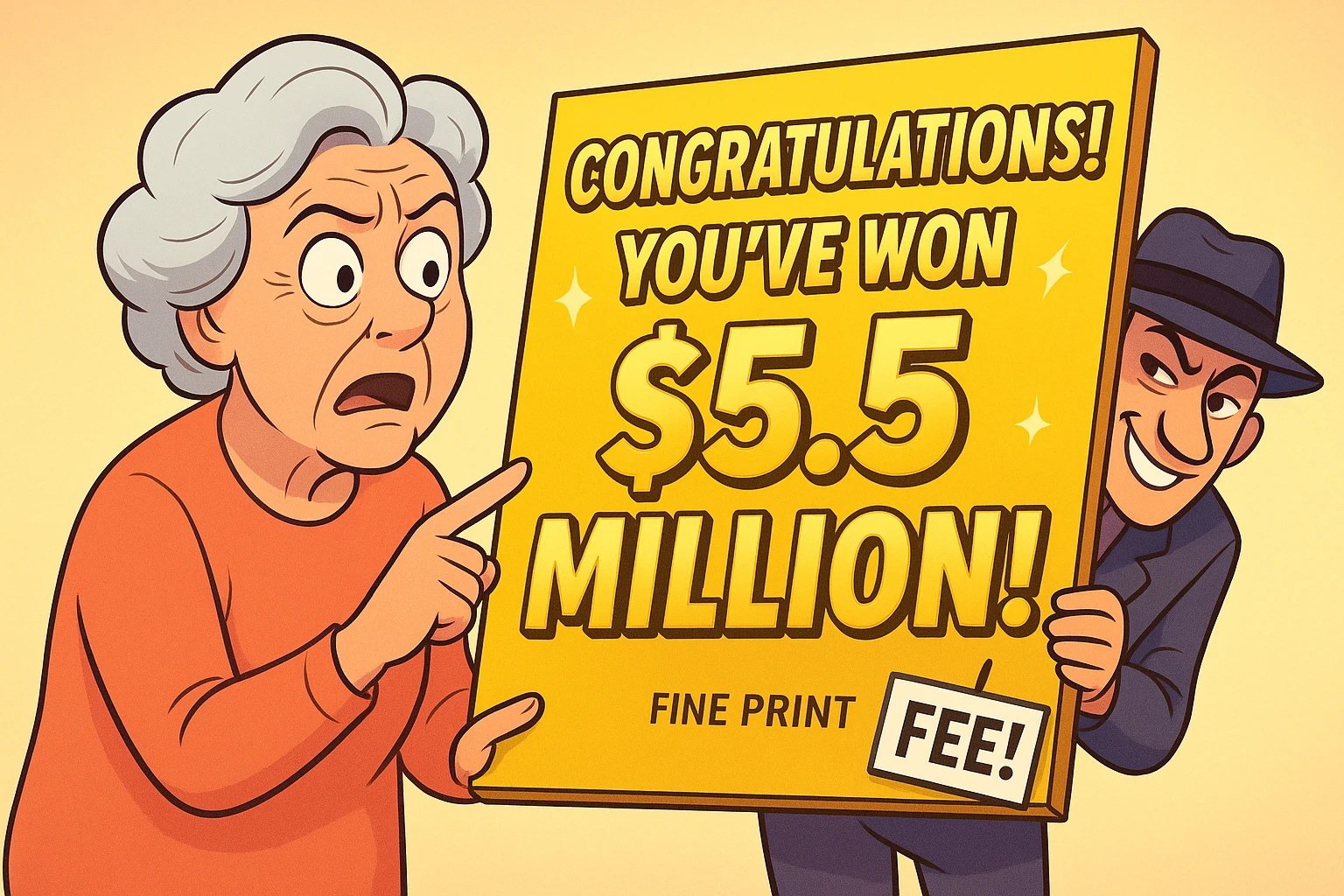
You rip it open. Congratulations! You’ve just won $5.5 million in a sweepstakes you don’t even remember entering. Your brain immediately floods with happy chemicals. You’re already mentally shopping for a private island just to get away from your neighbor’s 6:00 AM leaf blower.
But as you read the fine print, you spot a tiny catch. To claim your millions, you just need to wire a quick $250 “processing and tax fee” to a nice man named Gary. Suddenly, the dream pops like a cheap birthday balloon.
If this scenario sounds familiar, you are absolutely not alone. These “Pay to Play” scams are everywhere, filling our mailboxes and voicemails on a daily basis. Let’s pull back the curtain on how these scams operate, why they look so convincing, and how to spot the red flags before you hand over your hard-earned cash.
Let’s start with a truth so solid you could build a house on it: If you have to pay money to get a prize, you didn’t win a prize. You won a scam.
In the legal world, a legitimate sweepstakes is free to enter and free to win. In fact, if a company requires you to buy something or pay a fee to participate, it legally becomes a “lottery.” And here’s a fun piece of trivia: private companies are legally forbidden from running lotteries.
So, if a private sweepstakes company asks for a “processing fee,” “delivery charge,” or “handling cost,” they are either breaking federal law or they are scammers. (Spoiler alert: They are scammers).
One of the most common ways scammers trick smart people is by asking for “taxes upfront.” They tell you that you’ve won millions, but the IRS requires a $1,000 tax payment before they can release the funds. It sounds somewhat logical, right? We all know Uncle Sam always gets his cut.
But here is the ultimate lightbulb moment: Legitimate winnings are always a deduction game, never a collection game.
If you actually win the Powerball, the lottery commission simply subtracts the taxes from your total payout before handing you the check. Alternatively, they give you the full amount along with an IRS Form W-2G, leaving you to settle up with the government at tax time.
The real IRS does not ask for tax payments upfront, and they certainly don’t ask you to pay those taxes using Apple gift cards, Bitcoin, or wire transfers.
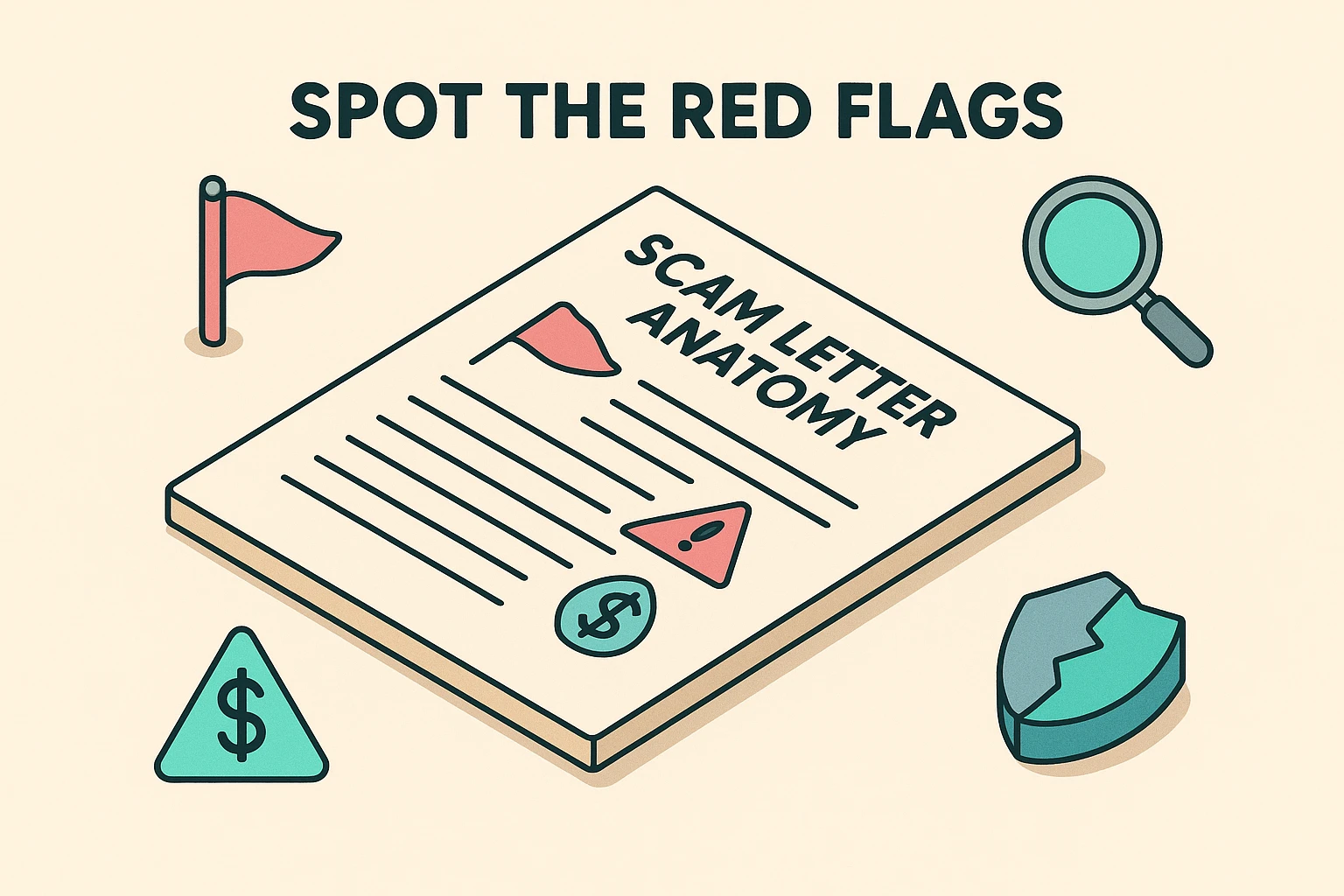
Scammers have gotten incredibly good at playing dress-up with their mail. But if you look closely, their “official” documents usually fall apart. Here are the glaring errors to look for:
The Made-Up Agencies: You might see letters from the “National Sweepstakes Bureau” or the “Division of Unclaimed Funds.” These sound terrifyingly official, but they are entirely made up. It’s like receiving a parking ticket from the “Department of Not Getting Caught.”
The Generic Greeting: If an organization is preparing to write you a check for $5 million, they should probably know your name. Letters that start with “Dear Fortunate Citizen” or “Valued Winner” are a massive red flag.
The Bulk Mail Stamp: Look at the postage in the top right corner. Scammers send millions of these letters out at once using “Presorted Standard” bulk mail. If you legitimately won a fortune, they’d spring for a first-class stamp.
You might wonder how anyone falls for this. But scammers don’t just target our wallets; they target our biology. They use exciting news to trigger an emotional response, giving you sweaty palms and a racing heart.
Once a victim pays that first $50 fee, the scammers use something called the “Sunk Cost Fallacy.” They call back and say, “Great news, your check is ready! We just need another $100 for customs.”
The victim thinks, “Well, I already invested $50. If I stop now, I lose that money and the millions!” This psychological trap keeps people paying over and over until their bank accounts are drained.
Have you ever received a notification that you won the “Spanish National Lottery” or an Australian sweepstakes? Take a moment to ask yourself: Have you been to Spain lately? Do you even speak Spanish?
Foreign lottery letters are an instant, 100% guarantee of a scam. Why? Because it is actually a violation of federal law for U.S. citizens to play a foreign lottery through the mail or over the phone.
Even if the “El Gordo” lottery was real and had somehow magically selected your name out of thin air, customs would seize the ticket before it ever reached your mailbox.
If you receive one of these letters or calls, your best defense is a good offense. First and foremost, never send money, gift cards, or wire transfers to claim a prize.
If these “officials” start aggressively blowing up your phone demanding payment, do not engage. Engaging with them often leads to even more harassment, which means you might find yourself needing a crash course in stopping a wangiri fraud attack or handling other nasty telephone trickery.
Finally, if you’ve already sent money, don’t let embarrassment keep you silent. Contact your bank immediately to see if the wire transfer can be stopped, and report the incident to the Federal Trade Commission (FTC) or your local authorities.
This is the infamous “Fake Check Scam.” They send you a check for $2,000 and ask you to send $1,500 back for taxes. By law, banks must make deposited funds available within days, making you think the check cleared. Weeks later, the bank realizes the check is totally fake, bounces it, and demands that you repay the money.
While it’s a nice thought that Aunt Mildred spent her afternoon entering your name into sweepstakes, legitimate lotteries don’t operate this way. You generally cannot win a massive sweepstakes without your own direct participation and consent.
Absolutely not. Do not deposit a check from an unknown sweepstakes under any circumstances. The check is fraudulent, and depositing it can cause your bank to freeze or even close your account for suspected fraud.
We all want to believe in a lucky break. The idea that a massive windfall could arrive in the mail on a random Tuesday is a beautiful fantasy.
But keeping your digital and financial life secure means learning to recognize when a dream is actually a nightmare in disguise. Remember: legitimate prizes won’t cost you a dime, the IRS doesn’t take gift cards, and you definitely didn’t win the Spanish Lottery. Keep that wallet closed, toss those letters in the recycling bin, and enjoy your peace of mind—it’s worth more than fake millions anyway!